
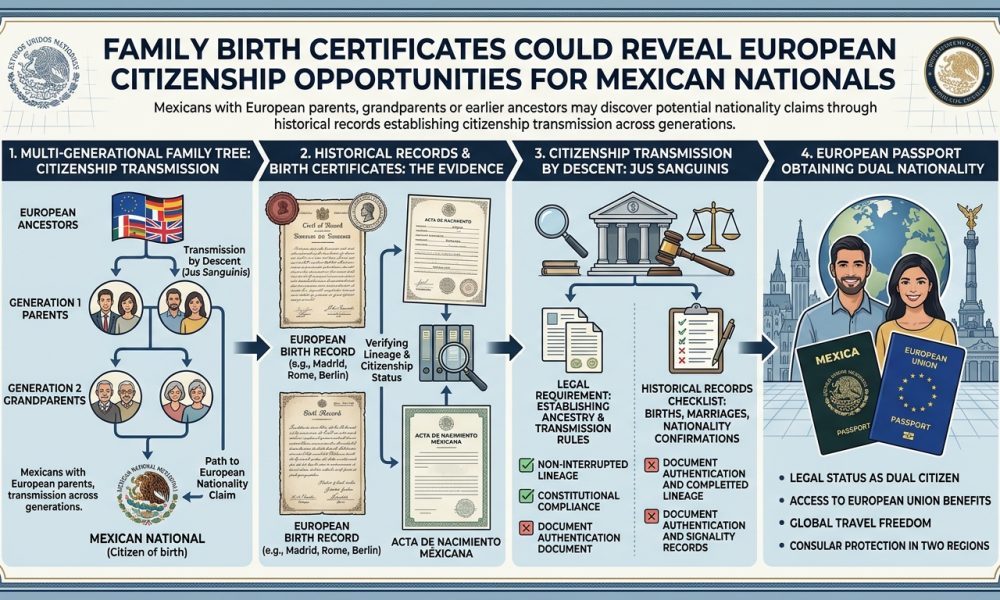
Mexicans with European parents, grandparents, or earlier ancestors may find potential nationality claims through historical birth certificates, marriage registrations, and citizenship records that establish lawful transmission across generations. However, eligibility depends on each European country’s current nationality legislation.
WASHINGTON, DC, November 19, 2026 — Mexican citizens researching their family histories may discover previously unrecognized opportunities to obtain European citizenship, as birth certificates, marriage records, and immigration documents can reveal ancestral connections that may establish legitimate nationality claims under European law.
Although millions of Mexican families have historical connections to European migration, having an ancestor born in Italy, Spain, Ireland, Poland, or another European country does not automatically establish citizenship eligibility without reviewing the applicable nationality rules and supporting documentation.
For qualifying applicants, recognition of European citizenship can provide valuable opportunities involving international residence, employment, education, and family mobility. At the same time, Mexico’s constitutional protections generally allow Mexican citizens by birth to retain their original nationality after acquiring another citizenship.
The growing interest in citizenship through ancestry highlights the importance of genealogical research, particularly when historical records preserved by relatives, churches, civil registries, and immigration authorities may establish legal relationships spanning several generations.
Family Birth Certificates Can Establish the Foundation of Citizenship Claims
A birth certificate can provide the first documentary link between a Mexican applicant and a European ancestor, identifying parents, places of birth, and other biographical information needed to reconstruct a legally relevant family lineage.
However, citizenship by descent generally requires more than proof of a biological relationship, because governments must determine whether the relevant ancestor possessed citizenship and whether that nationality could legally pass through each subsequent generation.
A Mexican applicant whose grandfather was born in Ireland, for example, may face a different eligibility assessment than someone whose great-grandfather emigrated from Italy, since Irish and Italian nationality laws set different requirements for ancestry and citizenship transmission.
Consequently, applicants should examine family records systematically before assuming that a European surname, historical family tradition, or an ancestor’s birthplace automatically qualifies them for a second passport.
Mexico’s Dual Nationality Framework Supports Ancestry-Based Planning
Mexico’s Constitution provides significant Protection for nationals by birth, allowing qualifying individuals to acquire foreign citizenship without automatically losing their Mexican nationality, which can make European ancestry recognition particularly attractive for internationally mobile families.
This distinction matters because Mexicans who acquired nationality through naturalization face separate constitutional provisions on voluntarily acquiring another citizenship, so they need individualized legal advice before pursuing an additional foreign nationality.
For Mexicans by birth, successfully obtaining European citizenship can create another lawful nationality relationship while preserving their existing Mexican citizenship. However, the European government must independently approve or confirm eligibility under its own laws.
Italy’s Citizenship Reforms Make Historical Records More Important
Italy historically offered comparatively broad opportunities for descendants of emigrants to obtain citizenship through ancestry. Still, legislative changes introduced in 2025 substantially restricted recognition for certain individuals born abroad who already hold another nationality.
In March 2025, Reuters reported on Italy’s decision to tighten citizenship by descent, explaining that the government sought to limit claims based on increasingly distant ancestral ties and strengthen applicants’ connection to Italy.
For Mexican families whose Italian ancestors immigrated several generations ago, the changes mean they must reassess historical eligibility assumptions against current legislation, including restrictions on parental or grandparental relationships and qualifying exceptions.
Although Italian birth certificates remain essential evidence, possessing documents identifying an Italian great-grandparent does not independently establish eligibility under the revised framework, particularly when citizenship transmission or applicable transitional provisions remain unresolved.
Italian Court Decisions Add Another Layer of Complexity
Italian citizenship recognition has also been affected by judicial decisions examining historical nationality rules, including cases where emigrants naturalized abroad and questions arose about whether their children retained Italian citizenship.
In July 2026, Italy’s highest court, the Court of Cassation, clarified aspects of historical citizenship transmission involving children who already held Italian nationality, addressing whether a parent’s later foreign naturalization automatically extinguished the child’s existing citizenship.
The decision highlights why Mexican applicants should distinguish historical nationality transmission from the separate eligibility restrictions introduced through the 2025 legislative reforms, since resolving one legal question does not automatically eliminate other applicable requirements.
For families maintaining documents from the nineteenth and twentieth centuries, the most reliable approach is to reconstruct the complete nationality history before determining whether a current recognition application has a valid legal foundation.
Irish Grandparents Can Establish a More Direct Citizenship Opportunity
Ireland offers an important ancestry-based pathway for qualifying individuals with a grandparent born on the island of Ireland. However, applicants ordinarily must complete the appropriate Foreign Births Registration process before obtaining an Irish passport.
A Mexican whose maternal grandmother was born in Dublin, for example, may potentially qualify even when the applicant’s parent was born in Mexico, provided the documented family relationship and nationality conditions satisfy Irish legislation.
The Irish Department of Foreign Affairs requires extensive supporting documentation, often including original civil records spanning three generations, and applicants must establish the relationship connecting them to the qualifying Irish ancestor.
For individuals whose Irish family connection extends to a great-grandparent, eligibility becomes more complicated because the intervening parent’s citizenship registration history and timing can determine whether nationality was legally transmitted.
Registration Timing Can Determine Irish Citizenship Eligibility
Under Ireland’s Foreign Births Register framework, qualifying applicants generally become Irish citizens when their births are entered on the register. Hence, registration timing matters, especially when citizenship is intended to pass to future generations.
If a parent acquired Irish citizenship through Foreign Births Registration only after a child was born, that child may not qualify through the same transmission route, depending upon the precise circumstances and applicable nationality provisions.
These timing requirements demonstrate why Irish ancestry claims require more than a family tree, because a missing registration event can interrupt eligibility even when the family relationship and historical Irish origin are undisputed.
For Mexican families applying across multiple generations, early documentary review can identify which relatives already hold citizenship and whether additional registrations are needed before future children are born.
Polish Citizenship Claims Require Detailed Historical Investigation
Poland presents a different ancestry-based opportunity because descendants may qualify for confirmation of citizenship when they establish that Polish nationality existed in the family and remained legally transmissible through successive generations.
A Mexican family whose ancestors left Poland in the early twentieth century may need historical birth records, marriage certificates, nationality documentation,, and evidenceofg any foreign naturalization after emigration.
Polish citizenship legislation has changed over time, so events such as foreign naturalization, military service, adoption, and other historically relevant circumstances may matter.
Successful confirmation can establish an existing citizenship relationship rather than confer ordinary residence-based naturalization, but applicants must still satisfy the Polish government’s documentary and legal requirements before requesting passports.
Historical European Borders Can Complicate Ancestry Research
European territorial boundaries changed repeatedly during the nineteenth and twentieth centuries, creating circumstances in which an ancestor’s birthplace may now belong to a different country from the sovereign state that governed the territory at birth.
A family document identifying an ancestor born in a former European empire may therefore require additional research before the applicant can determine whether Italian, Polish, Austrian, Hungarian or another nationality law is relevant.
Historical citizenship cannot always be inferred from modern geographic boundaries, because legal nationality may have depended upon residence, parental status, state succession arrangements and legislation governing the territory during the ancestor’s lifetime.
Mexican applicants researching European family origins should consequently distinguish the historical place of birth from the ancestor’s actual citizenship, particularly when migration occurred during periods of war, political transition or territorial reorganization.
Spanish Ancestry Creates Different Legal Questions
Mexican citizens with Spanish parents or grandparents may have potential nationality claims under Spanish law. Still, you must examine qualifying relationships, registration requirements, and historical legislation before assuming Spanish ancestry establishes an existing citizenship entitlement.
Spain’s nationality framework includes different provisions for citizenship by origin, options based on family relationships, and residence-based naturalization, so the applicant’s circumstances determine which legal pathway applies.
The temporary Democratic Memory Law application pathway also created opportunities for qualifying descendants. Still, its application period closed in October 2025, so references to that program may mislead new applicants in November 2026.
Mexicans unable to establish a valid ancestry-based claim may still explore Spain’s reduced naturalization residence period for qualifying nationals by origin of Ibero-American countries, provided they meet the required legal residence and other statutory requirements.
Birth Records Must Be Connected Across Every Generation
An ancestry application usually requires documentary evidence connecting each generation, starting with the European ancestor and continuing through the applicant’s parents and grandparents until the applicant’s birth record completes the lineage.
A single European birth certificate may establish an ancestor’s birthplace. Still, it cannot independently prove that the applicant descends from that person or that citizenship remained legally transmissible through every intervening family relationship.
Marriage certificates, parental records, civil registrations and official name-change documents can help establish the continuity necessary for nationality recognition, particularly when family members relocated between countries or adopted different surnames.
When records contain conflicting dates, incomplete names, or unexplained variations, applicants may need authorized corrections or supporting evidence before a foreign government will accept the documents as establishing the required legal relationship.
Church Archives Can Preserve Records Missing From Civil Registries
Mexican families researching European ancestors may discover that relevant civil registration records are unavailable because the individual was born before comprehensive civil registration systems existed or because historical records were damaged or lost.
In such cases, baptismal registers, parish marriage records, and other religious archives may provide valuable genealogical evidence. However,h their legal acceptability depends on the requirements set by the foreign nationality authority.
European diocesan archives and local parish offices sometimes preserve records extending back several centuries, offering potential connections between family names, ancestral villages and historical migration patterns that are not readily visible in modern databases.
However, applicants should distinguish a document’s genealogical usefulness from its legal sufficiency, because governments may require official archival certifications or additional civil documentation before recognizing religious records in citizenship proceedings.
Mexican Civil Registries Can Reveal Forgotten European Origins
Mexican birth and marriage registrations may include information identifying the nationality, birthplace, or parentage of earlier generations, providing valuable clues for families who no longer have original European documents.
An early Mexican marriage certificate identifying an immigrant’s European birthplace can direct research toward a particular municipality. In contrast, later birth certificates may establish how the immigrant’s family developed across successive generations.
These historical records can be especially important when family surnames have changed spelling or ancestors adopted Spanish-language versions of names originally recorded in Italian, Polish, or other European languages.
The objective is to establish a reliable documentary chain using authenticated records, rather than reconstructing citizenship eligibility solely from family stories or unofficial online ancestry profiles that cannot independently establish legal nationality.
Immigration and Naturalization Files Can Identify Citizenship Interruptions
Historical immigration records may show when a European ancestor arrived in Mexico, which nationality the individual claimed,, and whether the personlatery acquired Mexican citizenship through a formal naturalizationprocesse.
The date of naturalization can be legally significant because some European nationality systems historically treated voluntary acquisition of foreign citizenship as an event affecting the individual’s original nationality or its transmission to descendants.
For example, a European ancestor who naturalized in Mexico before the birth of a qualifying child may present a different legal situation from someone who acquired Mexican citizenship after that child’s birth.
These distinctions require review of the historical legislation in effect at the relevant time, making official naturalization records potentially as important as the ancestor’s original European birth certificate.
Passenger Lists and Immigration Documents Provide Supporting Evidence
Historical passenger manifests, residence registrations, and immigration files can help establish when European ancestors migrated to Mexico, which communities they settled in, and how their names appeared in contemporary government records.
Such documentation may be particularly useful when an ancestral village is unknown, or a family’s surviving records contain inconsistent descriptions of an immigrant’s birthplace or nationality.
However, passenger lists ordinarily do not replace official citizenship records because an individual’s reported nationality on a travel manifest may reflect administrative classification rather than a definitive legal determination under the relevant country’s laws.
Researchers should therefore use migration records to identify and corroborate family connections while seeking the civil and nationality documents required for formal recognition by the responsible European authorities.
Apostilles and Certified Translations Are Often Necessary
Mexican documents submitted to European nationality authorities may require apostilles or other recognized authentication procedures, together with certified translations into the language required by the government reviewing the application.
An apostille establishes the authenticity of a qualifying public document’s signature, seal, or official capacity under the relevant international convention. Still, it does not independently establish that the information proves citizenship eligibility.
Applicants should verify whether documents must be recently issued, whether electronic copies are acceptable, and whether translations must be completed by an officially recognized professional in the destination jurisdiction.
Careful preparation can prevent administrative complications, especially when a single nationality application involves numerous historical records issued by Mexican and European authorities across different decades.
DNA Testing Does Not Replace Legal Citizenship Evidence
Commercial genetic testing can help individuals explore family ancestry and identify possible relatives. Still, DNA results generally cannot replace the civil registration and citizenship documentation required for European nationality recognition.
A genetic connection to an ethnic or regional population does not necessarily establish descent from a legally qualifying citizen, nor does it demonstrate that nationality was transmitted under the relevant historical statutes.
Even when genetic evidence supports a claimed biological relationship, nationality authorities may require legally recognized parentage and official records, particularly where adoption, disputed parentage, or historical family circumstances complicate the lineage.
Mexican applicants should therefore treat DNA results as potential research assistance rather than proof that a European government must recognize their citizenship claim.
European Citizenship Can Provide Significant Residence and Employment Rights
Mexican nationals who successfully acquire citizenship in a European Union member state may gain the right to live and work in other member states under applicable European free movement law, subject to relevant administrative conditions.
These rights can provide substantial advantages for families interested in international employment, university education, professional development and long-term relocation without relying exclusively upon the temporary immigration permissions ordinarily required of foreign nationals.
However, citizenship in a European country outside the European Union does not automatically confer EU free movement rights, making the specific nationality acquired essential when evaluating the practical benefits of another passport.
Applicants should therefore compare the actual legal privileges of a proposed citizenship with their personal residence and employment objectives, rather than relying solely upon passport rankings or advertised visa-free travel destinations.
Citizenship Recognition and Passport Issuance Are Separate Procedures
An individual may qualify for citizenship through ancestry without immediately possessing a European passport, because nationality recognition, civil registration and passport issuance can involve separate government offices and administrative requirements.
In Ireland, for example, qualifying Foreign Births Registration applicants must ordinarily complete registration before applying for an Irish passport. At the same time, other countries may first require confirmation of an existing nationality status.
Mexican families should distinguish between preparing evidence of eligibility, receiving an official citizenship determination, and obtaining the final travel document, particularly when planning international relocation around an anticipated approval date.
Government processing times can vary by application volume, document complexity, and the individual consulate’s procedures, making guaranteed completion promises inappropriate unless supported by an official decision.
Dual Citizenship Does Not Eliminate Existing Nationality Obligations
Mexican citizens by birth generally benefit from constitutional Protection against loss of Mexican nationality after obtaining another citizenship. In contrast, citizens who acquired Mexican nationality through naturalization must consider separate constitutional restrictions.
For families that also hold American citizenship, U.S. government guidance on dual nationality explains that citizenship in another country does not automatically terminate existing American nationality and that American citizens remain subject to applicable U.S. passport requirements.
European citizenship can similarly involve obligations related to registration, civic responsibilities, and domestic laws, so prospective applicants should examine the legal implications of their new nationality alongside its international mobility benefits.
For internationally mobile Mexican families, coordinated advice on citizenship, travel documentation, and tax residence can help establish arrangements that meet the requirements of each relevant government.
Families Should Consider Citizenship Opportunities for Children
Parents exploring European citizenship through ancestry should investigate whether their children can qualify through the same family connection, particularly when registration deadlines or nationality transmission rules may affect future generations differently.
In some jurisdictions, a child may already possess citizenship through a parent, while another country’s legislation may require registration before the child’s birth to preserve eligibility for subsequent descendants.
The timing of applications can therefore become important when families expect to have additional children, since completing a parent’s citizenship registration after a child’s birth may not produce the same legal result.
A coordinated family application strategy should identify every potentially qualifying individual and verify each person’s documentary requirements without assuming that recognition of one relative automatically establishes citizenship for the entire family.
Amicus International Consulting and Ancestry-Based Citizenship Planning
For Mexican families discovering European connections through historical records, a structured nationality assessment can help distinguish potentially valid ancestral claims from cases where foreign naturalization or residence-based citizenship is more appropriate.
Amicus International Consulting discusses international mobility considerations through its second-passport and citizenship advisory services, providing an additional resource for individuals comparing lawful nationality opportunities and the practical benefits of international relocation.
Applicants should still rely on the responsible European government for authoritative eligibility decisions, ensuring family records, citizenship claims, and passport applications are submitted through official procedures and supported by authentic documentation.
Historical Records Can Reveal Opportunities Across Several Generations
A Mexican family’s collection of birth certificates may contain more than genealogical information, because the recorded names, birthplaces and parental relationships can establish a foundation for investigating citizenship rights previously overlooked by descendants.
However, each possible European nationality must be evaluated independently, with particular attention to changes in citizenship legislation, the timing of ancestral naturalization, and documentation demonstrating that nationality legally passed through the relevant generations.
The most productive research begins by establishing the applicant’s family lineage and confirming the European ancestor’s citizenship, then identifying any historical event that may have interrupted transmission before the applicant’s birth.
Conclusion: Family Records May Be the First Step Toward European Citizenship
Mexican nationals with European parents, grandparents, or earlier ancestors may find valuable opportunities for additional citizenship through historical family document. Successful applications depend on meeting the current nationality legislation of the relevant European government.
Ireland’s Foreign Births Register, Poland’s citizenship confirmation procedures and Italy’s revised ancestry restrictions illustrate why similar family histories can produce very different legal outcomes depending upon the country involved and the timing of relevant events.
For Mexican families considering international mobility in 2026, carefully preserved birth certificates, marriage registrations and naturalization records can provide the foundation for identifying legitimate European citizenship opportunities without relying upon unsupported assumptions about distant ancestry.
Ultimately, a second European passport can offer substantial residence, employment and family benefits when nationality is lawfully established, making accurate genealogical research and official citizenship verification essential components of responsible international planning.




