
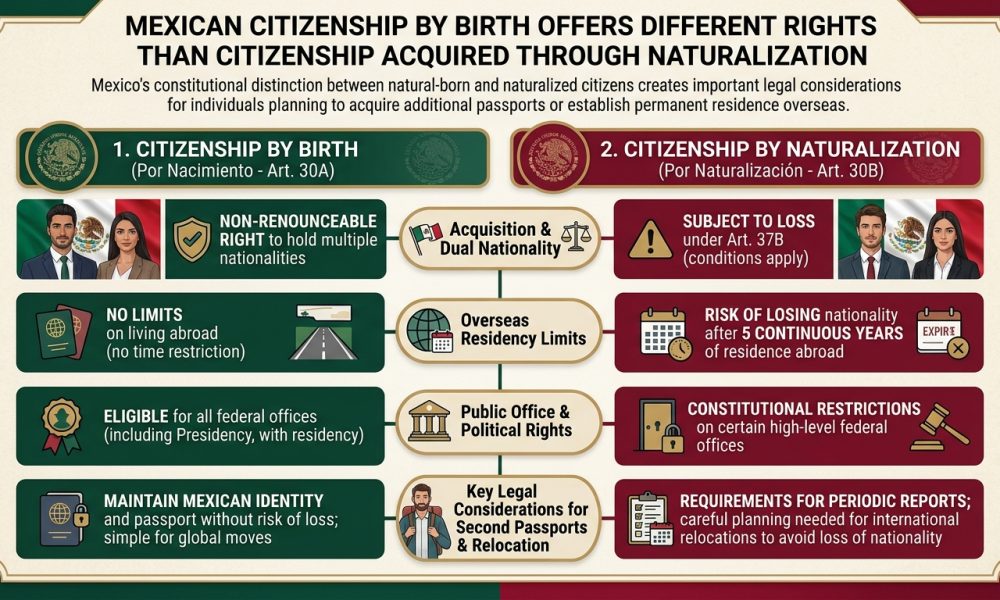
Mexico’s constitutional distinction between natural-born and naturalized citizens creates important legal considerations for individuals planning to acquire additional passports or establish permanent residence overseas, particularly when nationality retention, foreign passport use and eligibility for certain public positions are involved.
WASHINGTON, DC, November 19, 2026 — Mexico’s constitutional distinction between citizenship acquired by birth and nationality obtained through naturalization creates fundamentally different legal consequences for individuals pursuing second passports, international relocation and long-term residence outside the country, particularly when acquiring additional foreign nationality.
Although Mexican nationality can provide extensive residence, employment, property ownership, and international mobility rights, the constitutional protections available to Mexican citizens by birth differ significantly from those available to foreign nationals who later become Mexican citizens through naturalization.
The distinction is especially important for Mexican-American families, foreign-born professionals and individuals seeking additional citizenship through ancestry, marriage or investment, because certain actions that do not threaten Mexican nationality by birth can create serious concerns for naturalized citizens.
Mexico Recognizes Two Constitutional Categories of Nationality
Article 30 of the Mexican Constitution establishes that Mexican nationality may be acquired by birth or through naturalization, creating two legally recognized classifications with important consequences under other provisions of the country’s constitutional framework.
Mexicans by birth include individuals born within Mexican territory and those born abroad to Mexican parents under the relevant constitutional provisions. At the same time, naturalized Mexicans acquire nationality through procedures administered by the country’s competent government authorities.
Both classifications establish a legal connection to Mexico. They can provide substantial rights associated with nationality, but the Constitution distinguishes their treatment concerning nationality retention, certain government positions, and circumstances involving additional foreign citizenship.
Understanding these distinctions matters because holding a Mexican passport establishes nationality without necessarily revealing every legal consequence tied to the pathway through which the person originally became Mexican.
Article 37 Provides Stronger Protection for Mexicans by Birth
Article 37(A) establishes that a Mexican citizen by birth cannot be deprived of Mexican nationality, providing a significant constitutional safeguard for qualifying individuals who later obtain citizenship in another country through naturalization, ancestry, or other recognized procedures.
For a person born in Mexico who subsequently becomes an American citizen, this Protection generally allows Mexican nationality to continue without requiring the individual to surrender the original citizenship merely because United States naturalization has occurred.
The same constitutional principle can apply to qualifying individuals born outside Mexico who are legally Mexican by birth through their parents, making the classification particularly important for internationally established families maintaining connections with several countries.
However, constitutional Protection against loss of nationality does not mean that every office, government appointment, or nationality-sensitive position remains available to citizens holding another nationality, because separate provisions may impose additional eligibility requirements.
Naturalized Mexican Citizens Face Different Nationality-Loss Rules
Article 37(B) establishes separate circumstances for losing Mexican nationality acquired through naturalization, including voluntarily acquiring foreign nationality, presenting oneself as a foreigner in certain public documents, and using a foreign passport.
The constitutional provision also identifies continuous residence abroad for five years as a ground for loss of nationality acquired through naturalization, creating an important distinction for individuals planning permanent relocation outside Mexico.
These provisions mean that a naturalized Mexican considering another citizenship cannot safely rely upon the rules applicable to Mexicans by birth, particularly when the proposed application involves acquiring another nationality or routinely using foreign travel documentation.
Because the legal determination and administrative procedures governing loss of nationality require examination under applicable Mexican law, affected individuals should obtain qualified advice before taking actions that could threaten their existing citizenship status.
The 1998 Reform Changed Mexico’s Approach to Dual Nationality
Mexico’s modern dual-nationality framework emerged from constitutional changes that took effect on March 20, 1998, allowing Mexicans by birth to retain their nationality after obtaining citizenship in another country and strengthening ties with Mexican communities abroad.
The reform was particularly significant for emigrants living in the United States, where many Mexican nationals had previously faced difficult decisions about naturalization because acquiring American citizenship could jeopardize their original Mexican nationality.
Under the revised framework, Mexicans by birth gained stronger constitutional Protection to retain their nationality. At the same time, naturalized Mexican citizens remained subject to separate provisions on foreign citizenship and other conduct identified in Article 37.
This historical distinction still shapes international citizenship planning today, particularly when individuals assume that Mexico’s general acceptance of multiple nationalities applies equally to everyone holding a Mexican passport.
Mexican Citizenship by Descent Can Qualify as Citizenship by Birth
A person does not necessarily need to be born in Mexico to qualify as Mexican by birth, because Article 30 recognizes certain individuals born abroad to Mexican parents as nationals from birth.
Constitutional changes enacted in May 2021 expanded nationality transmission through Mexican parents born outside Mexico, eliminating an earlier generational limitation and creating additional opportunities for descendants seeking recognition of their Mexican heritage.
For qualifying families, the distinction means that obtaining Mexican civil registration and nationality documentation can recognize citizenship by birth rather than represent an ordinary naturalization process available to foreign residents.
The legal classification should still be verified through official records, because Mexican ancestry alone does not establish every required fact concerning parentage, citizenship transmission, or the documentation needed to obtain a Mexican passport.
American Naturalization Does Not Automatically Eliminate Mexican Birth Nationality
Mexicans by birth who become naturalized American citizens generally retain their original Mexican nationality under Article 37(A), allowing them to maintain a legal connection with Mexico while gaining the substantial rights associated with U.S. citizenship.
The U.S. Department of State explains in its official guidance on dual nationality that American law generally permits acquisition of additional foreign nationality and recognizes that citizens can maintain responsibilities under more than one country’s legal system.
However, an American citizen’s continuing nationality obligations include complying with United States passport requirements and applicable federal tax legislation, demonstrating that additional citizenship does not automatically eliminate the legal responsibilities imposed by the United States.
For Mexican-Americans considering retirement or permanent relocation, maintaining both nationalities can offer significant residential flexibility. Still, they must weigh these benefits against documentation requirements, international taxation, and any restrictions on public employment.
Naturalized Mexicans Must Consider Foreign Passport Use
One particularly consequential provision of Article 37(B) concerns the use of a foreign passport by an individual who acquired Mexican nationality through naturalization, because the Constitution expressly identifies this conduct among the grounds for nationality loss.
This creates an important distinction between a Mexican citizen by birth who legitimately uses an American passport and a naturalized Mexican whose use of foreign nationality documentation may create legal consequences under the Mexican constitutional framework.
However, a constitutional ground for nationality loss should not be confused with a determination that an individual automatically becomes stateless at an airport checkpoint, because competent authorities and applicable procedures must be considered.
For naturalized Mexican citizens who retain connections with another country, the potential interaction between foreign passport requirements and Mexican nationality rules makes individualized legal advice especially important before arranging international travel.
Five Years Abroad Can Have Consequences for Naturalized Citizens
Article 37(B) also identifies residence outside Mexico for five continuous years as a ground for loss of Mexican nationality acquired through naturalization, making extended overseas relocation particularly significant for this category of citizens.
A naturalized Mexican planning to establish permanent residence in Thailand, Spain, Canada or another destination should therefore consider the constitutional consequences before assuming that Mexican nationality can be maintained indefinitely without regard to foreign residence.
The constitutional distinction does not impose the same nationality-loss provision upon Mexicans by birth, who benefit from Article 37(A)’s Protection even when they establish long-term homes outside Mexican territory.
Individuals facing possible nationality loss should confirm how residence periods are calculated and how the competent Mexican authorities apply the relevant provisions, rather than relying on informal assumptions that occasional international travel necessarily resolves the issue.
Marriage-Based Mexican Naturalization Creates the Same Important Distinction
Foreign nationals married to Mexican citizens may qualify for an accelerated naturalization pathway when they satisfy applicable residence and other statutory requirements. Still, marriage itself does not automatically convert a foreign spouse into a Mexican citizen; an eligible applicant acquires Mexican nationality through naturalization, and that classification differs legally from nationality acquired by birth, even when the person has maintained a longstanding marriage and extensive family connections in Mexico.
The naturalized spouse must therefore evaluate Article 37(B) before voluntarily acquiring another nationality, using a foreign passport or planning prolonged residence abroad, because those constitutional provisions can remain relevant after citizenship approval.
This distinction illustrates why Mexican citizenship applications should address the applicant’s long-term international plans rather than focusing exclusively on eligibility, processing requirements, and the initial issuance of a nationality certificate or passport.
Mexican Naturalization Requires Government Approval and Genuine Eligibility
Foreign nationals seeking Mexican citizenship through naturalization must generally meet requirements under Mexico’s Nationality Law and related regulations, with the responsible authorities reviewing residence history, documentation, and other applicable eligibility conditions.
The standard naturalization pathway generally involves five years of qualifying legal residence. However, shorter periods may apply in specified circumstances involving marriage, family connections, nationality, or other categories recognized under Mexican legislation.
Applicants may also encounter requirements involving Spanish-language knowledge, Mexican history and cultural integration, subject to applicable statutory exceptions and administrative procedures established by the competent government institutions.
Successful naturalization requires a lawful government decision and properly issued documentation, not merely a Mexican residence permit, tax Identification number, civil registry record, or passport-like document obtained through an intermediary.
A Mexican Passport Does Not Reveal Every Nationality Restriction
A valid Mexican passport may establish citizenship for international travel. Still, it does not necessarily show whether the holder acquired nationality by birth or naturalization, or whether particular constitutional restrictions apply.
As a result, two individuals with substantially identical Mexican passports may occupy different legal positions when acquiring foreign citizenship, using another country’s passport, or establishing continuous residence outside Mexico for several years.
Government agencies examining nationality-sensitive matters may require additional evidence, including birth records, naturalization certificates, or official nationality determinations, before establishing which constitutional provisions govern the individual’s circumstances.
These distinctions demonstrate why a passport should be understood as a government-issued travel credential rather than a complete legal explanation of every right and obligation associated with the holder’s nationality.
Certain Mexican Government Positions Are Reserved for Citizens by Birth
Article 32 of the Constitution establishes that certain public functions and positions requiring Mexican nationality by birth can also restrict the acquisition or possession of another nationality, reflecting Mexico’s separate constitutional approach to public service eligibility.
Certain military, national security, maritime and aviation positions have historically carried nationality-related requirements. However, the precise qualifications depend upon the constitutional provision and legislation governing the specific appointment or activity.
A person who acquires Mexican nationality through naturalization may therefore be ineligible for designated positions reserved for Mexicans by birth, regardless of how long the individual has resided in Mexico or contributed professionally.
These distinctions are separate from the ordinary ability to establish residence, own qualifying property, work in permitted occupations, and participate in other activities available to Mexican nationals under applicable law.
Mexico’s 2026 Political Reform Renewed Attention to Dual Nationality
In October 2026, Reuters reported on Mexico’s reform restricting dual nationals from holding certain senior elected offices, describing changes affecting eligibility for presidential, gubernatorial, and Mexico City leadership,y with the relevant restrictions scheduled to apply beginning in 2028.
The reform attracted criticism from representatives of Mexican-American communities who argued that possession of another nationality should not diminish a person’s Mexican identity or automatically undermine longstanding political and civic connections.
Supporters emphasized the importance of national allegiance in senior public positions. At the same time, opponents raised concerns about political participation and the potential consequences for individuals whose dual citizenship resulted from family circumstances or international residence.
The debate illustrates that Mexico’s constitutional recognition of multiple nationalities can coexist with specific political eligibility restrictions, making citizenship retention and access to particular public offices legally distinct questions.
Mexican Nationality and Political Citizenship Are Not Identical Concepts
Mexican nationality establishes a legal relationship between an individual and the Mexican state. At the same time, exercising political citizenship rights also depends on constitutional provisions on age, eligibility, and other statutory conditions.
Article 34 identifies the general constitutional qualifications for Mexican citizenship in the political sense, while additional provisions govern voting, public office, and restrictions associated with particular governmental responsibilities.
Consequently, acquiring Mexican nationality through naturalization can provide substantial civic rights without necessarily establishing eligibility for every public position reserved for citizens by birth or subject to additional constitutional restrictions.
Internationally mobile individuals should therefore distinguish fundamental nationality rights from the narrower qualifications imposed upon particular political activities, especially when dual citizenship may affect eligibility under recently amended legislation.
Dual Citizens Must Follow the Travel Rules of Both Governments
Mexican-American dual citizens generally must comply with Mexican nationality requirements when entering or departing Mexico while also satisfying American rules governing travel into and out of the United States, including applicable passport obligations.
For a Mexican citizen by birth, using the appropriate foreign passport can be compatible with continued Mexican nationality. Still, it does not eliminate Mexican entry procedures or other responsibilities imposed on nationals.
For a naturalized Mexican, the same international itinerary may require a more complicated legal assessment because Article 37(B) expressly identifies foreign passport use as a potential ground for loss of Mexican nationality.
Travelers should therefore obtain appropriate government guidance concerning their precise nationality classification before assuming that documentation practices suitable for one category of Mexican citizen are equally appropriate for another.
Consular Protection Can Differ for Dual Nationals
Individuals holding citizenship in Mexico and another country may encounter restrictions on foreign consular intervention while physically present in Mexico, particularly when Mexican authorities treat the person as a domestic national under applicable law.
The same problem can arise when Mexican dual citizens visit their other country of nationality, where the receiving government may consider them its own citizens and limit the involvement of Mexican diplomatic representatives.
These considerations do not negate the advantages of dual nationality. Still, they show why two passports do not guarantee unrestricted diplomatic assistance, immunity from domestic legislation, or automatic Protection during legal disputes.
For naturalized Mexicans, uncertainty about continued nationality status can add complications, so accurate records and timely consultation with qualified advisers matter when international travel involves potentially conflicting legal obligations.
Mexican Birth Nationality Can Support Long-Term International Mobility
Mexicans by birth who establish lawful residence in another country can generally retain their original nationality while pursuing new professional, educational and family opportunities, providing considerable flexibility when circumstances require extended international relocation.
A Mexican citizen who lawfully acquires permanent residence or citizenship in another country may consequently maintain meaningful ties to Mexico, including the ability to return and exercise applicable nationality rights without beginning a new immigration application.
However, a foreign residence permit should not be confused with foreign citizenship, because immigration authorization and naturalization create different legal rights and may impose substantially different requirements concerning residence, documentation and eligibility.
The strongest international mobility arrangements therefore begin with accurate confirmation of Mexican nationality status and an informed evaluation of the additional country’s laws, rather than assuming that all second-passport pathways offer identical benefits.
Spain Offers a Relevant Example of Citizenship Planning
Mexicans by origin may qualify for Spain’s reduced two-year legal residence requirement when pursuing Spanish nationality, provided they meet the conditions set by Spanish legislation and maintain the required qualifying residence.
The reduced period does not create automatic citizenship, since applicants must still complete the relevant naturalization procedures and satisfy requirements concerning documentation, conduct, integration and government approval.
For Mexican citizens by birth, successful Spanish naturalization can create additional European Union residence and mobility rights while generally preserving the Protection of Mexican nationality established under Article 37(A).
By contrast, a Mexican whose citizenship was acquired through naturalization must examine the consequences under Article 37(B) before acquiring Spanish nationality, because the Mexican constitutional framework treats the two categories differently.
A Second Citizenship Does Not Automatically Change Tax Residency
Mexican nationality and Mexican tax residence are legally distinct classifications, meaning holding a Mexican passport does not automatically determine where every form of income is taxable or which financial reporting requirements apply.
Individuals establishing permanent residence abroad may become subject to foreign tax legislation, while Mexican tax obligations depend upon the applicable residence, income-source, and other statutory provisions governing their circumstances.
Mexican-American dual citizens can face additional complexity because American federal income tax requirements generally continue to apply to qualifying United States citizens living abroad, subject to relevant exclusions, credits and treaty provisions.
For naturalized Mexicans considering overseas residence, the financial analysis should address both tax consequences and separate constitutional nationality rules, ensuring lawful relocation planning does not overlook either issue.
Amicus International Consulting and Mexican Citizenship Planning
International citizenship planning requires careful attention to the distinction between acquiring another passport and maintaining the original nationality, particularly when Mexican constitutional provisions establish different protections for citizens by birth and naturalization.
Through its second-passport and international advisory services, Amicus International Consulting supports broader mobility planning involving citizenship, international residence, and documentation, while governmental nationality determinations remain the responsibility of the appropriate issuing authorities.
For individuals considering Mexican citizenship through naturalization, preliminary legal assessments should review existing foreign nationality, travel requirements, and long-term residence plans before making decisions that could conflict with Article 37.
For Mexicans by birth seeking additional citizenship, the planning priorities may instead focus on verifying foreign eligibility, maintaining accurate civil records, and understanding the continuing obligations associated with both nationalities.
Official Documentation Remains Essential to Nationality Recognition
Applicants seeking recognition of Mexican nationality by birth through ancestry may need properly issued birth certificates, evidence of parental nationality, and civil registry documentation before obtaining a Mexican passport or completing other administrative procedures.
Naturalization applicants require a different evidentiary process involving proof of qualifying residence and satisfaction of the relevant legal conditions, followed by an authorized governmental decision and issuance of appropriate nationality documentation.
Official records should accurately reflect a person’s legal identity and citizenship history, because inconsistent documentation can complicate passport applications, border inspections, foreign naturalization procedures, and other nationality-sensitive transactions.
Where questions arise about the authenticity or legal effect of citizenship documentation, obtain verification from the responsible Mexican authorities rather than relying exclusively on third-party claims or unofficial databases.
Nationality Loss Requires an Individual Legal Assessment
The constitutional grounds applicable to naturalized Mexicans should be evaluated through the procedures established by Mexican law, because determining whether nationality has been lost involves questions of legal status, evidence, and competent governmental authority.
An individual should not assume that nationality has automatically disappeared simply because a potentially relevant circumstance occurred, but neither should that person disregard constitutional provisions while planning international citizenship or residence arrangements.
If a naturalized citizen has already acquired another nationality or lived abroad for an extended period, qualified Mexican counsel can review the facts and determine which administrative procedures and legal remedies may apply.
The objective is to establish a reliable understanding of existing nationality status before making additional decisions about passports, international relocation, property ownership, or the exercise of citizenship rights.
Conclusion: Mexican Citizenship Classification Determines Important Legal Rights
Mexico’s nationality framework provides substantial opportunities for international mobility. Still, the constitutional distinction between citizenship by birth and nationality acquired through naturalization creates different consequences for individuals seeking additional passports or permanent residence abroad.
Article 37(A) provides lasting Protection for Mexicans by birth. In contrast, Article 37(B) identifies specific grounds for losing nationality acquired through naturalization, including voluntary foreign naturalization, use of a foreign passport, and continuous residence abroad for five years.
The differences extend beyond international travel because Article 32 and other constitutional provisions set nationality-related qualifications for certain government positions, showing that the legal consequences of citizenship depend on its classification and the activity involved.
For individuals evaluating Mexican citizenship in 2026, the key planning step is to determine whether nationality was acquired by birth or naturalization, confirm the applicable constitutional requirements, and seek appropriate legal guidance before pursuing further international citizenship opportunities.




