
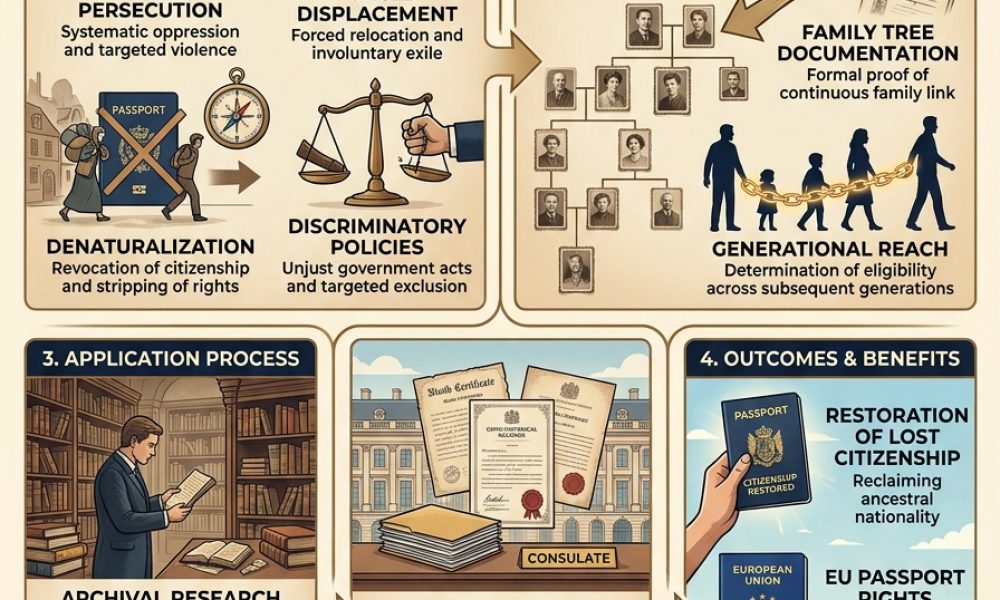
European historical restitution programs recognize certain descendants of people deprived of citizenship through persecution, displacement and discriminatory government policies, although eligibility and filing deadlines differ significantly between national systems.
WASHINGTON, November 16, 2026 — Descendants of European families uprooted by Nazi persecution, political repression and discriminatory nationality laws may qualify for special citizenship procedures. Still, the outcome depends on documented historical circumstances rather than ancestry alone or the existence of an old passport.
Germany and Austria maintain distinctive restitution pathways for eligible victims and descendants. At the same time, Spain’s Democratic Memory legislation illustrates how another country can recognize historic exile through a time-limited nationality option rather than an indefinitely available restoration process.
For applicants in the United States, Canada and elsewhere, researching an ancestor’s loss of status can uncover significant legal rights, provided the family establishes the correct statutory category and links each generation with authentic civil records.
Restitution Is Different From Ordinary Citizenship by Descent
Ordinary descent claims often ask whether citizenship passed automatically from a parent to a child under the law in force at the time of birth. In contrast, restitution programs can address nationality that persecution prevented someone from keeping or acquiring.
That distinction matters because a family might lack the uninterrupted citizenship chain required by ordinary nationality confirmation but still meet a reparative provision specifically designed to correct the consequences of exclusion, expulsion or discriminatory legislation.
An applicant might therefore qualify under a restitution statute even if an ancestor naturalized elsewhere after fleeing persecution. In contrast, a conventional citizenship-by-descent analysis could reach a different conclusion under historical laws governing loss of nationality.
Not every descendant of someone who fled war or lived under authoritarian government qualifies, however, because each program defines eligible victims, historical dates, relevant territory and the type of relationship that must be proved.
Germany Recognizes Two Important Restitution Routes
Article 116(2) of Germany’s Basic Law provides for restoration of citizenship to former Germans deprived of nationality on political, racial or religious grounds during the Nazi period from January 30, 1933, through May 8, 1945, and their descendants.
The provision particularly addresses formal deprivation under Nazi-era measures, including collective rules affecting German Jews living abroad. However, applicants must still establish that the ancestor came within the law and prove their direct descent.
German authorities distinguish specific legal acts of deprivation from other forms of citizenship loss. Hence, the correct application depends on identifying which mechanism affected the ancestor rather than broadly characterizing every wartime emigrant as expatriated.
A separate route under Section 15 of Germany’s Nationality Act, effective from August 20, 2021, covers additional victims whose citizenship was lost in other ways or whose opportunity to acquire German citizenship was denied through Nazi persecution.
Together, these routes recognize that historical persecution operated through several distinct and consequential legal mechanisms, including nationality deprivation, flight, foreign naturalization, marriage restrictions, and exclusion from citizenship procedures that would otherwise have been available.
Section 15 Can Address Previously Excluded Family Histories
German government guidance identifies circumstances involving an ancestor who lost German citizenship after escape by taking another nationality, as well as people prevented from becoming German or forced to surrender ordinary residence under specified historical conditions.
The 2021 reform is particularly important for descendants whose claims did not fit the narrower constitutional framework. However, a family must still demonstrate how the ancestor’s experience satisfies one of the statutory categories.
Government application guidance describes the roles of the Federal Office of Administration and German diplomatic missions, enabling people living abroad to assemble and submit evidence without assuming that ordinary residence inside Germany is a necessary preliminary step.
A relative’s Jewish heritage or residence somewhere in prewar Europe may provide a research starting point. Still, German restitution eligibility cannot be established merely from a surname, religious affiliation, or general account of wartime hardship.
Historical Sex Discrimination Also Complicated Transmission
Older nationality laws sometimes prevented women from transmitting citizenship to children on equal terms with men, creating situations where descendants of persecuted women were excluded even though their family histories closely resembled those of successful applicants.
A German Federal Constitutional Court decision in May 2020 broadened the interpretation of descendants for Article 116(2), including certain children born to deprived German mothers and foreign fathers, as well as other historically disadvantaged family lines.
Applicants should carefully review dates of birth, marriages, and parentage rather than assume that modern legal equality automatically rewrites every historical citizenship rule, since each restitution pathway provides specific remedies for past exclusions.
Austria Uses a Declaration for Qualifying Descendants
Austria’s Section 58c allows qualifying victims of National Socialist persecution and their direct descendants to acquire citizenship through a declaration, with an expanded framework that took effect in September 2020 and received further amendments in 2022.
The Austrian rules can cover descendants of persecuted persons who held Austrian citizenship, relevant successor-state nationality or stateless status and had the qualifying principal residence in Austria, provided the remaining historical conditions are met.
The precise territorial connection deserves particular attention when an ancestor came from the former Austro-Hungarian Empire, because living under that empire did not automatically create the principal-residence connection demanded by the modern Austrian restitution law.
Unlike ordinary Austrian naturalization, this restitution route generally does not require the applicant to move to Austria or renounce an existing nationality under Austrian law. However, you must check another country’s nationality rules separately.
Children, grandchildren and more distant direct descendants may qualify, and Austria’s official guidance recognizes certain minor adoptees within the descendant category, making authentic family records essential even when the original victim has long since died.
New Austrian Figures Show the Continuing Demand
According to a November 16 report by The Local on Austria’s 2026 citizenship figures, Austria granted citizenship to 5,731 descendants of Nazi-era persecution victims during the first nine months of 2026, showing that restitution remains a substantial active pathway.
Austria’s official statistics also recorded five naturalizations of victims themselves in that period and identified Israel, the United States and the United Kingdom among the principal former nationalities associated with the restitution category.
The figures also demonstrate why established international diaspora communities remain an important audience for restitution procedures, since many successful applicants reside outside the country whose citizenship their ancestors lost during persecution or displacement.
Those totals reflect completed decisions rather than pending applications and do not predict the outcome or processing time for any particular family, whose records, eligibility category, or administrative circumstances still need individual review. Birthday Ceremony Gives Restitution a Human Face.
On November 10, 2026, Austrian officials restored citizenship to Vienna-born Holocaust survivor Gabriele Keenaghan in London on her one hundredth birthday, decades after she escaped Nazi persecution aboard a Kindertransport bound for Britain.
The Austrian Foreign Ministry said her father was murdered at the Chełmno extermination camp, and the ceremony illustrated how contemporary law can acknowledge a specific injustice without undoing the loss experienced by a family.
Such personal examples illuminate why restitution has profound cultural and emotional meaning beyond border access. However, one exceptionally rapid individual decision should never be presented as a reliable processing forecast for other applicants.
Spain’s Democratic Memory Route Had a Filing Deadline
Spain’s Democratic Memory Act of 2022 expanded nationality options for specified descendants of originally Spanish people forced into exile, and also addressed certain descendants affected by historical discrimination against Spanish women married to foreigners.
The law created a three-year application period, followed by a government extension. Still, Spain’s Foreign Ministry confirms that the special application window expired in October 2025, making it essential in 2026 to distinguish between new filings and applications already lodged.
By May 31, 2026, Spain’s consular network had received more than 1.2 million in-person applications under this framework. It approved hundreds of thousands, showing strong demand without implying the deadline remains open.
Spain also recognized particular descendants of Spanish women who had lost nationality by marrying foreigners before the 1978 Constitution, illustrating that historical restitution can address gender-based nationality injustice alongside exile caused by repression.
People who missed the special period should investigate whether a different current nationality provision applies, rather than assume that previously publicized instructions can still create a fresh right to apply under an expired option.
Not Every Historic Exile Falls Within a Restitution Statute
The term persecution can describe experiences of extraordinary severity. Still, nationality programs use precise legal definitions that may refer to a particular regime, territory, protected characteristic, departure date, or documented loss of status.
A family displaced by postwar border changes may need ordinary citizenship confirmation rather than Nazi-persecution restitution, while another family affected by discriminatory marital nationality rules may have a separate legal basis requiring different documentation.
Researchers should therefore identify the exact historical event that altered the ancestor’s legal position and determine whether the relevant country’s current law provides a remedy, rather than equating displacement, heritage, and citizenship entitlement.
Archives Become Central When Family Papers Are Missing
Birth and marriage registers, prewar residence certificates, naturalization petitions, refugee records, and historic identity documents can help reconstruct the family’s history, particularly when wartime destruction, forced migration, or name changes left gaps across generations.
German officials describe documents showing earlier citizenship, the ancestor’s persecution and subsequent foreign nationality, while Austrian guidance also recognizes certain compensation records or prior findings that may reduce the need to resubmit evidence.
Where records were destroyed or scattered, researchers may need to carefully reconstruct a timeline across municipal archives, migration files and refugee collections, while explaining why names or birthplaces appear differently in multiple languages.
An archive entry describing someone as German, Austrian or Jewish must be interpreted in its historical context, because ethnicity, religion, local residence and legal citizenship were not always recorded consistently by the same authorities.
Translations, apostilles, and certified extracts may be necessary. Still, applicants should first confirm what the competent authority will accept, avoid unnecessary expense, and preserve original records rather than modifying documents to fit a preferred narrative.
A Verified Family Chain Matters at Every Generation
The strongest applications trace the applicant’s relationship to the qualifying ancestor through genuine birth, marriage, adoption, and name-change records, with dates that explain how one generation connects to the next despite different countries and languages.
A grandparent’s surname may have changed during immigration, and a parent’s birth certificate may use another spelling. Still, such differences require legitimate explanations and archival corroboration, not invented certificates or altered identity documents.
Adoption records and previously unregistered family relationships can require particularly careful additional legal interpretation, especially when a restitution category defines direct descendants differently from the ordinary nationality rules that existed during an ancestor’s lifetime.
Families with several potentially eligible siblings should coordinate research while recognizing that each applicant may need an individual file, current Identification, and the specific forms required by the country reviewing the restitution claim.
No Universal Language or Residence Rule Applies
Restitution often differs substantively from ordinary naturalization, since Germany’s designated reparative provisions and Austria’s Section 58c generally do not impose the usual lengthy residence and language requirements on qualifying descendants living abroad.
That does not make the procedures automatic, because government officials still determine whether the historical facts and documentary proof meet the specific law and may request additional information before reaching a final decision.
Applicants should avoid importing ordinary citizenship requirements from unrelated programs or assuming every European ancestry pathway offers the same exemptions, since each scheme’s legal purpose and conditions differ markedly.
Citizenship Approval and Passport Issuance Are Separate Stages
A favorable restitution determination can provide the legal basis for acquiring or restoring nationality, but obtaining a passport generally requires later identity verification and issuance through the competent national authority under its own document rules.
The timing of acquisition may also depend on the legal route, including receipt of a naturalization certificate in Germany or completion of the declaration process in Austria. Therefore, do not describe a pending application as existing citizenship.
Applicants should also separate legal recognition of citizenship from registering a birth abroad or obtaining consular identity documents for their own children, because transmission to another generation may engage a different set of rules.
For families hoping to travel to the European Union, a future passport can matter. Still, they should consider residence, work, and other rights only after nationality has legally taken effect and they have obtained the appropriate documents.
American Descendants Have Their Own Dual-Nationality Duties
The United States Department of State’s dual-nationality guidance explains that American citizens can also hold foreign citizenship but must use United States passports when entering and leaving the country and remain subject to applicable domestic laws.
A German or Austrian restitution decision does not automatically cancel American citizenship or existing financial obligations. At the same time, the relevant European country may impose separate passport, registration, or civic responsibilities on its new national.
Applicants should review any other citizenship they hold before filing, because another jurisdiction’s loss rules or obligations may differ from those of the United States even when Germany or Austria permits nationality retention under its restitution framework.
Moreover, newly acquired European citizenship can affect international travel and residence options without determining income taxation by itself, since taxes depend on separate nationality, domicile and residence rules that require individual professional assessment.
Independent Advisers Cannot Replace Government Decisions
Amicus International Consulting describes second-passport advisory services for clients investigating lawful international mobility. Still, restitution eligibility must be independently established by competent European authorities using authentic evidence and current national statute.
Its analysis of second passports and ongoing American tax reporting also provides relevant context for separating an additional nationality from continuing duties, rather than treating citizenship restoration as an automatic financial or legal reset.
Anyone seeking paid assistance should request a clear explanation of the eligible ancestor, applicable statutory route, required archives, and anticipated government process, and avoid representatives who guarantee results before examining the historical record.
Reclaiming Nationality Begins With Reconstructing History
Families exploring restitution should first establish which government held authority over the ancestor, what persecution or discriminatory rule affected that person’s status,, and whether crrent nationality law provides a remedy for descendants.
They should then obtain authentic records connecting the generations, identify the competent authority and check current filing conditions, keeping expectations realistic about review times and treating historical suffering with the seriousness it warrants.
Citizenship restitution can connect descendants to a nationality denied to their familie. Still, families’ due rests on accurate records, legally recognized relationships, and government decisions ,rnot onassumptions that every ancestral tragedy automatically produces a second passport.




