
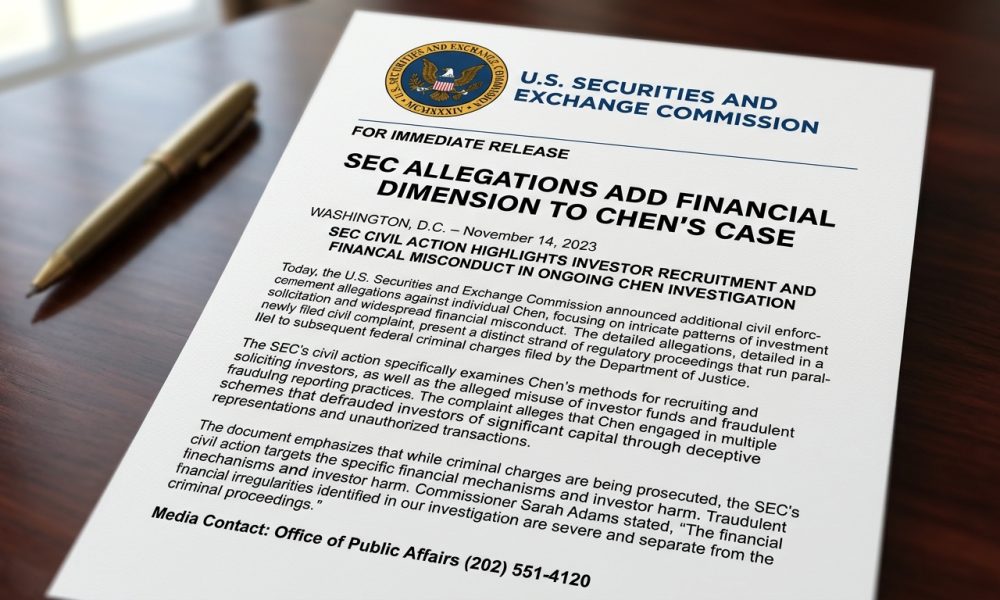
The 2018 civil securities complaint examined undisclosed investment commissions, alleged self-dealing and unregistered brokerage activity, revealing a financial dimension distinct from the federal visa fraud and obstruction charges that followed.
WASHINGTON, November 12, 2026 — The federal case involving former California immigration attorney Danhong “Jean” Chen reveals how investment-based immigration services can attract scrutiny from securities regulators and criminal investigators, with separate proceedings examining financial disclosures, investor relationships and allegedly fraudulent immigration documentation.
The Securities and Exchange Commission filed a civil enforcement complaint on October 18, 2018, alleging that Chen, her then-husband Jianyun “Tony” Ye and associated parties received millions of dollars in undisclosed commissions from investments recommended to foreign nationals pursuing United States permanent residence.
Federal prosecutors later brought criminal charges involving visa fraud and obstruction. Still, the SEC allegations added a distinct financial dimension involving investment solicitation, conflicts of interest, brokerage registration, and the responsibilities of professionals advising immigration clients.
Understanding the difference matters because the civil complaint, the criminal indictment, and the later guilty plea addressed overlapping events through different legal frameworks, with separate evidentiary requirements, remedies, and consequences for the individuals involved.
SEC Complaint Examined Millions in Allegedly Undisclosed Commissions
The Securities and Exchange Commission’s October 2018 enforcement announcement alleged that Chen, Ye and the Law Offices of Jean D. Chen, with assistance from associate Kuansheng Chen, obtained more than $10 million in undisclosed commissions through securities sales to immigration clients.
The underlying civil complaint described more than $12 million in transaction-based compensation tied to hundreds of investor clients, providing more detail than the rounded figure in the commission’s public announcement of its enforcement action.
Regulators alleged these payments were separate from ordinary legal fees and tied to investors’ decisions to purchase interests in projects promoted through the federal EB-5 Immigrant Investor Program, raising questions about undisclosed financial incentives.
The allegations mattered for more than the amount received because regulators examined whether clients understood their advisers’ financial relationships and whether the services involved securities transactions subject to federal registration and antifraud requirements.
Investor Immigration Created Overlapping Professional Responsibilities
The EB-5 program permits qualifying foreign investors to pursue permanent United States residence through eligible investments associated with job creation, subject to immigration requirements, project documentation and the government’s assessment of individual applications.
During the period examined by the SEC, Chen’s law firm represented foreign nationals pursuing immigration benefits, while the complaint alleged that the firm and associated individuals also recommended investment opportunities from which they obtained transaction-related compensation.
These activities raised regulatory questions because providing legal advice about immigration requirements is not necessarily equivalent to acting as a securities broker, particularly when compensation depends on whether a client completes an investment.
The distinction matters for lawful investor immigration because professional representatives may perform different roles involving legal documentation, financial recommendations, and investment transactions, each potentially governed by separate disclosure obligations and regulatory requirements.
Regulators Alleged a Hidden Ownership Interest
The SEC further alleged that Chen and Ye secretly acquired and controlled Golden State Regional Center LLC, an organization associated with EB-5 investment offerings, while continuing to recommend projects to immigration clients without disclosing their ownership interests.
According to the complaint, Kai Hao Robinson appeared publicly as the regional center’s controlling manager. At the same time, regulators alleged that she functioned as a nominal representative acting under the direction of Chen and Ye.
The alleged arrangement became central to the securities investigation because clients receiving investment recommendations could reasonably consider whether their advisers had an undisclosed ownership interest in the projects or organizations receiving their money.
These were allegations made in a civil complaint, and their inclusion in the SEC’s announcement should not be confused with a criminal verdict establishing that every asserted ownership arrangement or securities violation had been proven.
Financial Conflicts Became a Central Enforcement Concern
As Bloomberg Law reported on October 19, 2018, the SEC accused Chen and Ye of obtaining substantial commissions through EB-5 securities transactions while allegedly operating without the registration required for certain securities brokerage activities.
The reporting highlighted the relationship between immigration representation and investment promotion. This combination can create regulatory concerns when clients believe they are receiving independent advice, but their advisers allegedly benefit financially from particular recommendations. Financial incentives by themselves do not make investment advice fraudulent or unsuitable. Still, undisclosed compensation can become material when investors rely on professional guidance to select projects involving substantial personal savings.
The Chen allegations therefore illustrate why transparent compensation arrangements and meaningful conflict disclosure matter in investment-based immigration, even when the immigration application and securities transaction are processed through different institutions.
SEC Allegations Included Unregistered Brokerage Activity
Federal securities laws distinguish certain professional advisory services from activities that may constitute securities brokerage, including circumstances where an intermediary solicits investment purchases and receives compensation tied directly to completed transactions.
The SEC alleged that Chen, Ye, and associated parties participated in securities sales without appropriate registration, making the nature of their solicitation activities and compensation arrangements relevant to determining whether they violated federal brokerage requirements.
Regulators also alleged violations of antifraud provisions under the Securities Act of 1933 and the Securities Exchange Act of 1934, expanding the case beyond licensing questions to the accuracy of representations made to investors.
The civil action sought remedies including injunctions, disgorgement, prejudgment interest and financial penalties, which differ substantially from imprisonment and other punishments available following convictions in federal criminal proceedings.
Investor Funds Moved Through Law Firm Accounts
The original SEC complaint described arrangements in which Chen’s law firm allegedly received and transferred substantial investor funds, sometimes facilitating transactions between immigration clients and regional centers involved in EB-5 offerings.
Regulators alleged that money also moved through personal accounts associated with Chen and Ye during certain periods, creating additional questions about financial oversight, recordkeeping, and whether clients understood the relationships among participants handling their investments.
The movement of investor money through an intermediary does not, by itself, establish theft or securities fraud, so it is important to examine the specific legal arrangements, authorized purposes, and disclosures associated with the transactions.
Nevertheless, the allegations showed why regulators scrutinized the financial infrastructure behind the investment recommendations, rather than limiting their examination to the immigration forms submitted to government authorities or the eventual residency outcomes clients sought.
The Complaint Examined Offshore Financial Arrangements
The SEC also described alleged arrangements involving a personal associate and overseas financial relationships, claiming these structures helped conceal compensation tied to investment solicitations and the activities of individuals involved in the EB-5 offerings.
Cross-border payments can occur legitimately in international investment transactions. Still, regulators may examine whether they were properly disclosed, accurately reported, and connected to that requires compliance with U.S. securities laws.
The central legal question involves the actual conduct and applicable requirements, not the mere existence of a foreign bank account or international financial relationship, since geographical complexity alone is not evidence of fraud.
For investor immigration professionals, these allegations reinforce the importance of maintaining reliable transaction records and identifying the parties receiving compensation, particularly when money moves among legal advisers, regional centers and overseas intermediaries.
Regulators Alleged Attempts to Conceal Evidence
The SEC’s October 2018 announcement also alleged that Chen and Ye backdated documents and altered or removed business records after learning of the commission’s investigation, raising separate questions about the integrity of the evidence they provided to regulators.
Such allegations matter because financial enforcement investigations depend on reliable records showing when agreements were signed, who controlled particular entities, and how payments were authorized or distributed among individuals and organizations.
A document bearing an earlier date does not automatically establish misconduct, but intentionally creating misleading records or concealing relevant information can affect the credibility of explanations offered during an authorized regulatory investigation.
The SEC’s claims of evidence alteration also help explain why subsequent criminal investigators examined alleged obstruction, although specific criminal responsibility depended on separate charges, evidence, and later judicial proceedings.
Civil Enforcement and Criminal Prosecution Followed Different Paths
The SEC filed its civil action in the Northern District of California during October 2018, while a federal grand jury returned a separate criminal indictment against Chen and Ye in March 2019.
The criminal indictment alleged visa fraud, obstruction, and related offenses involving immigration applications submitted to United States Citizenship and Immigration Services, extending the government’s examination beyond alleged financial conflicts into the accuracy of representations made to immigration authorities.
A securities regulator can pursue civil remedies without proving the same statutory elements required for a criminal conviction, meaning that similar underlying events can generate proceedings with different legal standards and potential outcomes.
Consequently, the SEC’s allegation of unregistered brokerage activity should not be described as an offense for which Chen was necessarily criminally convicted, just as the later visa fraud conviction cannot automatically establish every securities allegation.
The Criminal Indictment Focused on Immigration Documents
Federal prosecutors alleged that Chen and Ye submitted immigration materials containing false signatures and misleading representations involving the regional center’s ownership, the law firm’s representation of clients and the proposed use of investor funds.
These assertions differed from the SEC’s emphasis on investment solicitation because criminal visa fraud concerns knowingly false or fraudulent immigration-related representations meeting the statutory requirements of the charged offense.
The government also alleged obstruction connected with investigations by the FBI and SEC, creating a further legal dimension involving whether particular conduct improperly interfered with authorized federal inquiries.
The indictment contained allegations rather than established guilt when returned, and responsible reporting must cover the subsequent criminal case without assuming that every original count was ultimately admitted or proven.
Chen’s Departure Complicated the Federal Proceedings
Chen left the United States in October 2018, shortly after the SEC civil complaint was filed, and remained abroad for several years before authorities in the Kyrgyz Republic detained her in connection with the outstanding American criminal proceedings.
The timing matters because her departure preceded the March 2019 indictment, making it inaccurate to suggest that she initially left the country after being convicted or after the federal grand jury returned those particular charges.
Her extended absence complicated the criminal prosecution while illustrating why civil enforcement, international travel and Extradition proceedings must be described separately, even when each concerns the same defendant and related conduct.
The public record establishes the eventual international law enforcement cooperation that returned Chen to federal court. Still, it does not justify unsupported assumptions concerning every travel document or financial arrangement she used while abroad.
Extradition Returned Chen to the United States
In March 2025, authorities extradited Chen from the Kyrgyz Republic to the United States, allowing federal prosecutors to resume proceedings associated with the indictment returned six years earlier in the Northern District of California.
American officials described the transfer as the first Extradition from the Kyrgyz Republic to the United States on federal criminal charges, representing an important development in international cooperation rather than a determination of criminal guilt.
The Extradition illustrates that residence abroad does not automatically eliminate outstanding American criminal proceedings. However, whether a country may surrender an individual depends on applicable law and international arrangements.
Importantly, the transfer related to the criminal case and should not be confused with the SEC’s civil request for financial remedies, which involved different legal procedures and regulatory objectives.
November 2025 Guilty Plea Established Criminal Responsibility
Chen pleaded guilty in November 2025 to one count of visa fraud and two obstruction-related counts, resolving the criminal prosecution through admitted offenses rather than a jury verdict on every allegation originally included in the indictment.
The guilty plea established responsibility for those specific criminal offenses, but it did not transform every allegation in the 2018 securities complaint into a proven criminal violation or resolve all possible questions in the civil case.
This distinction matters because separate proceedings may involve overlapping evidence without producing identical legal findings, and readers need to understand precisely which conduct was admitted and which claims originated as regulatory allegations.
The plea also changed the appropriate language for reporting the criminal case, making descriptions that refer solely to accusations incomplete unless they acknowledge the later conviction and the court’s sentencing decision.
January 2026 Sentence Closed a Major Criminal Chapter
On January 27, 2026, Chen received a 30-month federal prison sentence, followed by two years of supervised release and a $20,000 fine, according to the SEC Office of Inspector General’s investigative summary.
Those penalties arose from criminal proceedings involving visa fraud and obstruction, not from the SEC’s initial civil complaint seeking remedies for allegedly undisclosed commissions and investment-related misconduct.
The sentencing outcome provides an established legal development. At the same time, any characterization of the civil case’s ultimate disposition requires separate verification rather than assuming that the criminal plea automatically disposed of the regulator’s outstanding claims.
The distinction protects reporting integrity because sentencing, civil liability, and professional disciplinary consequences arise from different proceedings, each addressing particular legal responsibilities even when events from one investigation inform another.
Professional Accountability Extended Beyond the Criminal Sentence
Chen’s federal convictions also became relevant to professional disciplinary proceedings, showing how serious misconduct in immigration representation can affect an attorney’s professional status independently of securities litigation or criminal punishment.
The broader case demonstrates why investor immigration clients should understand who provides legal advice, who recommends financial products, and who receives compensation from investment decisions, particularly when different commercial relationships are presented as a single professional service.
Document Integrity and Financial Transparency Remain Separate Obligations
For individuals navigating lawful immigration and international identity requirements, accurate government documentation remains essential. At the same time, transparent investment arrangements require separate attention to financial disclosures, conflicts of interest, and the authority of intermediaries offering professional services.
The distinction also appears in Amicus International Consulting’s explanation of passport security and document authenticity, which addresses verification of government-issued identity credentials rather than the financial suitability or regulatory compliance of investments tied to immigration applications.
Chen Case Demonstrates the Importance of Accurate Legal Reporting
The SEC allegations provide a financial explanation for the government’s initial scrutiny of Chen’s investment-related activities, while the later criminal prosecution established separate violations involving immigration documents and obstruction of federal investigations.
The case shows why reporters must keep a clear distinction between alleged undisclosed commissions, proven criminal offenses, and subsequent disciplinary consequences. Hence, readers understand the specific authorities, legal standards, and outcomes tied to each proceeding.
Ultimately, the Chen investigation demonstrates how investment-based immigration can expose overlapping regulatory responsibilities, making transparent financial relationships, truthful government submissions, and accurate descriptions of legal proceedings essential to protecting investors and maintaining confidence in lawful immigration systems.




