
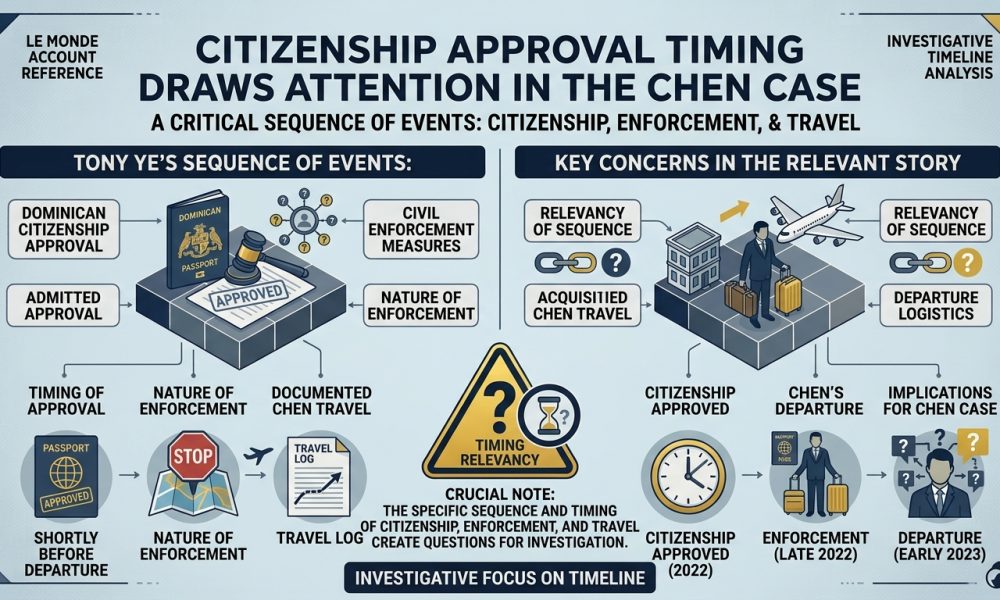
Le Monde’s investigation placed Danhong “Jean” Chen’s acquisition of Dominican citizenship shortly before she left the United States in October 2018, raising questions about citizenship screening, identity verification, and the timeline of financial enforcement proceedings.
WASHINGTON, DC, November 11, 2026 — The timing of California immigration attorney Danhong “Ean” Chen’s acquisition of Dominican citizenship has become a significant element of an international investigation examining how investment-based nationality programs assess applicants whose professional activities are approaching regulatory or criminal scrutiny.
Chen reportedly obtained citizenship from the Caribbean island of Dominica shortly before leaving the United States in October 2018, around the time American securities regulators filed a civil enforcement complaint alleging misconduct involving foreign investors seeking permanent residence.
The sequence attracted international attention because the additional citizenship reportedly gave Chen a Dominican passport identifying her as Maria Sofia Taylor, raising questions about the relationship between nationality approval, historical identity records, and authorities’ ability to connect documents issued under different names.
Although the proximity of those events invites legitimate questions about screening procedures and the information available to Dominican officials, it does not independently establish that citizenship was unlawfully granted or that the Caribbean government knowingly approved an applicant attempting to avoid American authorities.
Le Monde Investigation Reconstructs a Controversial Departure
An October 2023 Le Monde investigation into Dominica’s citizenship-by-investment program examined Chen’s circumstances as part of a broader international reporting project on passport recipients linked to criminal allegations, financial disputes, and politically sensitive backgrounds.
The newspaper reported that Chen acquired Dominican citizenship only weeks before leaving the United States and then traveled using a Dominican passport under the name Maria Sofia Taylor, prompting scrutiny of the screening conducted before her naturalization.
The investigation described her departure as occurring immediately after American financial regulators initiated proceedings against her, while raising questions about how authorities responsible for citizenship approvals evaluate applicants with complex business histories and potential legal exposure.
Importantly, the newspaper’s description of citizenship obtained weeks earlier should not be confused with a verified exact approval date, because publicly available reporting does not establish the complete administrative sequence of Chen’s original Dominican application.
The distinction between a reported approval period and a documented government decision matters because investigators assessing a screening failure must establish what information existed, when officials could reasonably have discovered it, and whether applicable rules required disclosure.
October 2018 Civil Enforcement Was Not the 2019 Criminal Indictment
The Securities and Exchange Commission filed its civil enforcement complaint against Chen, Jianyun “Tony” Ye, and other defendants on October 18, 2018, alleging fraudulent investment solicitation, undisclosed compensation arrangements, and misconduct involving the federal EB-5 immigrant investor program.
The United States Justice Department’s March 2019 indictment announcement later confirmed that Chen became a naturalized citizen of Dominica in October 2018, around the time the SEC filed its civil complaint, and departed the country immediately afterward.
This chronology matters because the federal criminal indictment was announced in March 2019, several months after Chen’s departure, so it is inaccurate to suggest she left immediately after the October 2018 indictment.
The October enforcement action was a civil securities proceeding. In contrast, the subsequent federal indictment involved criminal allegations concerning visa fraud, obstruction, and identity-related offenses, with different legal standards and procedural consequences applying to each case.
Although Le Monde characterized the circumstances as an effort to escape American justice, establishing Chen’s precise motivation requires separating the documented timeline from the publication’s interpretation of her intentions.
The Citizenship Approval Raises Questions About Available Information
Dominica’s citizenship-by-investment program allows qualifying foreign nationals to obtain citizenship through legally authorized economic contributions or investments, subject to the eligibility and screening requirements the government established at the time of application.
For Chen, the central screening question concerns whether relevant financial allegations, professional relationships, identity records, or regulatory inquiries were reasonably discoverable before officials made their citizenship decision, rather than whether serious criminal proceedings developed afterward.
A civil enforcement complaint filed after an applicant receives citizenship cannot automatically establish that officials should have anticipated its contents, particularly where the underlying investigation had not been publicly disclosed or independently verified.
Conversely, a pending regulatory inquiry or documented professional misconduct might warrant additional review when applicable law requires disclosure of such matters and reliable records demonstrate that the information was accessible before approval.
The complete chronology would therefore require access to the original citizenship application, government receipt dates, background investigation materials, interview records, identity verification findings, and the administrative decision establishing Chen’s naturalization.
The Passport Name Creates a Separate Verification Issue
The use of Maria Sofia Taylor as an additional identity became prominent in accounts of Chen’s international movements, particularly because prosecutors subsequently identified her by both names when describing the criminal proceedings and Extradition efforts.
A person may lawfully change their name or acquire nationality under another recognized legal identity. However, immigration and citizenship authorities must still determine whether they disclosed relevant previous identities and biographical records where legally required.
An alternative name does not, by itself, establish identity fraud, because that determination requires examining underlying legal records, applicable naming requirements, representations submitted to government agencies, and evidence of intentional misrepresentation.
Nevertheless, historical identity verification becomes especially important when applicants have practiced under one name, owned businesses under another, and acquired travel documentation containing personal particulars that differ from records held by foreign regulators.
For citizenship authorities, the key question is whether screening procedures can reliably connect earlier and later identity records without treating lawful name changes as suspicious or overlooking material inconsistencies that require investigation.
The Financial Investigation Had Begun Before Chen Left
By October 2018, the SEC had investigated Chen’s immigration practice and financial relationships involving EB-5 investments, ultimately alleging that the attorney, her spouse, and associated entities received millions of dollars in undisclosed transaction-based compensation.
The regulator alleged that Chen and Ye secretly controlled Golden State Regional Center while recommending investments connected to that entity, creating potential conflicts between their professional duties to immigration clients and the commercial incentives tied to investment promotion.
According to the SEC, the defendants obtained more than $10 million in undisclosed commissions through transactions involving foreign investors. However, the civil complaint’s allegations must be distinguished from the precise offenses later established in criminal proceedings.
The SEC also alleged that records were altered and evidence was concealed during the investigation, demonstrating why financial enforcement authorities considered the underlying circumstances relevant to investor Protection and the integrity of securities markets.
These allegations provide context for the timing of Chen’s departure. Still, they do not establish that Dominican citizenship officials possessed the same investigative materials or knew the contents of confidential American regulatory inquiries before granting nationality.
The Timing Invites Scrutiny Without Proving Government Complicity
When citizenship approval occurs shortly before a person becomes the subject of publicly disclosed enforcement proceedings, the sequence can attract legitimate scrutiny from journalists, financial institutions, immigration authorities, and foreign governments responsible for evaluating international mobility risks.
However, a finding of government complicity would require evidence that officials knowingly disregarded material information, deliberately circumvented applicable screening rules, or approved documents despite discovering disqualifying facts that should have prevented naturalization.
The publicly documented chronology does not, by itself, establish those conditions, because a government may lawfully approve an applicant before significant allegations become public or before judicial proceedings establish criminal conduct.
Determining whether screening was inadequate therefore requires examination of the standards in force during 2018, the evidence available to investigators at that time, and any declarations Chen made concerning previous names or professional activities.
Historical investigations become less reliable when current regulatory expectations are applied retroactively without considering the legal requirements and investigative resources available when the original citizenship application was actually assessed.
Dominica’s Investment Citizenship Program Faces Wider Questions
Established in 1993, Dominica’s citizenship-by-investment program was designed to generate economic contributions for a small Caribbean country whose infrastructure, development priorities, and financial resilience create substantial demand for international investment.
Supporters emphasize that well-run citizenship programs can provide government revenue and opportunities for legitimate applicants seeking greater mobility. At the same time, critics question whether commercial incentives may weaken screening or encourage overreliance on program income.
The 2023 international investigation examined thousands of Dominican citizenship recipients and identified individuals associated with criminal investigations, convictions, sanctions, or controversial business activities, raising broader questions about the effectiveness of historical background checks.
Those categories require careful separation because an individual who is convicted of fraud presents a different evidentiary situation from someone accused of wrongdoing, investigated without charges, or subjected to disputed political allegations.
A responsible review should also distinguish applicants whose legal problems preceded naturalization from those who became involved in criminal proceedings years afterward, since the timing directly affects conclusions about preventable screening failures.
Citizenship Screening Must Examine More Than Criminal Convictions
A meaningful citizenship review may include checks against criminal records, sanctions information, political exposure databases, adverse financial reporting, and independently verified identity documents, with applicable requirements determined by the laws governing the program.
Criminal convictions are one category of evidence, but sophisticated screening often requires considering relevant regulatory actions, unresolved proceedings, material business disputes, and unexplained inconsistencies that can affect an applicant’s suitability.
Such inquiries must be conducted fairly because investigations and allegations do not establish guilt, while names appearing in databases may refer to unrelated individuals or result from inaccurate reporting, mistranslation, or mistaken identity.
Professional investigators should therefore evaluate source reliability, compare biographical information, seek documentary confirmation, and escalate material discrepancies rather than relying exclusively on automated database matches or unverified reports from commercial information providers.
In Chen’s case, these distinctions matter because the SEC civil complaint was filed close to the reported citizenship approval period, creating uncertainty about what Dominican investigators could reasonably have known beforehand.
Modern Passport Security Cannot Establish a Complete Background History.
Contemporary passports incorporate physical and electronic security features intended to help authorities identify counterfeit credentials, unauthorized alterations, and inconsistencies between machine-readable information and the document presented during an inspection.
These measures can provide strong evidence that the named authority genuinely issued a travel document. Still, they do not independently establish whether the holder accurately disclosed previous identities, civil proceedings, or professional relationships during naturalization.
Amicus International Consulting’s passport security guide, which examines counterfeit detection and identity Protection, explores this distinction and outlines the purpose of modern travel document safeguards and the importance of understanding their verification functions.
An authentic Dominican passport could therefore establish that a government issued a travel credential while leaving separate questions about the administrative history, citizenship application evidence, and any material representations made before issuance.
The broader lesson is that secure credentials and reliable background screening serve complementary purposes, so immigration authorities and regulated institutions must examine underlying records when circumstances justify further investigation.
Citizenship Does Not Automatically Remove Existing Legal Obligations
Acquiring another nationality does not ordinarily erase prior professional conduct, terminate civil enforcement proceedings, extinguish financial obligations, or prevent prosecutors from pursuing criminal charges within their lawful jurisdiction.
A person may hold citizenship in more than one country while remaining subject to applicable laws governing securities transactions, business relationships, criminal investigations, and obligations incurred before acquiring the additional nationality.
In the Chen case, subsequent American proceedings showed that holding Dominican citizenship did not permanently prevent federal authorities from seeking international cooperation or bringing her before a United States court.
The relevant legal distinction is between possessing valid nationality and obtaining immunity from legal accountability, because a second passport provides no general Protection against properly supported enforcement actions arising from earlier conduct.
At the same time, holding another passport should not be treated as proof that a person intends to avoid lawful obligations, since legitimate dual citizenship arrangements are common and can arise from entirely lawful personal circumstances.
The Criminal Case Developed Years After the Original Departure
The federal criminal indictment issued in March 2019 alleged that Chen and Ye participated in a scheme involving fraudulent EB-5 immigration submissions, including false signatures and inaccurate representations concerning investment arrangements and corporate control.
Prosecutors said the law office represented more than 100 foreign investors whose combined investments totaled about $52 million, though those figures did not establish that every participating client knowingly engaged in misconduct.
Ye subsequently pleaded guilty in 2021 and received a twelve-month federal prison sentence, while Chen remained abroad as American authorities continued efforts to obtain her return through international legal cooperation.
In March 2025, the Justice Department announced that Chen had been extradited from the Kyrgyz Republic, describing the transfer as the first Extradition from that country to the United States involving federal criminal charges.
The Extradition marked a major procedural development but did not prove the allegations against Chen, who remained entitled to the protections of the American criminal justice system until the charges were resolved.
Later Convictions Change the Historical Context
Chen pleaded guilty in November 2025 to federal visa fraud, witness tampering, and obstruction-related offenses, resolving the fourteen-count indictment through admissions to particular crimes rather than separate convictions on every original charge.
On January 27, 2026, she received a sentence of thirty months in prison, two years of supervised release, and a $20,000 fine, establishing a substantially different legal position from the allegations described in the original 2018 enforcement reporting.
The subsequent convictions provide a firm foundation for describing Chen’s criminal responsibility. Still, they do not automatically establish that Dominican citizenship officials knowingly approved fraudulent documentation or possessed evidence of her future convictions during the 2018 application process.
A historical screening assessment must therefore distinguish conduct ultimately admitted in court from what investigators could have identified before nationality was granted, recognizing that later findings can illuminate earlier events without resolving every administrative question.
In August 2026, a New York appellate court also imposed professional disciplinary consequences arising from Chen’s federal convictions, further demonstrating how immigration fraud proceedings can produce lasting professional repercussions beyond criminal sentencing.
What an Accurate Citizenship Timeline Must Establish
An authoritative reconstruction of Chen’s citizenship approval would begin with the original application date, followed by documentary submission, financial due diligence, identity checks, approval, naturalization, and issuance of any related passport.
Investigators would then compare that sequence with the start of relevant American financial inquiries, any notifications Chen received, the October 18, 2018, SEC complaint, and her documented departure from the United States.
Without complete access to those records, journalists can responsibly report that naturalization occurred around the time of the enforcement action, but should avoid presenting an exact approval date that available documents do not establish.
The same caution applies to assertions about when Chen first intended to leave the country, whether she made a particular travel arrangement before regulatory disclosure, and how much Dominican officials knew about her professional circumstances.
A credible investigation must distinguish an unusual chronology from definitive conclusions about deception, official negligence, or intentional assistance, because each conclusion requires different supporting evidence and a different level of certainty.
Lessons for International Citizenship Applicants
For legitimate applicants considering another nationality, the Chen chronology reinforces the importance of accurate disclosures, verifiable identity histories, and professional advice that distinguishes lawful personal mobility planning from efforts to conceal material information.
Amicus International Consulting’s second passport services overview provides related context for lawful international mobility planning. However, the relevant country’s official procedures and applicable legislation govern eligibility, naturalization decisions, and passport issuance.
Applicants should understand that lawful nationality acquisition may require disclosing previous names, existing citizenships, business interests, criminal histories, and other relevant circumstances, with precise obligations varying by jurisdiction and application category.
Professional advisers should also avoid promising that another passport will prevent future investigations, eliminate legal obligations, or create an identity disconnected from historical records maintained by financial institutions and government authorities.
The strongest foundation for a durable second citizenship arrangement is an accurately documented application supported by authentic records, transparent professional relationships, and a government decision that can withstand legitimate scrutiny.
Conclusion: Citizenship Timing Matters, but Evidence Determines Its Meaning
The timing of Danhong “Jean” Chen’s acquisition of Dominican citizenship remains an important part of her international legal history because the reported approval occurred close to the SEC’s October 2018 enforcement action and her departure from the United States.
Le Monde’s investigation raised legitimate questions about how the SEC screened citizenship applicants facing significant financial or legal scrutiny. At the same time, American government records independently confirmed the approximate naturalization period and the sequence of enforcement proceedings.
The subsequent Extradition, guilty plea, and prison sentence establish the ultimate criminal outcome. Still, they do not independently prove that Dominican officials knowingly overlooked disqualifying information when Chen originally applied for citizenship.
For governments administering investment citizenship programs, the case highlights the importance of reliable identity histories, timely adverse-information checks, transparent application records, and procedures that can identify relevant discrepancies before final naturalization decisions.
For journalists and international mobility advisers, the central lesson is equally significant: citizenship approval, civil enforcement, international travel, criminal indictment, and conviction must be placed in the correct chronological order before concluding misconduct or regulatory failure.
Ultimately, the Chen case illustrates why credible international citizenship systems depend not only on secure passports and lawful investment procedures, but also on independent screening and documented decisions that can withstand retrospective examination.




