
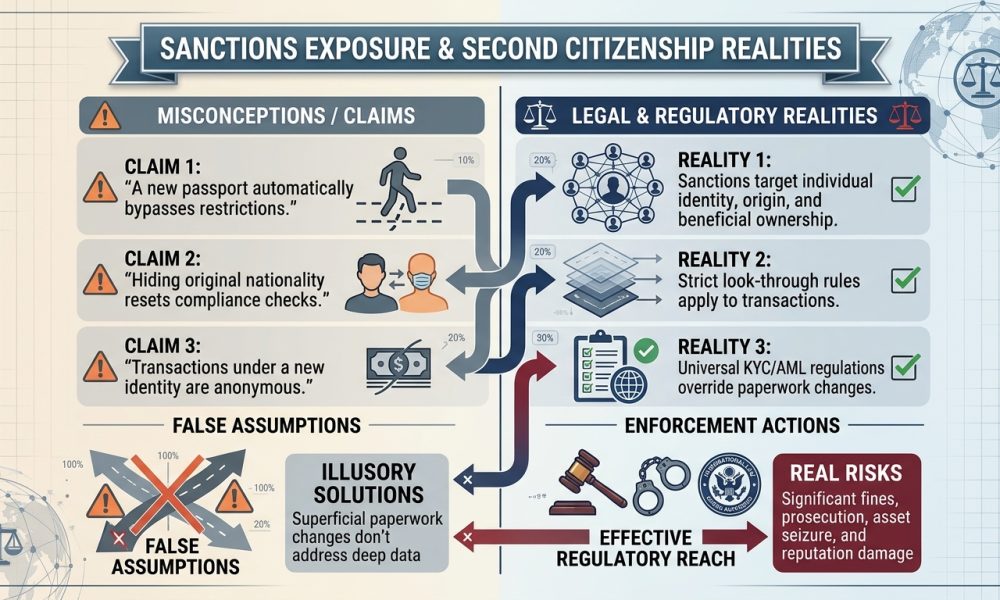
Executives should question suggestions that another nationality automatically resolves sanctions exposure, with any proposed business or financial activity requiring assessment under the rules that apply.
WASHINGTON, DC, November 9, 2026 — International executives, investors, and business owners considering second citizenship face increasingly complex legal questions as economic sanctions affect cross-border banking, corporate ownership, international travel, and the recognition of government-issued identity documents.
Although acquiring another nationality may provide legitimate international mobility and residential opportunities, a second passport does not automatically eliminate sanctions restrictions, authorize otherwise prohibited transactions, or remove the legal consequences of previously established business and financial relationships.
The distinction has become particularly important as governments intensify scrutiny of investment migration programs, foreign ownership structures, and individuals whose commercial activities involve sanctioned jurisdictions, restricted businesses, or entities connected with designated persons.
For applicants evaluating expensive citizenship arrangements, the central question is whether the proposed nationality offers lawful benefits while remaining compliant with sanctions regulations governing their personal circumstances, business activities, financial institutions, and international transactions.
European Citizenship Programs Face Sanctions-Related Scrutiny
International attention has increasingly focused on citizenship-by-investment programs that previously granted nationality to wealthy applicants whose later business activities or political connections drew sanctions from Western governments.
A 2025 Financial Times investigation into Maltese investment citizenship recipients and Russian sanctions identified individuals who had obtained Maltese passports before becoming subject to sanctions or other serious regulatory concerns, highlighting questions about investor screening and subsequent oversight.
The investigation reported that seven individuals who had acquired Maltese nationality were later sanctioned by the United States, European Union, or Ukraine in connection with Russia’s war, illustrating how citizenship approvals can precede significant changes in an applicant’s legal circumstances.
These findings did not establish that every investment citizenship recipient engaged in misconduct. Still, they showed why governments increasingly examine whether nationality programs allow individuals with elevated financial or political risks to obtain additional documentation.
Second, Citizenship Does Not Cancel Existing Sanctions Obligations
Economic sanctions generally operate through legal rules that identify prohibited activities, designated individuals, restricted entities, financial interests, or particular jurisdictions, rather than relying exclusively on the nationality listed in a person’s current passport.
According to the United States Treasury Department’s official guidance on who must comply with OFAC sanctions, American citizens and lawful permanent residents remain subject to applicable American sanctions requirements regardless of where they are physically located.
Consequently, an American executive who acquires citizenship in another country generally remains subject to relevant United States sanctions obligations, even when conducting business overseas or presenting a foreign passport during an otherwise legitimate transaction.
Acquiring additional nationality may change certain immigration or residence rights. Still, it does not independently authorize commercial dealings prohibited by applicable sanctions regulations or remove restrictions affecting property and financial interests.
Sanctions Designations Are Not Determined Solely by Nationality
One of the most significant misunderstandings surrounding sanctions involves the assumption that restrictions apply uniformly to everyone holding a passport from a particular country, regardless of their actual activities or legal status.
In reality, sanctions programs differ considerably: some target specific people or organizations, while others restrict certain industries, financial transactions, territories, or dealings involving designated governments and associated entities.
An individual holding nationality from a heavily sanctioned country is not necessarily personally designated, just as someone holding citizenship from an otherwise unrestricted country may nevertheless be subject to targeted financial sanctions.
For executives, the relevant analysis should identify whether the individual, proposed counterparty, beneficial owner, transaction, or underlying activity falls within an applicable prohibition, rather than relying on assumptions based solely on passport nationality.
A New Passport Does Not Erase a Sanctions Designation
Individuals who become subject to targeted sanctions generally remain affected by the relevant designation until the responsible authority modifies or removes the restriction, even if they later acquire additional citizenship.
A government-issued passport displaying another nationality does not automatically change the identity of the person named in a sanctions designation or invalidate the identifying information maintained by responsible regulatory authorities.
Sanctions records may include identifying details such as dates of birth, previous names, nationalities, addresses, and other information intended to distinguish designated individuals from people with similar personal characteristics.
Changing a legal name or acquiring another passport therefore cannot be responsibly described as a guaranteed way to remove restrictions, particularly when the sanctions continue to apply to the same underlying individual.
Corporate Ownership Creates Sanctions Questions Beyond Passport Identity
International corporations sometimes operate through several subsidiaries, holding companies, investment vehicles, or other legal entities, creating ownership arrangements that require independent examination when sanctions restrictions involve shareholders or individuals exercising control.
Under American sanctions rules, entities owned directly or indirectly at least fifty percent in aggregate by one or more blocked persons are generally considered blocked under OFAC’s ownership policy, even without separate Identification on the primary sanctions list.
This principle shows why establishing a new corporation under an additional nationality does not necessarily remove restrictions on ownership interests, particularly where designated individuals continue to hold substantial financial interests in the organization.
Executives considering international restructuring should therefore obtain qualified legal advice concerning ownership, control, applicable sanctions programs, and transaction-specific restrictions before assuming that incorporating a business abroad changes its regulatory position.
Beneficial Ownership Disclosures Remain Important
Financial institutions and corporate service providers may examine beneficial ownership when assessing international transactions, because identifying the individuals who ultimately own or control an organization can be necessary for sanctions compliance and broader financial risk management.
An applicant’s second passport may establish lawful nationality, but it does not automatically establish who controls corporate assets, receives economic benefits, or exercises authority over businesses operating through multiple jurisdictions.
When a sanctioned individual holds an ownership interest, the legal consequences can depend on the sanctions program, ownership percentage, control arrangements, and whether additional restrictions affect the proposed commercial activity.
Accurate corporate records and beneficial ownership disclosures therefore remain important safeguards for executives seeking legitimate international expansion without creating additional exposure through incomplete or misleading information about their business relationships.
Foreign Banking Access Requires Independent Compliance Review
Second citizenship is sometimes promoted as a way to expand international banking opportunities. Still, financial institutions maintain independent compliance responsibilities that can affect customers regardless of the nationality listed on their Identification documents.
Banks may evaluate sanctions designations, customer residence, beneficial ownership, transaction purposes, source of wealth, and relationships with restricted counterparties before deciding whether to establish or maintain a financial relationship.
An authentic passport does not necessarily overcome these requirements, particularly where the institution identifies restrictions affecting the applicant, associated companies, or funds originating from transactions subject to legal prohibitions.
Executives should consequently distinguish lawful financial diversification from assurances that another citizenship automatically permits transactions that remain restricted under American, European, British, or other applicable sanctions frameworks.
Dollar Transactions Can Create Additional Jurisdictional Questions
International commercial transactions may involve financial institutions, payment processors, or correspondent banking relationships operating within the United States, creating circumstances where American sanctions requirements become relevant even when counterparties are located elsewhere.
Using United States financial infrastructure can introduce regulatory obligations affecting payment execution, particularly when a transaction involves blocked property, designated persons, restricted services, or activities prohibited under an applicable sanctions program.
However, a dollar-denominated transaction does not automatically mean every sanctions prohibition applies, because jurisdiction and liability require examining the actual payment arrangements and relevant legal provisions.
Businesses should therefore assess proposed transactions with qualified compliance professionals rather than assuming a second passport resolves financial restrictions or that every international payment carries the same legal consequences.
Non-American Executives May Also Face Sanctions Exposure
Although American citizens and businesses have extensive obligations under United States sanctions regulations, foreign individuals and companies can also face legal consequences when their conduct involves prohibited transactions or other activities within American jurisdiction.
Certain sanctions programs also restrict foreign persons, particularly when their conduct enables prohibited activity by American persons or meets statutory criteria for secondary sanctions or other enforcement measures.
The precise consequences depend on the governing legal authority, making it inappropriate to suggest that foreign nationality automatically places executives beyond the reach of every American financial or commercial restriction.
For internationally active businesses, responsible compliance planning should identify which countries’ laws apply to the transaction, involved parties, financial institutions, goods, services, and ownership relationships before commercial commitments become binding.
European Sanctions Can Affect Citizens of European Countries
European Union sanctions may restrict assets, transactions, or travel involving designated persons, so citizenship of an EU member state does not automatically eliminate every limitation imposed under applicable European law.
European institutions have examined the consequences of investor citizenship arrangements involving Russian nationals who later became sanctioned, including whether nationality procedures could undermine restrictions established for security and foreign policy purposes.
The European Commission has also emphasized that sanctions-related entry restrictions can remain significant even where an individual possesses nationality that ordinarily provides substantial movement rights within participating European countries.
These developments demonstrate why applicants should distinguish general citizenship privileges from legally imposed restrictions that may apply to particular individuals or transactions despite an otherwise valid European passport.
Citizenship by Investment Screening May Examine Sanctions History
Government-operated citizenship programs may require applicants to disclose previous nationalities, business interests, criminal proceedings, financial relationships, and other information considered relevant to security screening or the integrity of nationality decisions.
An applicant whose financial history involves sanctioned entities may face enhanced examination, requests for additional evidence, or rejection where the applicable program’s requirements prohibit approval under those circumstances.
Private advisers cannot conclusively guarantee that a government will disregard sanctions-related findings, because the ultimate assessment remains subject to relevant legislation, administrative standards, and the authority responsible for citizenship decisions.
Applicants should therefore obtain accurate information about screening procedures before making substantial nonrefundable contributions, particularly when unresolved compliance concerns could materially affect eligibility or the timing of an official decision.
Source-of-Wealth Evidence Can Become Especially Important
Citizenship applications involving substantial financial contributions frequently require applicants to demonstrate the lawful origins of their assets, particularly where commercial activities span several jurisdictions or involve complex corporate arrangements.
Evidence may include business financial statements, audited accounts, property sale documentation, inheritance records, investment statements, and other materials explaining how funds were accumulated and transferred into the proposed citizenship arrangement.
Where sanctions are relevant, the government may need to determine whether the funds or transactions involve restricted persons or activities, independently of whether the applicant meets the published financial threshold.
An applicant with sufficient wealth may still face legal complications if the proposed contribution cannot be accepted lawfully, showing why financial qualification and sanctions compliance must be evaluated separately.
Passport Applications Cannot Resolve Restricted Property Questions.
A citizenship decision concerns recognition or acquisition of nationality, whereas sanctions affecting blocked property or financial interests involve separate legal rules governing whether particular assets may be transferred, managed, or otherwise dealt with.
Even where a foreign government approves an applicant for citizenship, the decision does not necessarily authorize a bank to release blocked funds or permit transactions prohibited by another jurisdiction’s sanctions legislation. An additional passport should therefore not be confused with a license to dispose of restricted property, complete previously prohibited transactions, or access financial services that remain legally unavailable.
When assets are subject to blocking requirements, the appropriate course is to obtain qualified legal advice about the governing restrictions and any applicable authorization procedures before attempting financial transactions.
Sanctions Licenses Are Different From Citizenship Approvals
Certain sanctions frameworks provide mechanisms through which responsible authorities may authorize activities that would otherwise be prohibited, although eligibility depends on the specific program and proposed transaction.
These permissions are separate from nationality applications because they address the legality of specific activities rather than whether an individual qualifies for citizenship through naturalization, descent, or investment.
A passport issued by another government does not substitute for a required sanctions license, just as an authorization permitting a particular transaction does not independently establish eligibility for foreign citizenship.
Executives should avoid treating these different government decisions as interchangeable, particularly where a proposed business investment, asset transfer, or professional service involves several regulatory authorities.
International Travel Privileges Can Be Restricted Independently
Second citizenship may provide additional lawful travel opportunities. Still, sanctions-related travel restrictions can create complications that general comparisons of visa-free destinations or international passport rankings cannot resolve.
A designated individual may face restrictions on admission, transport services, or travel-related financial arrangements, depending on the countries involved and the legal measures applicable to their circumstances.
A valid passport provides key identity and nationality information but does not guarantee that every destination will admit the traveler or override legally applicable entry restrictions.
Applicants should therefore review travel privileges separately from financial sanctions, recognizing that nationality, visa eligibility, and targeted restrictions are related but legally distinct considerations.
Legal Name Changes Do Not Eliminate Historical Identity Records
Executives who lawfully change their names may need to update government IDD, corporate registrations, banking records, and professional documents. Still, those administrative changes generally preserve legally relevant connections to earlier identities.
Sanctions screening may involve previous names, historical records, corporate relationships, and other identifying information, making it inappropriate to assume that a legally recognized name change automatically removes an existing designation.
Where records contain genuine inaccuracies or outdated information, the appropriate response is to seek correction through authorized procedures rather than provide false explanations or conceal information required by regulators.
The integrity of identifying information is especially important during citizenship applications because documentary inconsistencies can generate additional questions concerning eligibility, financial history, and the reliability of submitted evidence.
Anonymous Living and Sanctions Compliance Must Remain Separate
International executives may have legitimate reasons to seek confidential residential arrangements, reduce unnecessary public exposure, and protect personal information. Still, privacy measures must remain consistent with applicable financial disclosure and sanctions requirements.
For individuals evaluating lawful anonymous living and personal privacy planning through Amicus International Consulting, the important distinction is between protecting personal information from unnecessary public disclosure and withholding information legally required by government authorities.
A confidential residence or legitimate privacy arrangement cannot, on its own, invalidate a sanctions designation, remove financial restrictions, or authorize transactions prohibited under laws applicable to the individual or their associated businesses.
Responsible privacy planning should therefore preserve accurate Identification, reliable financial documentation, and compliance with existing legal obligations while limiting unnecessary disclosure through protections permitted by the relevant jurisdictions.
Second Passport Advisers Should Avoid Unsupported Guarantees
Applicants researching second passport services through Amicus International Consulting should understand which nationality pathways are legally available and whether their personal circumstances require additional sanctions, financial, or immigration advice.
Professional advisers can assist with eligibility assessments, authentic documentation, authorized application procedures, and international planning, but they cannot guarantee that another nationality will override sanctions imposed by independent governments.
Any service agreement involving an applicant with potential sanctions exposure should distinguish citizenship-related professional responsibilities from legal conclusions concerning banking eligibility, restricted property, commercial transactions, and international travel.
When sanctions concerns are material, appropriate legal specialists should assess the relevant restrictions before making financial commitments, particularly when citizenship programs involve substantial nonrefundable contributions or significant international investments.
Compliance Reviews Should Precede Major Commercial Decisions
Executives planning international investments should identify relevant sanctions jurisdictions, counterparties, ownership arrangements, financial institutions, and applicable restrictions before proceeding with business transactions that could create additional legal exposure.
A risk-based compliance review can clarify whether particular activities are prohibited, permitted, or subject to government authorization, while recognizing that sanctions programs change and individual circumstances require careful examination.
The review should also consider whether existing contracts, banking arrangements, or professional commitments involve designated entities, particularly where international business structures create overlapping obligations across several legal jurisdictions.
Obtaining additional citizenship may remain a legitimate independent objective, but it should not be presented as the legal solution to restrictions that require separate regulatory analysis.
Credible International Planning Depends on Legal Transparency
The growing intersection of sanctions enforcement and investment migration shows why nationality decisions must be evaluated alongside financial regulation, corporate compliance, personal Identification requirements, and international government cooperation.
For business owners and internationally mobile families, additional citizenship can provide meaningful lawful benefits without automatically lifting restrictions tied to designated persons, blocked assets, or transactions subject to sanctions legislation.
Ultimately, sanctions-related passport claims deserve close examination because acquiring another nationality does not automatically remove existing legal restrictions, and the permissibility of any proposed financial or commercial activity depends on the rules governing the actual circumstances.
A sustainable international strategy should therefore combine authentic citizenship documentation, independent sanctions advice, accurate financial records, and transparent professional services, ensuring that mobility and privacy objectives are pursued without creating additional regulatory or criminal exposure.




