
The African island nation’s emerging citizenship-by-investment program offers a contribution-based route through its National Transformation Fund. Still, applicants must examine government authorization, family eligibility, administrative delays, financial requirements, and actual international travel privileges before relying on advertised affordability.
WASHINGTON, DC, November 7, 2026 — São Tomé and Príncipe is emerging as a new participant in the international second citizenship market, offering a government-authorized contribution pathway that has attracted interest from applicants comparing affordability, family inclusion, and alternatives to Caribbean investment migration programs.
The Portuguese-speaking island nation in the Gulf of Guinea off Central Africa introduced its citizenship-by-investment framework in 2025, linking foreign contributions to national development objectives while establishing procedures for background screening, official approvals, and nationality documentation.
Although the program advertises a comparatively low contribution threshold, prospective applicants must distinguish financial accessibility from overall suitability, particularly as administrative changes, restrictions affecting certain applicants, and delays between approval and passport delivery complicate straightforward comparisons.
A New Citizenship Program Expands the International Market
São Tomé and Príncipe established its citizenship-by-investment framework through Decree-Law No. 07/2025, which entered into force on August 1, 2025, building upon the country’s existing nationality legislation and creating an additional route for qualifying foreign applicants.
Unlike citizenship through ancestry or conventional residence-based naturalization, the new arrangement allows eligible individuals to seek nationality through a prescribed contribution, subject to government evaluation and completion of the applicable legal and administrative requirements.
Its arrival offers another option for internationally mobile families. Still, the program’s relatively short operating history means applicants have less long-term evidence about administrative consistency, passport renewals, and regulatory stability than they might find elsewhere.
The National Transformation Fund Provides the Contribution Route
The program’s principal financial pathway involves a nonrefundable contribution to the National Transformation Fund, which the government established to support development priorities involving infrastructure, energy, tourism, and other sectors considered important to economic diversification.
The government has described the initiative as an opportunity to attract additional international capital while maintaining legal oversight, emphasizing that applicants must satisfy official requirements rather than obtain nationality solely through an unrestricted financial transaction.
For applicants, the contribution represents a permanent expenditure rather than a conventional investment offering ownership, dividends, or capital repayment, making the financial calculation fundamentally different from purchasing a business or income-producing property.
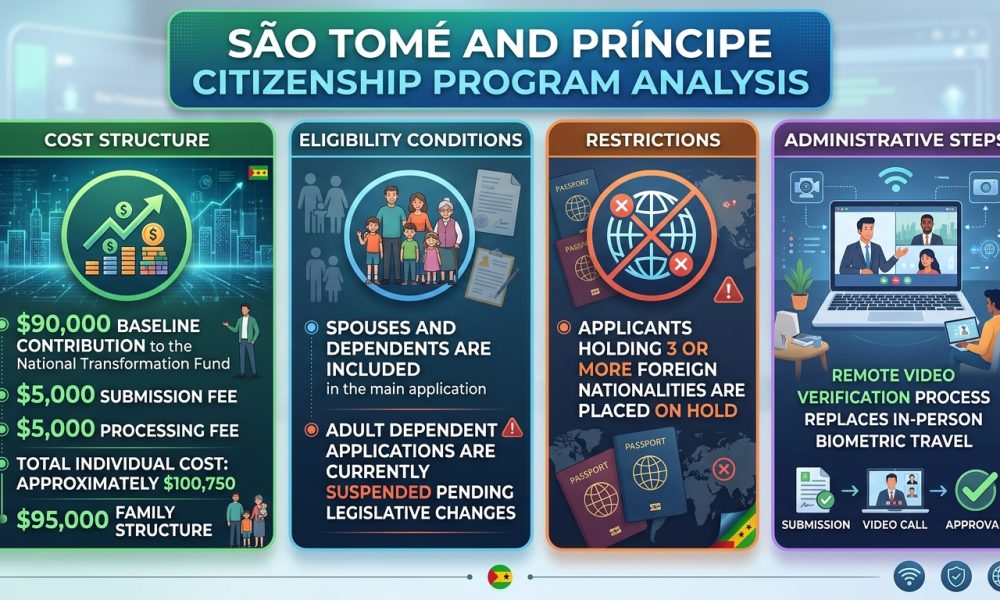
The Published Individual Contribution Begins at US$90,000
Program materials currently identify a US$90,000 minimum contribution for an individual applicant, placing São Tomé and Príncipe below the starting contribution thresholds advertised by several established Caribbean citizenship-by-investment jurisdictions.
However, that amount should not be interpreted as the full price of obtaining nationality, because government submission charges, processing expenses, document issuance fees, and professional services can increase the actual financial commitment.
A lower contribution threshold may attract cost-conscious applicants. Still, the relevant comparison must include eligibility, administrative reliability, travel rights, and the likelihood that the resulting nationality satisfies the applicant’s actual international objectives.
Additional Government Charges Change the Total
Published program materials identify a US$5,000 submission fee, a US$5,000 processing fee, and US$750 in document issuance charges for an individual applicant, in addition to the qualifying National Transformation Fund contribution.
On that published schedule, the principal government-related payments for a single applicant total approximately US$100,750 before separate professional services, document preparation, translations, international transfers, or any additional requirements arising from individual circumstances.
Applicants should obtain an updated written quotation through an appropriately authorized representative before transferring funds, because fee schedules and administrative procedures can change as a relatively new citizenship program develops its operating systems.
Family Applications Offer a Different Contribution Structure
The program’s published contribution schedule lists US$95,000 for a qualifying family with two to four members, with an additional US$5,000 contribution generally applying for each additional eligible dependent beyond the initial household category.
That structure can look attractive compared with programs requiring substantially higher family contributions. Still, individual document issuance charges, eligibility conditions, and government processing expenses still matter to the total cost.
Families should confirm exactly which relatives qualify before selecting a contribution category, because an advertised household price does not automatically confirm that every spouse, adult child, parent, or other family member can receive citizenship.
Adult Dependent Eligibility Has Become a Significant Concern
An important development emerged in 2026 when the citizenship administration acknowledged that legislative clarification was needed on whether adult dependent children and certain other family members could be included under the investment program.
A September 21, 2026, notice published by São Tomé and Príncipe’s consular representation in Germany explained that affected adult family applications could be submitted and considered, while the naturalization and passport issuance stages remained suspended pending legislative changes.
This distinction matters for multigenerational households, because preliminary eligibility discussions or favorable administrative progress cannot be treated as guarantees that an adult relative will receive a completed citizenship certificate and passport.
Applicants With Multiple Existing Nationalities Face Restrictions
The program’s Citizenship by Investment Unit issued an April 10, 2026, memorandum explaining that it was placing applications from individuals already holding three or more foreign nationalities on hold pending changes to the governing nationality legislation.
That restriction is particularly relevant to internationally mobile applicants who already possess several passports, because eligibility cannot be assumed merely because the applicant satisfies the financial contribution requirement and has no criminal history.
Prospective applicants must therefore disclose their full nationality history and seek current guidance on eligibility, especially when promotional materials broadly describe the program as available to applicants from many different countries.
Official Administrative Changes Have Affected Passport Issuance
The April 2026 memorandum also described changes allowing remote issuance procedures for national identity documentation, replacing earlier requirements for in-person biometric enrollment at designated government or diplomatic locations.
The revised arrangement included video verification through the responsible civil registry authorities, potentially reducing the need for applicants to travel internationally solely to complete an administrative stage of their nationality documentation.
Nevertheless, remote verification should not be confused with automatic approval, because applicants remain subject to identity checks, government decision-making, citizenship registration, and the separate legal processes required before an ordinary passport becomes available.
Early Program Data Reveals an Approval-to-Issuance Gap
A September 2, 2026, Investment Migration Insider report examining São Tomé and Príncipe’s first-year citizenship statistics described 548 applications, 350 approvals, and 12 refusals during the program’s initial reporting period.
The same report identified 117 citizenship grants and 29 passports issued, illustrating how administrative approvals can substantially exceed completed naturalizations and physical document deliveries during the early operation of a citizenship initiative.
Those figures do not establish that every outstanding applicant will eventually be refused or delayed indefinitely, but they demonstrate why promotional processing estimates must identify the precise milestone being measured.
Processing Estimates Should Cover the Complete Application
Commercial materials describe government review periods of about eight weeks. Still, that figure should not be interpreted as a guaranteed timeline from first inquiry to physical possession of a usable passport.
Document collection, source-of-funds verification, government examination, formal approval, contribution payment, nationality registration, and passport production can occur at different stages, each potentially introducing delays that vary with the applicant’s circumstances.
Families should therefore request separate estimates for initial preparation, government decision-making, legal recognition of citizenship, and final document issuance before making international travel or relocation commitments based on an advertised completion period.
Government Approval Remains a Sovereign Decision
The legal framework provides for official examination of citizenship applications, including review by the responsible administrative authorities and participation by the public prosecution service under the procedures established in the applicable decree-law.
Applicants must meet documentary and financial requirements before the responsible government institutions determine whether the application qualifies, meaning the contribution does not automatically create a right to approval.
Private intermediaries can help assemble applications and communicate with officials, but no representative can lawfully replace a government nationality decision or guarantee an applicant will pass mandatory screening.
Contributions Are Generally Due After Preliminary Approval
Program materials indicate that the principal National Transformation Fund contribution is ordinarily payable after the citizenship authority grants approval in principle, distinguishing the major qualifying payment from earlier submission and processing expenses.
This arrangement can reduce exposure to the full contribution before a preliminary decision. However, applicants may already have incurred nonrefundable government charges, professional fees, and document preparation expenses during the screening process.
A responsible financial plan should identify each payment milestone and the circumstances governing refusal or withdrawal, rather than assuming that all money transferred during an unsuccessful application will be returned.
Source-of-Funds Documentation Remains Important
Applicants should expect questions about how they accumulated their wealth and where the specific money intended for the citizenship contribution originated, particularly when financial arrangements involve businesses, investments, inheritances, or international transfers.
Supporting records may include bank statements, corporate ownership documents, employment information, property sale agreements, and other evidence appropriate to the applicant’s circumstances and the government’s current verification standards.
A comparatively affordable contribution does not remove financial integrity obligations, because a legitimate citizenship program must evaluate whether applicants satisfy its legal standards independently of their willingness and ability to pay.
The Development Fund Serves National Economic Objectives
São Tomé and Príncipe’s government has presented the National Transformation Fund as a mechanism for supporting public projects, including energy improvements, infrastructure, healthcare, education, and development initiatives intended to strengthen the country’s economic capacity.
The International Monetary Fund’s assessment of the country’s 2026 budget also identified expected receipts from citizenship-by-investment activity, reflecting the government’s interest in incorporating the program into its broader public financing strategy.
However, announced development priorities and projected revenue should be distinguished from audited expenditure and completed projects, because credible public accountability requires information about actual collections, fund allocations, and measurable results.
A Lower Contribution Does Not Guarantee Superior Travel Access
The practical value of another nationality depends partly on destinations available without advance visas. Still, foreign governments set those arrangements and can change them independently of the country issuing the passport.
São Tomé and Príncipe does not offer the same visa-free access to the European Schengen Area or the United Kingdom as certain established Caribbean passports, so broad comparisons based solely on acquisition costs can be misleading.
Applicants interested in European residence, British business travel, or American immigration opportunities should review the destination’s official rules before assuming an inexpensive second passport provides the international access they need.
Portuguese Language Connections Do Not Create Automatic EU Rights
São Tomé and Príncipe belongs to the Community of Portuguese Language Countries, providing cultural, diplomatic, and regional connections with other Portuguese-speaking states, including Portugal, Brazil, and several African nations.
Membership in that community should not be confused with Portuguese citizenship or EU citizenship, because a São Toméan passport does not independently grant unrestricted residence or employment throughout EU member states.
Any mobility advantages associated with Portuguese-speaking country agreements must be evaluated under the specific immigration rules of the intended destination, particularly when families hope to establish permanent residence rather than make short visits.
Citizenship Should Be Evaluated Against Actual Residence Objectives
A second nationality can provide a legal connection to its issuing country, including applicable residence rights. Still, those benefits may be less relevant when the applicant has no intention of living or conducting business there.
Families considering São Tomé and Príncipe should examine local healthcare, accommodation, education, employment opportunities, transportation, banking access, and international connectivity before concluding that the nationality provides a practical relocation alternative.
The country’s affordability may matter less when the applicant’s main goal is to settle elsewhere, because immigration permission in a third country generally requires a separate application and compliance with different requirements.
Americans Must Consider Continuing Legal Responsibilities
The U.S. Department of State’s official guidance on dual nationality explains that American citizens may hold another nationality while still facing applicable U.S. legal obligations and passport requirements.
Acquiring São Toméan citizenship does not automatically end American federal tax responsibilities, remove financial reporting obligations, or establish an unrelated personal identity recognized by banks and government authorities.
Applicants maintaining businesses, retirement investments, trusts, or family property across borders should seek qualified cross-border advice before assuming another passport creates tax advantages, anonymity, or legal protections unrelated to citizenship itself.
Passport Authentication Cannot Resolve Every Eligibility Question.
Modern biometric passports contain electronic identity information and security mechanisms that compatible inspection systems can examine. Still, a successful scan cannot independently establish the legal basis of nationality or confirm that administrative restrictions have been resolved.
Amicus International Consulting explains these distinctions in its guide on how to scan a passport’s NFC chip and understand the results, separating document authentication from citizenship recognition and current government validity.
An authentic passport can still be expired, canceled, or unsuitable for a particular journey, making official records and current destination requirements more important than unsupported assurances about electronic document scanning.
Authorized Representation and Contracts Deserve Scrutiny
Applicants should verify whether the individual or company offering citizenship services has current authorization to operate within the government’s approved application framework, especially as new programs attract international marketing agencies and commercial intermediaries.
Written agreements should distinguish government contributions, application charges, due diligence expenses, professional services, refund provisions, and administrative responsibilities, and payment instructions should be independently confirmed before transferring substantial funds.
A low advertised starting price is of limited value when the contract fails to identify the responsible authority, the application’s legal stage, or the circumstances under which funds become nonrefundable.
Professional Planning Should Compare Complete Household Outcomes
Families exploring lawful second passport options through Amicus International Consulting should begin by identifying their eligibility, nationality history, proposed dependents, available financial resources, and intended residence or travel objectives.
A comprehensive assessment should also distinguish initial government approval from formal citizenship recognition and passport issuance, especially where restrictions on adult dependents or administrative backlogs could affect the household’s international planning.
Professional coordination can help organize legitimate applications and explain the relevant procedures. Still, the issuing government makes the final decision, and no private representative can guarantee nationality or international entry privileges.
The Program’s Newness Requires Particular Attention
Established citizenship programs have accumulated years of application history, administrative practice, and international regulatory scrutiny. At the same time, São Tomé and Príncipe’s newer offering has had less time to demonstrate consistent processing outcomes.
The program’s first-year statistics and 2026 administrative updates show why prospective applicants should request current evidence about completed citizenship grants and passport deliveries rather than relying entirely on projected government decision times.
Future improvements may resolve specific operational difficulties, but applicants should base decisions on current requirements and administrative conditions rather than assuming every anticipated legislative amendment will arrive on schedule.
Affordability Is Only One Measure of Citizenship Value
São Tomé and Príncipe’s contribution model may appeal to individuals seeking a comparatively inexpensive government-authorized citizenship opportunity, especially when purchasing qualifying real estate is neither financially attractive nor relevant to their plans.
Nevertheless, the complete comparison must consider family eligibility, restrictions involving existing nationalities, government screening, document delivery, international travel privileges, and the practical rights available after naturalization.
Ultimately, São Tomé and Príncipe ranks second in passport comparisons as an emerging option whose advertised affordability deserves examination. Still, a sound decision depends on verified government terms, reliable administrative outcomes, and whether the nationality provides meaningful benefits for the applicant and family.




