
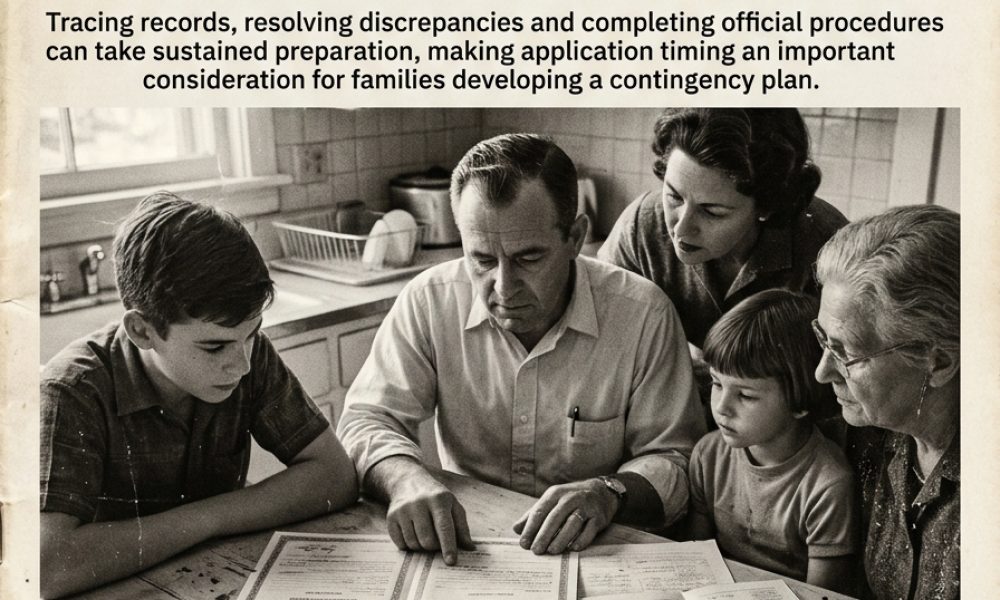
Ancestral nationality can provide valuable future residence rights, but locating historical documents, resolving inconsistencies, satisfying government requirements, and obtaining travel credentials demand preparation that cannot reliably be compressed into an emergency departure.
WASHINGTON, DC, November 5, 2026 — Families seeking a second citizenship as Protection against political uncertainty, economic disruption, or unexpected personal circumstances may find their biggest constraint is not eligibility itself, but the time needed to establish and document it.
An ancestral connection can create a genuine entitlement under the relevant nationality law, yet obtaining official recognition may involve multiple generations of civil records, government correspondence, identity verification, and processing periods beyond the applicant’s control.
Those administrative realities make early preparation essential, because a citizenship claim still under investigation during a relocation emergency may offer little immediate help with airline boarding, lawful settlement, or the separate immigration needs of accompanying relatives.
A Legal Entitlement and a Ready Passport Are Different Things
Citizenship acquired automatically through birth or descent can exist before an individual receives a passport. Still, airlines and foreign authorities generally require acceptable contemporary documentation rather than an unsupported explanation of family heritage at departure.
A person may have a strong claim through a Canadian parent or an Irish grandparent but still need an official certificate, registration, or passport before that nationality becomes a practical international travel option.
Families should distinguish the legal status they may already have from the documents they can present, since confusing those questions can create misplaced confidence during time-sensitive travel or relocation decisions under the rules currently applied by authorities.
Demand Can Expand Faster Than Administrative Capacity
An Associated Press report on Canada’s expanded citizenship-by-descent rules described a surge of American interest after the December 2025 reforms, including people investigating distant ancestral ties while considering future mobility, family opportunities, and personal security.
The report described significant pending application volumes and processing delays, showing why newly recognized eligibility does not necessarily translate into a quick certificate or an immediately usable second passport for every applicant when the entire family expects to relocate.
Periods of unusually high demand can affect appointments, responses, and review queues, so families should avoid extrapolating from an acquaintance’s earlier approval or a promoter’s advertised timeline when making costly departure commitments during a period of unusual administrative demand.
Family Research Often Starts With Missing Documents
A citizenship inquiry may begin with a grandparent’s birthplace and a handful of family papers. Still, official applications can require a reliable documentary chain identifying each parent-child relationship between that ancestor and the applicant.
Older birth certificates may be stored in provincial archives, municipal registries, church collections, or overseas civil offices, each operating with distinct record-search procedures, access conditions, fees, and turnaround periods under the varied procedures of those original custodians.
Applicants can save time by identifying the original record custodians early, recording alternate spellings and locations, and requesting authentic records rather than assuming commercial genealogy results will satisfy government evidence standards before making any substantial financial commitments overseas.
Official Records Carry More Weight Than Family Stories
Family histories can provide useful leads, but a relative’s recollection that an ancestor was Canadian or held another nationality does not necessarily establish citizenship under legislation in force when earlier generations lived across jurisdictions.
Canadian guidance, for example, calls for authentic, reliable, verifiable documents issued by original authorities for every relevant generation. At the same time, third-party family research ordinarily cannot independently substantiate the full legal claim under published evidence requirements and procedures.
If an applicant cannot locate an original record, they may need to document attempts to obtain it and provide acceptable alternative evidence, which may include additional correspondence. At the same time, the authority evaluates the application as submitted.
Small Discrepancies Can Create Lengthy Questions
Names may appear differently across immigration files, birth certificates, marriage records, and later Identification, especially when families moved between languages or jurisdictions and clerks transliterated information using inconsistent historical conventions across several countries and distinct civil registries.
A discrepancy does not necessarily invalidate a genuine claim. Still, authorities may require an explanation supported by official correction records, marriage documents, legal name-change orders, or other evidence connecting the same individual across records.
Resolving those issues before submission can reduce avoidable delays. However, applicants should never manufacture missing entries or change historical facts merely to produce a cleaner documentary sequence for an application, which could create additional problems during official review.
Birth and Naturalization Dates Can Determine Eligibility
Citizenship-by-descent rules sometimes depend on whether a parent naturalized elsewhere before or after a particular child’s birth, whether an ancestor retained nationality, or whether registration occurred within a statutory deadline under the nationality legislation then in legal force.
That makes chronological accuracy essential, because two relatives sharing the same ancestor may reach different outcomes when their births, parental citizenship, or family registrations occurred under different versions of the law because earlier legal requirements may have differed significantly.
A careful timeline can identify which records matter most and prevent applicants from paying for extensive submissions based on the assumption that every descendant of a qualifying ancestor receives identical treatment without a reliable foundation for nationality recognition.
Legislative Changes Can Open Doors Without Eliminating Review
Canada’s reforms effective December 15, 2025, expanded recognition for certain descendants born abroad before that date, while introducing different substantial-connection requirements for some children born abroad afterward to Canadian parents also born overseas.
A family may therefore discover newly available rights for existing adult relatives, yet still need to determine whether future children qualify through a parent’s documented physical presence before their births under the rules specifically governing those later births.
Government changes can alter eligibility and create new demand at the same time, reinforcing the importance of checking current rules rather than relying on outdated websites, past refusals, or generalized marketing descriptions when applicants consider making expensive international commitments.
Applications Do Not All Follow the Same Legal Route
Proof of citizenship for someone already recognized under nationality law differs from naturalization after residence, registration by descent, or citizenship acquired through a government-authorized investment procedure in another jurisdiction, rather than through a single interchangeable administrative route.
Each route can involve different forms, qualifying events, application fees, background checks, interviews, and documentary evidence, making a universal promise of rapid second citizenship misleading even when one specific program offers comparatively streamlined processing.
Families should identify the precise legal basis of every proposed application before estimating dates, because preparation for the wrong procedure can consume resources without moving anyone closer to an approved travel document before committing to housing or international transportation.
Published Processing Times Are Not Departure Guarantees
Government processing estimates may reflect completed cases rather than a binding deadline for new applicants, and complex files can require extra verification, requests for information, or review of historical documentation when applications involve historical or difficult-to-verify evidence.
Canadian authorities explicitly acknowledge that applications outside Canada and the United States may involve additional mailing time, and that complexity or incomplete materials can change the duration of the official assessment under the government’s current published administrative instructions.
The safest planning assumption is that quoted timelines may shift, particularly where original certificates must cross borders or an application cannot proceed until a missing record is located and verified during periods of high demand or disruption.
Urgent Processing Is Limited and Must Be Justified
Some authorities recognize exceptional circumstances that may warrant urgent treatment. Still, those procedures usually require a qualifying reason and supporting evidence, not a simple declaration that the applicant wishes to relocate quickly.
Canada, for example, permits requests for urgent citizenship-certificate processing in certain hardship or other specified situations, while retaining discretion to assess whether the relevant circumstances and documents justify priority consideration rather than promising immediate approval for every applicant.
Families should explore official emergency options when appropriate, but not as a substitute for planning, because urgent requests can still fail or require information unavailable during a crisis, even when the family has pressing travel plans.
Family Members May Require Separate Applications
A parent who successfully establishes foreign citizenship does not automatically resolve the immigration status of a spouse, adult child, or dependent relative, and different family members may qualify under different nationality provisions, depending on the rules governing each relative’s status.
Some children may inherit nationality automatically, while others require registration or proof of a parent’s earlier residence, and spouses commonly need separate sponsorship or other lawful immigration permission before long-term settlement, especially where different dates of birth affect eligibility.
Coordinating each person’s status in advance helps avoid situations where one relative can board an aircraft immediately. At the same time, other household members may not be able to travel or reside at the destination as international travel deadlines approach.
Children’s Documents Add Another Layer of Preparation
Parents may need individual passports for every child, along with birth records, custody information, consent documentation, or proof of citizenship that has never previously been requested for a minor born outside the ancestral country.
Application procedures may also require parental signatures or official recognition of an adoption, and those issues can become more complicated when one parent lives abroad, or relevant family orders were issued elsewhere before authorities can complete their review.
An emergency relocation plan should therefore account for the youngest family member’s records instead of focusing exclusively on the principal applicant’s second passport or the adults’ existing travel permissions while separately addressing legal requirements affecting younger travelers.
A Second Citizenship Does Not Cancel American Requirements
The U.S. Department of State’s guidance on dual nationality explains that American dual nationals must enter and depart the United States using U.S. passports, even when they also hold another country’s valid travel documents.
An additional citizenship can create valuable residence rights abroad. Still, it does not automatically erase existing United States legal responsibilities or provide a universal exemption from the destination’s entry and documentation procedures, even where both documents remain otherwise legally valid.
Households should examine passport validity, airline requirements, and the rules of every transit country before committing to a journey, particularly when their proposed route involves several borders or family members with different nationalities.
Passport Issuance Can Follow Citizenship Recognition
Even after an authority confirms citizenship, the individual may still need a separate passport application involving photographs, identity evidence, fees, and additional government review before obtainingbefore obtaining a document acceptable for ordinary international travel, especially when the family has a pressing reason to depart.
Some applicants assume a nationality certificate doubles as a travel document, but it may instead demonstrate citizenship when applying for the passport that will later support boarding and immigration inspection.
A realistic timetable should include this final stage, especially where appointment availability, delivery logistics, or an upcoming expiration date can affect the usefulness of an otherwise successful nationality decision, particularly when the applicant is applying from abroad.
Digital Passport Checks Cannot Replace Official Decisions
Electronic passports may contain contactless chips and cryptographic protections that compatible readers can inspect. Still, these features do not independently establish that a citizenship application has been approved or a person’s immigration status remains valid.
Amicus International Consulting’s guide to scanning a passport’s NFC chip and understanding the results explains why reading stored information differs from examining digital authenticity and confirming official document status through the appropriate issuing authority.
A successful smartphone scan cannot provide missing ancestral evidence, complete an incomplete application, or turn a prospective citizenship claim into a government-issued passport for an urgent international departure when travel arrangements are being made under pressure.
Practical Relocation Tasks Have Their Own Timelines
Housing, employment, schools, medical coverage, and local banking arrangements may require planning independently of citizenship, particularly when the household has never lived in the destination or lacks established community connections and may take longer than the nationality application itself.
A second nationality may permit lawful residence and work in its issuing country. Yet, professional licenses, lease requirements, financial Identification, and school admissions can still require separate approvals or documentation before any family member commits to living overseas.
Families should map those dependencies alongside the citizenship application so that receiving a passport does not trigger a rushed departure into unfamiliar circumstances without adequate accommodation, income, or healthcare arrangements, especially when several family members must travel together.
Contingency Planning Works Best Before Pressure Builds
A family can begin by checking legal eligibility, identifying the relevant civil-record authorities, and creating an organized timeline of applications, document requests, possible corrections, and passport issuance requirements well before the family must navigate unfamiliar systems.
Keeping secure copies and tracking responses from original custodians can reduce repetitive work. At the same time, independent legal advice may help when historical nationality laws, adoption, or conflicting documents add complexity, and it can also support the practical move itself.
These preparations preserve options without predicting a crisis, and they reduce the temptation to rely on unverified intermediaries promising instant citizenship through undocumented connections or invented personal histories instead of meeting the requirements of official agencies.
Early Preparation Turns a Potential Right Into a Usable Option
A legitimate ancestry claim can provide lasting mobility and residence opportunities. Still, its practical value during upheaval depends on completing the official steps long before an urgent departure becomes necessary.
Families who begin early can address missing records, clarify each relative’s status, and plan realistic settlement arrangements rather than discovering under pressure that even an apparently straightforward application requires sustained administrative attention without accepting questionable promises of instant approval.
Ultimately, citizenship applications need time before a relocation crisis because lawful nationality recognition is an evidence-based government process. At the same time, a dependable contingency plan requires verified status, valid travel documents, and preparation for life after arrival.




