
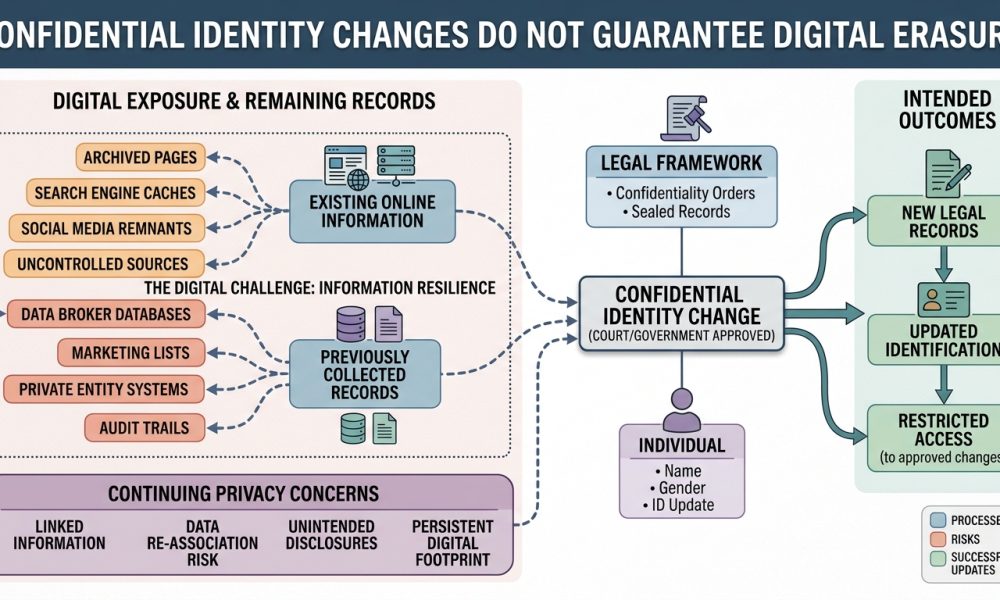
Existing online information, archived public records, commercial data broker databases, search engine results, and previously collected identifying details can keep raising privacy concerns after a court or government agency approves a confidential legal name change, especially for survivors seeking Protection from harassment, stalking, or unwanted Identification.
WASHINGTON, DC, October 29, 2026 — Americans obtaining confidential legal name changes to protect their personal safety or limit unwanted public exposure increasingly confront a difficult reality: government approval of a New Legal Identity does not automatically eliminate historical information already circulating through commercial databases, internet archives, financial records, and digital platforms.
Although courts may seal certain proceedings, restrict publication of identifying information, or authorize confidential name changes under applicable state laws, these protections generally operate within defined legal boundaries rather than automatically requiring unrelated private companies to erase previously collected personal information.
For survivors of domestic violence, stalking, harassment, identity theft, and other circumstances involving legitimate privacy concerns, the distinction between legally recognized identity changes and comprehensive digital erasure has become increasingly important as personal information moves between public records, commercial databases, and online services.
The resulting challenges go beyond ordinary internet searches because historical names, residential addresses, employment histories, property transactions, and other identifying details may remain accessible through systems that operate independently of the courts or agencies that approve confidential changes.
A Confidential Name Change Does Not Erase Existing Digital Records
A confidential legal name change generally authorizes the individual to use a newly recognized name while potentially restricting access to specified judicial information. Still, it does not automatically invalidate historical records created before the change.
Government agencies, financial institutions, employers, educational organizations, and other entities may retain previous identifying information for legitimate administrative, contractual, regulatory, or historical purposes, even when an individual’s current legal name has been updated through appropriate procedures.
These records can remain associated with the individual because legal name changes ordinarily preserve continuity of rights and obligations, including existing financial contracts, citizenship status, professional qualifications, property interests, and other legally significant relationships.
The existence of such records does not necessarily indicate that confidentiality protections have failed, since those protections may restrict particular forms of public disclosure without requiring every institution to destroy information maintained under separate legal obligations.
Data Brokers Present Continuing Privacy Challenges
Commercial data brokers collect and organize information from numerous sources, including public records, commercial transactions, online activities, and other available datasets, sometimes producing detailed profiles that connect individuals with previous names, addresses, relatives, and professional relationships.
These activities can create privacy concerns when individuals obtain confidential name changes because information assembled before the legal transition may remain available through people-search websites or other commercial systems that were never directly involved in the original court proceedings.
An August 12, 2025, WIRED investigation on data brokers and hard-to-find deletion procedures described how more than 30 data brokers made their removal instructions less discoverable through ordinary search engines, complicating efforts by consumers seeking to exercise privacy rights.
The investigation, conducted by The Markup and CalMatters and published in cooperation with WIRED, highlighted how the practical accessibility of privacy controls can affect consumers even when legal mechanisms exist for requesting the removal of personal information.
For individuals whose safety depends on reducing unnecessary public exposure, these difficulties demonstrate why obtaining a confidential legal name change should not be confused with the automatic disappearance of previously collected information from commercial databases.
Search Engine Results and Original Records Are Different Systems
Search engines generally organize and display references to information published elsewhere, meaning removing a particular result from search listings does not necessarily eliminate the underlying material maintained by the website, organization, or database that originally published it.
A person may successfully request that certain identifying information be excluded from search results. At the same time, the original webpage remains accessible through direct navigation, alternative search services, archived copies, or other legitimate methods of locating the underlying information.
Conversely, removing material from its original website may not immediately eliminate references appearing in search engines or other services that previously indexed the information, particularly when those systems require additional processing before updated records appear.
These distinctions matter because consumers often interpret a search result’s disappearance as proof that information has been permanently deleted, even though copies or historical references may remain elsewhere.
A legally sound privacy strategy should therefore distinguish the publication of information, search engine indexing, commercial redistribution, and institutional recordkeeping, because each process operates under different technical conditions and potentially different legal requirements.
Federal Consumer Guidance Recognizes the Limits of Data Removal
The Federal Trade Commission has acknowledged that people-search websites may expose sensitive information, including residential addresses, telephone numbers, family relationships, and other personal details that consumers may reasonably prefer to keep outside ordinary public searches.
Its official guidance on people-search websites and information removal requests explains how individuals can request certain removals, while recognizing that data may remain available through other sources or reappear when commercial databases obtain updated records.
The guidance also explains that removal requests do not automatically delete underlying public records, so individuals seeking confidentiality may need to distinguish a commercial website’s information practices from the records government agencies originally collected.
For survivors seeking Protection through confidential name changes, this distinction matters because a successful request to one commercial provider may not affect another provider holding similar information from an independent source.
Consumers should also consider the information required to verify a removal request, since some providers ask for additional identifying details that may raise legitimate concerns about unnecessary disclosure to organizations that already have sensitive personal data.
Public Records Can Preserve Historical Identity Information
Public records concerning property ownership, court proceedings, professional licensing, business registrations, and other government activities may contain historical identifying information that was accurate when the underlying transaction or administrative event occurred.
A later confidential name change does not necessarily authorize altering or destroying those earlier records, especially when separate statutes govern public access, document retention, property rights, or the preservation of official historical information.
For example, a property transaction completed under a previous legal name may remain associated with that name in historical ownership records, even when the individual subsequently receives updated Identification documents reflecting a legally approved change.
The availability of confidentiality protections for such records depends on the governing jurisdiction and applicable legal procedures, making it important to distinguish specifically protected judicial filings from unrelated records held by other agencies.
Individuals concerned about disclosure should seek appropriate legal guidance on available protections rather than assuming a court order restricting access to one proceeding automatically extends to every public record containing the former name.
Old Residential Addresses Can Remain Connected to Individuals
Residential history represents a particularly sensitive category of information for survivors who relocate because of threats, stalking, domestic violence, or other circumstances in which disclosure of personal locations may create serious safety concerns.
Historical addresses may appear in property records, consumer reports, commercial directories, archived webpages, and other systems that continue retaining information even after a person changes their name or establishes a protected mailing address.
Address confidentiality programs can provide important safeguards for eligible individuals. Still, their Protection generally depends on state law and may not automatically cover every existing commercial database or historical government record.
Consequently, a substitute mailing address should not be understood as a guarantee that all previous residential information has disappeared, particularly when earlier records were lawfully collected or published before the individual entered the program.
Victim advocates and qualified legal professionals can help individuals understand the scope of available protections while avoiding the assumption that administrative enrollment alone creates comprehensive digital anonymity.
Social Media and Archived Content Create Additional Exposure
Social media platforms, professional networking services, discussion forums, and older online profiles may contain photographs, identifying details, location references, and personal relationships established long before an individual obtained a confidential legal name change.
Even when a person updates a profile or closes an account, other users may still be able to access information previously shared through comments, tagged photographs, copied content, or independent publications outside the original account holder’s control.
Archived online material can create similar complications because preservation services or previously created copies may keep historical content available, although availability and removal procedures differ by platform and circumstance.
These challenges can affect individuals whose former names no longer appear on current government Identification, since historical online references may still link past information to professional activities, relatives, or earlier locations.
A coordinated privacy review can help identify unnecessary exposure, but no ordinary administrative procedure can guarantee the recovery or deletion of every copy previously distributed through independent online systems.
Commercial Privacy Services Cannot Promise Universal Deletion.
A growing commercial privacy industry helps identify personal information, prepare removal requests, and monitor participating data broker websites, reflecting consumer demand for greater control over information distributed through online databases.
These services may offer practical benefits by reducing unnecessary public exposure. Still, their effectiveness depends on which providers they cover, applicable legal rights, cooperation from information holders, and the continued availability of underlying data sources.
Some providers may remove selected records while retaining information legally exempt from deletion, needed for contract administration, or kept in systems outside the privacy service’s operational control.
Consumers should therefore evaluate promises of complete digital disappearance cautiously, particularly when advertisements imply that a single payment can permanently remove every historical reference to an individual’s previous legal identity.
A responsible service description should explain the categories of information addressed, available legal remedies, meaningful limitations, and the circumstances under which removed information may subsequently reappear through independently maintained records.
Financial Institutions Retain Legitimate Identification Responsibilities
Banks, investment firms, insurance companies, and other regulated financial institutions maintain customer records that may include previous names, historical addresses, account information, and documentation supporting the original establishment of financial relationships.
A confidential name change may require institutions to update current Identification information. Still, it does not necessarily eliminate their responsibilities to preserve transaction histories, maintain accurate ownership records, or comply with applicable regulatory retention requirements.
Financial institutions may also require evidence connecting previous and current names when processing account changes, particularly when substantial assets, existing contractual rights, or concerns about unauthorized activity make identity continuity important.
These requirements can coexist with legitimate privacy protections because restricted public disclosure and authorized institutional verification serve different purposes. However, institutions should handle sensitive documentation in accordance with applicable confidentiality and information security obligations.
For survivors, clear communication with the right institutional personnel can help create accurate records while minimizing unnecessary disclosure, especially when a confidential court order or protected residential address adds administrative complexity.
Credit Histories Usually Continue Across Legal Name Changes
Consumer credit reporting systems generally try to preserve continuity between financial accounts tied to the same individual, so a legally approved name change does not automatically create an entirely new credit history.
Existing loans, credit cards, payment records, and other reportable financial relationships may remain connected to the consumer through identifying information maintained by reporting agencies and the institutions that supply account data.
This continuity can benefit individuals possessing favorable credit histories because established payment records may remain relevant when applying for housing, financing, insurance, or other services that consider legitimate financial information.
However, survivors who experienced financial abuse or unauthorized borrowing may encounter additional complications involving disputed accounts, inaccurate records, or historical information that continues appearing after their legal names have changed.
Appropriate consumer Protection procedures can help address inaccuracies and identity theft. Still, name changes should not be presented as mechanisms that automatically remove legitimate debts or prevent lawful financial institutions from recognizing historical relationships.
Government Identification Systems Maintain Separate Records
Federal and state Identification agencies generally administer their own procedures for recognizing name changes, so updates to one document do not automatically trigger identical changes across every government information system.
The Social Security Administration, Department of State, state motor vehicle departments, and other authorities may require different supporting documentation before issuing corrected records or replacement Identification credentials in a person’s legally recognized name.
These processes help preserve administrative accuracy and continuity while allowing individuals to use their current legal names, but they do not necessarily require agencies to destroy all previous identifying information.
A replacement passport may display the updated legal name. At the same time, government authorities continue to maintain historical application records under applicable rules, illustrating the difference between updating current Identification and eliminating previous administrative history.
Individuals whose name changes are confidential should review each agency’s specific requirements and seek appropriate legal assistance when they must submit protected judicial documents through official verification procedures.
Electronic Passport Verification Does Not Erase Previous Identities
Modern biometric passports contain electronic security features that help authorities and compatible applications assess stored identity information. Still, these technical systems perform a different function from court-ordered confidentiality or the management of historical government records.
When a passport is replaced after a lawful name change, the new document generally reflects the approved identifying particulars. At the same time, its electronic information supports verifying the replacement credential rather than creating a separate legal person.
Amicus International Consulting explains these technical distinctions in its detailed guide on scanning a passport’s NFC chip and interpreting the results, including how electronically stored information relates to authentication procedures.
Successful passport authentication may support confidence in the integrity of particular document information. Still, it does not establish that earlier identity records have disappeared or that unrelated institutions must delete historical references.
This distinction matters when individuals seek confidentiality protections alongside international travel or relocation, because authentic replacement documents do not automatically eliminate prior legal obligations, immigration records, or financial relationships.
Data Protection Laws Offer Rights With Important Limitations
Privacy legislation in different jurisdictions can give individuals rights to access, correct, restrict, or request deletion of certain personal information. Still, those rights depend on the relevant law and how records are maintained.
California’s privacy framework, for example, establishes qualifying consumer rights concerning personal information held by covered businesses, subject to statutory exceptions and procedural requirements that can limit the extent of mandatory deletion.
Other American states maintain their own consumer privacy laws. At the same time, federal protections regulate particular categories of information, creating a fragmented legal environment rather than one universal national right to erase every historical identity record.
An organization may lawfully retain some information when necessary to satisfy regulatory obligations, prevent fraud, fulfill contractual responsibilities, or comply with other recognized exceptions under the legislation governing its activities.
Consequently, assess deletion rights against the relevant information holder, applicable jurisdiction, purpose of processing, and legal exceptions, rather than assuming they exist solely because a confidential name change exists.
Digital Erasure Claims Can Mislead Vulnerable Consumers
Individuals seeking confidential identity changes may encounter commercial advertisements promising complete online disappearance, permanent removal of historical names, or the creation of an entirely disconnected identity following payment for specialized services.
Such promises deserve careful examination because a lawful name change does not automatically invalidate historical government records, remove legitimate financial information, or require independent publishers to destroy previously collected materials.
The distinction matters most when consumers face immediate personal safety concerns, since unrealistic assurances may influence major financial decisions or encourage reliance on privacy protections that don’t work as advertised.
Professional advisers should distinguish services they can perform directly from outcomes controlled by courts, government agencies, commercial databases, search providers, and other independent organizations maintaining legally relevant records.
Clear explanations of these limitations help consumers evaluate legitimate confidentiality services without confusing reduced public visibility with the universal removal of personal information from every digital and institutional system.
Survivors May Need Coordinated Professional Assistance
Victim advocates, attorneys, qualified privacy professionals, and appropriate government officials can provide different forms of assistance when individuals seek confidential name changes while addressing historical online information and previously collected personal records.
Legal professionals may evaluate the scope of confidentiality orders and applicable privacy legislation, while advocates can help individuals identify assistance programs and understand administrative requirements affecting sensitive identity documentation.
Privacy specialists may assist with lawful removal requests and information security assessments. However, their services should be distinguished from legal representation and should not be advertised as guarantees of permanent digital disappearance.
When several professionals participate, clear responsibilities and appropriate confidentiality arrangements matter because unnecessary redistribution of sensitive identifying details could undermine the protections an individual seeks to establish.
A coordinated approach can address legitimate disclosure concerns while preserving accurate records and respecting the legal responsibilities of institutions authorized or required to maintain particular information.
International Relocation Does Not Guarantee Online Anonymity
Some individuals consider international relocation or additional citizenship to pursue greater personal privacy, but moving to another country does not automatically erase information already held by domestic financial institutions, government agencies, or online publishers.
A person may lawfully establish residence abroad and obtain new government-issued Identification. At the same time, historical information remains tied to earlier professional activities, property ownership, financial accounts, or records maintained under the laws of previous jurisdictions.
Foreign privacy legislation may provide additional rights in specific circumstances, but those protections do not necessarily apply to every information holder or require deleting records maintained elsewhere.
International financial institutions and immigration authorities may also request accurate historical identity information for legitimate verification purposes, even when applicants possess current Identification documents reflecting legally approved changes.
The appropriate objective should therefore be lawful privacy planning and accurate documentation, not the assumption that changing citizenship or residence automatically creates complete digital separation from earlier personal records.
Privacy Protection Requires Ongoing Attention
Personal information can reappear online when public records change, commercial databases acquire new information, or previously unavailable material becomes accessible through independent systems, making privacy Protection an ongoing concern rather than a single completed administrative event.
Individuals who have obtained confidential legal name changes may benefit from understanding which records are protected, what information remains publicly available, and which lawful correction or removal procedures apply at particular organizations.
The appropriate level of ongoing review depends on personal circumstances, privacy concerns, available resources, and the actual risks of exposure, rather than requiring every individual to undertake extensive or constant online monitoring.
Privacy planning should also protect access to existing accounts and maintain accurate official documentation, because unnecessary changes can create administrative complications without meaningfully reducing public exposure.
For survivors facing continuing threats, professional safety planning can help determine which measures are appropriate while avoiding broad assumptions about the effectiveness of any single technical, commercial, or legal remedy.
Confidentiality and Accurate Historical Records Can Coexist
A confidential legal name change can provide meaningful Protection by limiting access to specific judicial information or supporting the lawful use of updated identifying documents, even though records created before the change may still exist elsewhere.
The continued presence of historical information does not automatically defeat the legal purpose of confidentiality. Still, it shows why privacy protections must be evaluated by their actual scope and the institutions responsible for implementing them.
Government agencies, financial institutions, commercial publishers, and digital platforms have different legal responsibilities, so a court’s authority over its own records does not necessarily dictate how unrelated organizations must manage historical information.
For individuals seeking lasting privacy, understanding these differences supports more realistic planning. It reduces the risk of relying on services that promise outcomes beyond the authority of the organization providing them.
Ultimately, confidential identity changes do not guarantee digital erasure because legal recognition of a new name and the preservation of historical information serve different purposes, requiring careful coordination of legitimate privacy rights, administrative accuracy, and ongoing personal information Protection.




