
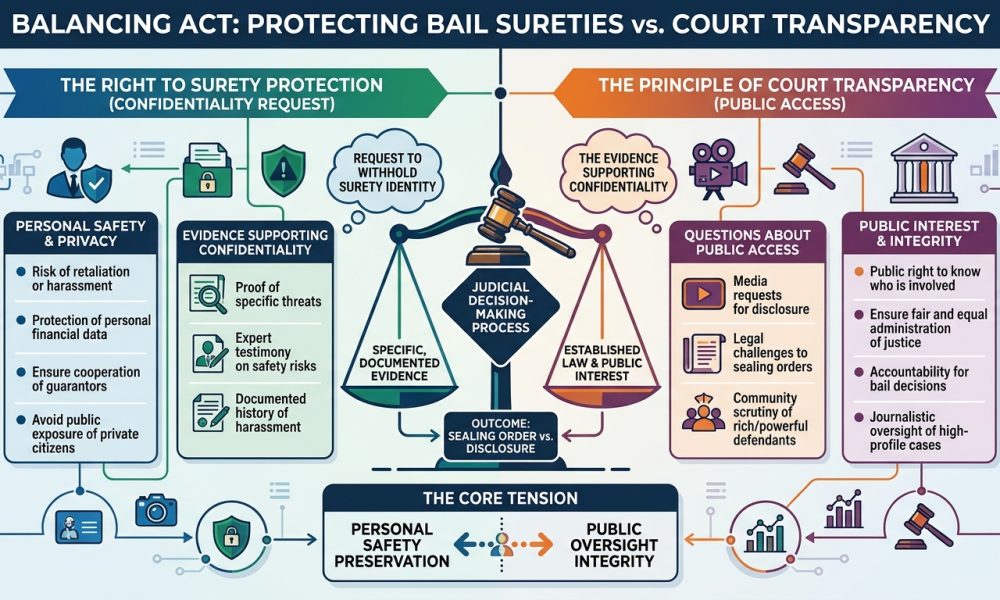
Requests to withhold a financial guarantor’s identity involve questions about personal safety, public access and the evidence supporting confidentiality.
WASHINGTON, DC, October 28, 2026 — Americans who provide financial guarantees for criminal defendants may find that supporting another person’s pretrial release involves more than financial responsibility, especially when court proceedings expose their identities, personal relationships, and potentially sensitive financial Information to public scrutiny.
Although bail sureties often participate in criminal proceedings to help relatives, friends, or professional associates remain out of custody while awaiting trial, publicly available court records can raise unexpected privacy concerns beyond the original financial commitment.
Federal courts must balance those concerns against longstanding principles of judicial transparency, recognizing that the public generally has an interest in understanding how release decisions are made, who guarantees compliance, and whether appropriate safeguards protect the integrity of criminal proceedings.
The issue received substantial national attention during the prosecution of former cryptocurrency executive Sam Bankman-Fried, when two individuals who agreed to guarantee portions of his pretrial release sought to remain unidentified amid concerns about harassment and unwanted publicity.
A January 2023 Reuters report on the judicial decision to disclose Bankman-Fried’s bail guarantors described how a federal judge weighed personal-safety arguments against requests from news organizations seeking access to Information in judicial records.
The resulting dispute illustrated an important legal principle that continues to shape confidentiality applications: financial guarantors may possess legitimate personal security interests, but their participation in public criminal proceedings does not automatically entitle them to anonymity.
Bail Sureties Play an Important Role in Pretrial Release
A bail surety is an individual or organization that undertakes specified financial obligations to encourage a criminal defendant to comply with court-imposed conditions, particularly those requiring attendance at scheduled proceedings.
Depending on the jurisdiction and release arrangement, the surety may sign a financial bond, pledge property, provide collateral, or assume contractual responsibility for an amount that becomes relevant if enforceable bond conditions are breached.
These arrangements can involve parents supporting adult children, friends assisting longtime acquaintances, or professional bonding companies undertaking obligations within regulated commercial bail systems, although their legal responsibilities differ substantially.
An individual who signs a personal recognizance-related financial guarantee may face different exposure than someone depositing cash or securing a commercial bond with residential property, so carefully review the agreement.
The financial commitment can also carry reputational consequences because court filings may identify the guarantor and create a publicly documented relationship with a defendant whose allegations have drawn significant community or national attention.
For sureties who are private individuals rather than public figures, this possibility raises questions about whether legitimate support for a defendant should necessarily expose unrelated personal details to widespread internet searches and media scrutiny.
Federal Court Records Begin With a Presumption of Public Access
American courts generally recognize that public access to judicial proceedings supports accountability, allowing citizens and journalists to examine how judges exercise Authority, evaluate evidence, and impose conditions affecting individual liberty.
The federal judiciary explains in its official guidance on public access to court proceedings and records that authorized public systems provide access to most federal case files. However, some records may be redacted or sealed.
This general availability means that bail documents filed with a court may become accessible to journalists, researchers, litigants, and members of the public unless applicable law or a judicial order restricts disclosure.
However, the legal right of access varies by document because constitutional principles, common-law doctrines, statutory protections, and the function of a particular filing can shape the applicable standard.
A criminal indictment, judicial ruling, sealed investigative record, and financial guarantee may therefore receive different treatment when a court evaluates whether disclosure is required or confidentiality is justified.
Judges must identify the legal basis for access and weigh recognized countervailing interests before deciding whether to disclose sensitive information, redact it, or maintain it under an appropriately supported sealing order.
The Bankman-Fried Dispute Demonstrated Competing Legal Interests
The Bankman-Fried bail proceedings highlighted the tension between financial guarantor confidentiality and public scrutiny, especially because the criminal case drew extensive international attention.
Two additional guarantors signed separate financial undertakings valued at $500,000 and $200,000. At the same time, defense attorneys initially sought to prevent the public disclosure of their identities because they feared unwanted attention and potential threats.
Several news organizations challenged the confidentiality arrangements, arguing that identifying the individuals supporting the defendant’s release would allow the public to examine an important component of the federal judicial process.
In January 2023, United States District Judge Lewis Kaplan concluded that the common-law presumption favoring access to the guarantors’ names outweighed the confidentiality arguments in that case.
The judge did not treat the dispute as establishing that every surety must always be publicly identified, instead examining the legal status of the documents, the asserted interests, and the evidentiary basis for withholding Information.
The two guarantors were subsequently identified in February 2023 as Stanford University academics Larry Kramer and Andreas Paepcke, illustrating how a judicial access decision can expose previously confidential participants in a widely reported criminal proceeding.
Personal Safety Concerns Require More Than Generalized Assertions
Requests for confidentiality often emphasize that public Identification could expose sureties to harassment, unwanted media contact, reputational damage, or threats stemming from their association with controversial criminal defendants.
These concerns can be particularly significant when proceedings involve organized crime, politically sensitive allegations, substantial financial losses, or highly publicized disputes that have already generated hostility toward individuals associated with the defendant.
Nevertheless, asserting that disclosure might attract unwanted attention does not automatically justify secrecy, because courts must evaluate the seriousness, specificity, and evidentiary support behind the claimed danger.
Supporting material may include documented threats, relevant security incidents, credible professional assessments, or other circumstances showing why disclosure poses a concrete concern. However, the required showing depends on the legal standard.
When genuine risks exist, attorneys can ask courts to consider tailored protections, while recognizing that the judge must also weigh transparency interests and explain why restrictions are warranted.
A request grounded in identifiable facts generally presents a more meaningful legal question than a broad preference for avoiding publicity, particularly when the individual voluntarily participates in proceedings that carry recognized public accountability interests.
Financial Privacy and Personal Anonymity Are Different Questions
One important distinction separates a surety’s identity from sensitive financial Information, because protecting bank account numbers, residential addresses, or private financial records does not necessarily require concealing the guarantor’s name.
Federal courts may restrict access to certain personal identifiers while leaving documents otherwise publicly available, showing that confidentiality can protect specific Information without eliminating scrutiny of the underlying judicial transaction.
Federal Rule of Criminal Procedure 49.1 protects specified personal Information, including financial account numbers, Social Security numbers, birth dates, and certain residential details, in criminal case filings.
Those protections do not automatically guarantee anonymity for everyone who provides financial assistance to a defendant, so courts must distinguish mandatory redaction requirements from broader discretionary sealing decisions.
A court could therefore determine that the public may know who guaranteed a bond while separately protecting unnecessary account details, private financial statements, or sensitive Information unrelated to evaluating the release arrangement.
This distinction also benefits guarantors because it lets attorneys identify specific disclosure risks without assuming the only remedies are complete anonymity or unrestricted publication of every supporting document.
Applicable Legal Standards Must Support Sealing Orders.
A motion to seal court records asks a judge to restrict access to Information that would otherwise be available through established judicial procedures, so the request is subject to legal standards that protect transparency.
Depending on the jurisdiction and the records involved, courts may assess whether recognized privacy or safety interests outweigh access rights and whether the proposed restriction goes beyond what is reasonably necessary.
A complete sealing order may prevent public examination of an entire document. At the same time, a narrower arrangement might conceal selected Information or permit publication of a redacted version containing the essential judicial details.
Judicial decisions must account for applicable precedent and procedural requirements, rather than treating a private agreement among the defendant, surety, and prosecutor as automatically sufficient to eliminate public access.
Even when prosecutors do not oppose confidentiality, the court may retain an independent obligation to consider public access interests, particularly when journalists or other parties seek review of a sealing decision.
The result is an individualized assessment rather than a guaranteed entitlement, requiring careful attention to the Information at issue, the potential harm, and the legal framework governing judicial records.
News Organizations Can Challenge Confidentiality Requests
Journalists often seek access to criminal court records because they reveal how public institutions exercise Authority, evaluate financial guarantees, and decide whether defendants should remain free during pending prosecutions.
In prominent cases, identifying a surety may help explain whether financial support comes from family members, business associates, or others whose relationships may help explain the court’s release decision.
However, public interest in a criminal proceeding does not necessarily justify publishing every private detail about people connected with the defendant, particularly when disclosure would add little meaningful Information.
Courts evaluating requests from news organizations must therefore distinguish legitimate transparency interests from Information whose exposure could create substantial personal harm without materially advancing understanding of the judicial process.
The Bankman-Fried dispute showed that media organizations can seek intervention solely to assert public access rights, even when they are not parties to the underlying criminal prosecution.
This procedural opportunity allows judges to hear competing arguments before deciding whether confidentiality should continue, be modified, or yield to a legally recognized presumption favoring disclosure.
Private Individuals May Face Disproportionate Public Exposure
Unlike defendants whose criminal proceedings are already publicly documented, bail sureties may enter the legal process without anticipating that their names and personal associations will become searchable across international news platforms.
A retired professional, university employee, family friend, or small-business owner may support a defendant because of longstanding personal connections without endorsing the allegations or conduct prosecutors describe.
Public Identification can still lead to online speculation, unwanted communications, professional questions, or mistaken assumptions about the nature of the relationship between the surety and the accused individual.
These consequences are especially concerning when online reporting continues to circulate for years after the defendant’s case concludes, potentially linking a guarantor’s name to allegations unrelated to their own behavior.
At the same time, reputational discomfort alone may not overcome the public access interests protected by applicable law, making careful documentation of more serious risks particularly important.
Courts must balance the potential consequences for innocent third parties with the public’s legitimate interest in examining judicial arrangements that affect release decisions and the enforcement of criminal procedure.
Anonymous Living Services Cannot Replace Judicial Authorization.
Individuals concerned about publicity may explore lawful residential confidentiality, restricted personal disclosures, and other privacy measures intended to reduce exposure without misrepresenting identity or interfering with government reporting requirements.
For those evaluating anonymous living and personal privacy arrangements through Amicus International Consulting, bail surety confidentiality illustrates the distinction between ordinary personal discretion and legally enforceable restrictions on public access to judicial records.
A private residential arrangement may limit access to certain personal Information outside the courthouse. Still, it does not independently authorize altering, concealing, or removing Information that must appear in judicial filings.
Similarly, confidentiality agreements between private parties cannot automatically override a court’s access rules, prevent journalists from examining lawfully available records, or bind a judge who has not approved the proposed protections.
Someone considering financial responsibility for a defendant should therefore evaluate potential disclosure before signing an undertaking, rather than assuming that subsequent privacy planning can reverse Information already released through public proceedings.
Lawful confidentiality begins with accurately identifying the records that require Protection and assessing whether a competent court can restrict their disclosure under the applicable legal standards.
Legal Identity Changes Do Not Erase Existing Surety Obligations
A surety who lawfully changes their name after signing a financial guarantee generally remains responsible for obligations that continue under the governing agreement, because the legal relationship concerns the individual rather than a permanent spelling of their name.
The same principle applies when guarantors change residence, reorganize personal finances, or update official Identification, since such administrative changes do not automatically discharge judicially recognized financial commitments or related contractual obligations.
Individuals considering lawful legal identity changes and documentation planning should therefore distinguish the legitimate use of updated Identification from any claim that a new name eliminates historical financial liabilities.
A legally recognized name change may require updating relevant records and establishing continuity between previous and current identities, particularly when a court or financial institution must enforce an existing guarantee.
Providing fabricated identifying Information or concealing legally required details can create additional problems, making accurate documentation essential even when the guarantor has legitimate reasons to seek greater personal privacy.
For people already associated with publicly available court records, a new name also cannot guarantee that historical reporting, archived documents, or established legal connections will disappear from public or institutional records.
State Court Procedures May Produce Different Confidentiality Outcomes
Although prominent federal cases offer useful examples, state courts operate under distinct statutes, judicial rules, public records provisions, and constitutional doctrines that may affect whether guarantor Information becomes public.
Some jurisdictions rely heavily on commercial bail arrangements, while others increasingly use nonfinancial release mechanisms, creating different circumstances in which relatives, private guarantors, or licensed bonding companies become involved.
The types of documents available to the public may also differ, particularly where state law restricts certain financial Information or establishes specific procedures for sealing sensitive material.
A confidentiality request considered appropriate in one jurisdiction may be treated differently elsewhere because the governing legal standards, evidentiary requirements, and public access protections are not necessarily identical.
Attorneys should therefore determine whether the matter involves federal or state proceedings, identify the documents containing the surety’s Information, and review the available protections before assuring anonymity.
The correct legal conclusion depends on the governing framework and the circumstances presented to the court, not on a general expectation that all guarantors receive identical treatment throughout the United States.
Financial Guarantors Should Understand Their Exposure Before Signing
Prospective sureties should understand that agreeing to support a defendant can create financial responsibilities, require disclosure of personal Information, and potentially associate their names with court proceedings that attract public attention.
Before accepting those obligations, individuals can seek independent legal advice regarding the applicable bond terms, disclosure requirements, potential financial liability, and whether legitimate confidentiality protections are available.
An attorney can assess whether certain financial documents contain Information that requires redaction and whether documented safety concerns support a request for additional Protection under relevant judicial rules.
However, prospective guarantors should not rely on promises that their identities will remain permanently confidential, because judges may later reconsider sealing decisions or authorize disclosure following a legally supported challenge.
A confidentiality arrangement should also distinguish Information available to the court and authorized officials from Information potentially released publicly, since those audiences may receive different levels of access.
Understanding these distinctions before participating allows sureties to make more informed decisions about financial support without assuming that private intentions or personal relationships automatically determine how judicial records are treated.
Court Transparency and Personal Safety Require Individualized Decisions
The broader dispute over bail surety confidentiality reflects an enduring tension in American criminal justice: open proceedings promote public confidence, while unrestricted disclosure can expose private individuals to significant personal consequences.
A financial guarantor’s willingness to support an accused person does not establish responsibility for the underlying allegations. Yet, the guarantor’s participation may remain relevant to the public’s understanding of judicial release decisions.
Courts must therefore consider the specific Information sought, the applicable right of access, the strength of the asserted confidentiality interests, and the possibility of narrower protections before determining the appropriate outcome.
Protecting bail sureties requires more than assuming anonymity is either automatically available or categorically prohibited, because courts must evaluate judicial transparency, documented safety concerns, and applicable law together.
For defendants, prospective guarantors, and legal professionals, the central lesson is that confidentiality should be addressed through accurate disclosures, properly supported judicial requests, and a clear understanding of the financial and reputational consequences.
Ultimately, a balanced legal approach preserves public accountability while recognizing that individuals who assume financial responsibility for criminal defendants may have legitimate privacy interests that warrant careful, evidence-based judicial consideration.




