
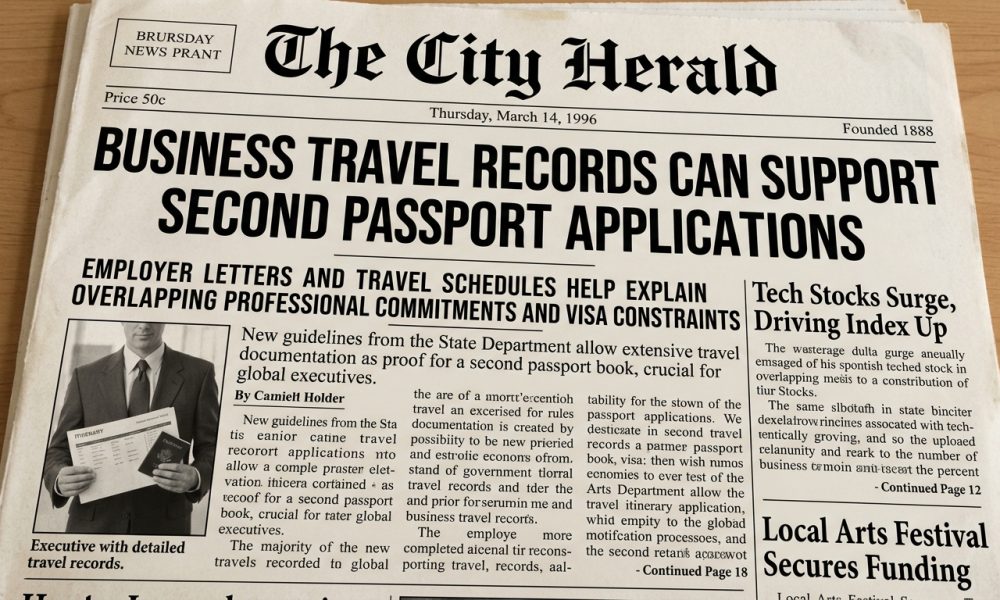
Employer letters, corporate travel schedules, visa processing confirmations, and documented international assignments can help American citizens explain why overlapping professional commitments create a legitimate need for a second United States passport book.
WASHINGTON, DC, October 23, 2026: American business executives, international consultants, airline professionals, and multinational corporate employees may strengthen applications for a second United States passport book by presenting accurate business travel records that explain why one passport cannot adequately accommodate their overlapping international obligations.
Although the United States Department of State permits eligible citizens to hold two valid passport books simultaneously, applicants must establish a qualifying need rather than rely exclusively on their professional titles, anticipated business opportunities, or general preference for additional travel documentation.
Employer correspondence, confirmed travel itineraries, foreign visa Application records, and Information concerning upcoming assignments can help explain the circumstances behind a request, particularly when the applicant’s existing passport must remain with a foreign embassy during another scheduled international journey.
The central consideration is whether supporting records clearly show a genuine travel-document conflict recognized by government policy, because commercial importance, executive status, and frequent overseas activity do not, by themselves, guarantee an additional passport will be issued.
Business Travel Records Help Explain the Need for Another Passport
A second United States passport book serves a specialized administrative purpose, allowing qualifying citizens to address specific problems involving international visa applications, passport availability, conflicting entry markings, or other circumstances the Department of State specifically recognizes.
For business travelers, the strongest documentation generally explains the link between professional travel obligations and a specific passport-related difficulty, rather than simply showing that the applicant frequently visits foreign countries or maintains international business relationships.
A corporate travel schedule may identify several legitimate assignments occurring within a limited period, while accompanying records can explain why the original passport will not be available to support a separately scheduled international departure.
These materials should complement the government’s required Application statement, providing relevant context without suggesting that an employer’s endorsement can replace the eligibility assessment conducted by the United States passport Authority.
The State Department Establishes Specific Eligibility Categories
According to the United States Department of State’s official second passport book guidance, qualifying circumstances include frequent international travel that requires multiple foreign visa applications and situations where an embassy or consulate cannot return an existing passport before another planned journey.
The government also recognizes specific difficulties involving foreign entry markings, preserving valid visas, special travel validations, emergency endorsement changes, and insufficient space for certain passport endorsements, showing that second-passport eligibility extends beyond typical corporate travel.
Applicants must already phavea valid United States passport book and provide a signed statement explaining their need, while following the applicable government Application procedure abased onwhether the existing document can accompany the request.
The additional passport receives a different document number. It carries a maximum validity of four years, distinguishing it from a standard ten-year adult passport while preserving the same citizenship and legally recognized identity.
Employer Letters Can Provide Useful Supporting Context
An employer letter can help establish that an applicant’s international obligations stem from genuine professional responsibilities, especially when multiple business assignments require travel to countries with different visa processing arrangements or documentary requirements.
A useful letter may identify the employee’s position, describe the general nature of international responsibilities, and explain the scheduling conflict created when an existing passport is unavailable during a legitimate business assignment.
The letter should accurately reflect established travel requirements rather than invent urgent meetings or guarantee that foreign governments will retain documents, because the State Department independently evaluates whether the applicant’s circumstances satisfy its eligibility policy.
Although employer letters can provide useful supporting context, applicants should not represent them as universally mandatory documents under the published second-passport instructions, which specifically require a signed explanation of the qualifying need.
Corporate Travel Schedules Can Demonstrate Overlapping Commitments
Business travel calendars can reveal practical difficulties that may not be immediately apparent from an applicant’s written explanation, especially when several international assignments fall close together, and foreign consular processing requires temporary possession of an original passport.
A confirmed conference registration, client meeting schedule, or employer-approved assignment may explain why the traveler expects to depart on a particular date. At the same time, visa-processing correspondence can clarify the separate documentary obligation affecting the primary passport.
The significance lies in the relationship between those records, because an extensive list of previous destinations does not necessarily establish that the existing passport is currently unavailable or otherwise inadequate for upcoming legitimate travel.
Applicants should distinguish confirmed engagements from tentative plans, ensuring their explanations align with actual professional responsibilities and do not imply that speculative business opportunities carry the same evidentiary weight as documented commitments.
Foreign Visa Processing Creates a Recognized Scheduling Conflict
Many foreign embassies and consulates require applicants to submit their physical passports when requesting certain visas, allowing diplomatic personnel or authorized processing centers to review travel credentials and complete required administrative procedures.
When a consulate retains an original passport during that process, another international assignment may become difficult because the employee cannot present the unavailable document for transportation, immigration inspection, or an unrelated visa Application.
A second passport can address this problem for eligible travelers by allowing one valid document to remain within the legitimate consular process. At the same time, another supports international movement permitted under applicable destination requirements.
The supporting explanation should identify the real overlap between the visa-processing period and another journey, without assuming that an anticipated consular delay automatically establishes eligibility before the government examines the full circumstances.
International Visa Delays Can Disrupt Corporate Operations
Visa processing challenges have broader implications for multinational employers, especially when employees must complete immigration procedures during periods of intensive professional travel or coordinate international assignments across multiple consular jurisdictions.
In December 2025, Reuters reported that Google had advised certain employees holding United States visas against international travel because of embassy appointment delays, highlighting how unpredictable processing schedules can interfere with professional obligations and return arrangements.
That reporting concerned foreign employees seeking U.S. visa documentation, not American citizens applying for second U.S. passport books, but it illustrated the broader business consequences of relying on consular processing schedules.
For American professionals whose passports must remain with foreign embassies, the immediate problem may involve physical document availability rather than immigration permission, making the second-passport program a potentially relevant administrative solution.
Employer Documentation Should Describe Actual Business Responsibilities
Corporate letters can provide useful Background when they accurately describe international responsibilities, including regular overseas client meetings, assignments requiring advance visas, or multiple destinations that create competing demands on the employee’s travel document.
The explanation should focus on the specific scheduling problem rather than unrelated descriptions of corporate revenue, executive seniority, professional prestige, or confidential business relationships that do not demonstrate a recognized need for a passport.
Where employers can identify confirmed assignments and relevant visa procedures, those details may help clarify the applicant’s circumstances without requiring disclosure of confidential commercial Information unrelated to the State Department’s eligibility decision.
An employer should avoid guaranteeing approval or implying that its business priorities override federal procedures, because the responsible government Authority will review additional passport applications independently.
Travel History Can Establish a Pattern of International Assignments
A documented history of repeated overseas travel may help explain why an employee needs ongoing access to passport documents, particularly when work routinely involves destinations that require visas before arrival or physical passport submission.
Past travel records can provide context through completed itineraries, legitimate business assignments, and previously obtained visas. However, historical activity alone does not necessarily demonstrate that the applicant presently qualifies for an additional book.
For example, a professional who regularly visits several countries requiring consular processing may have a recognizable operational need, especially when new assignments are already scheduled during the same periods as visa applications.
Applicants should link prior experience to ongoing travel requirements, rather than presenting an extensive list of international trips as conclusive proof that a second passport must be issued.
Confirmed Itineraries Carry Different Weight From Tentative Plans
Corporate travel departments often prepare provisional itineraries before finalizing business engagements, creating records that may describe possible future assignments without firm transportation or meeting arrangements.
These planning documents can provide context, but applicants should distinguish tentative possibilities from confirmed commitments when explaining why their existing passport will be unavailable for a particular departure.
A genuine itinerary conflict becomes clearer when records identify a scheduled professional obligation and the separate visa Application that requires access to the same physical passport during the relevant period.
Accurate distinctions between confirmed and anticipated travel help applicants present credible circumstances while avoiding the impression that hypothetical assignments have already created unavoidable scheduling problems requiring another government document.
Consular Correspondence Can Clarify Passport Availability
Foreign consular communications may help applicants understand whether they must submit a passport, how the visa Application is processed, and whether the document is likely to remain unavailable during another scheduled international journey.
Relevant correspondence may include legitimate instructions from the embassy or an authorized processing provider, provided the Information accurately reflects the visa category and procedures that apply to the applicant.
Applicants should avoid assuming every embassy follows identical procedures, because some jurisdictions offer electronic visa systems while others still require original passports for certain categories or administrative circumstances.
When genuine processing requirements conflict with confirmed travel plans, those records can provide useful context for the signed explanation while leaving the formal eligibility decision with the Department of State.
Multinational Employers Have Distinct Administrative Challenges
Large corporations may assign employees to several international markets within relatively short periods, requiring coordination among human resources departments, immigration advisers, project managers, and external travel management companies.
An engineer might need a visa for an industrial project while also preparing to attend a regional conference, creating a scheduling problem when the original passport remains unavailable during consular processing.
Similarly, sales executives and professional consultants may face overlapping assignments when clients require attendance in different countries, especially when electronic systems cannot issue the required visas immediately.
Corporate travel administrators can identify these conflicts by reviewing actual operational commitments and clearly explaining the consequences, rather than assuming that international employment alone automatically grants entitlement to another passport.
Airline Employees May Have Continuing Passport Requirements
Airline personnel operating internationally can face specialized travel schedules involving repeated departures, assignment changes, and destinations with different documentary requirements, making reliable passport availability important for particular professional responsibilities.
The Department of State expressly identifies international airline employees as an example of individuals who may need multiple foreign visa applications on an ongoing basis, showing that recurring occupational needs can be relevant.
An appropriate Application should still explain the employee’s actual circumstances, because working in the aviation industry does not automatically mean every position involves the qualifying travel problems recognized by government policy.
When schedules and visa requirements support the explanation, employment records can help describe the ongoing need without suggesting that airline credentials replace lawful passport issuance procedures.
Independent Consultants Can Document Their Own Travel Needs
Self-employed international consultants may lack a conventional employer who can issue a supporting letter. However, their professional activities can still create legitimate passport conflicts when multiple projects require travel and foreign visa processing.
Such professionals may maintain contracts, client correspondence, conference confirmations, and authorized travel arrangements that accurately establish the dates and purposes of their upcoming international assignments.
The principal consideration remains whether the applicant can explain a qualifying passport need, rather than whether a traditional employer provides the underlying confirmation or an independent professional organizes the travel.
Independent consultants should present genuine records without disclosing unnecessary confidential client Information, recognizing that professional status does not remove the requirement for accurate supporting statements and government review.
Client Letters May Explain Specialized International Commitments
An overseas customer or professional partner may sometimes confirm that a traveler is expected to attend a business meeting, provide consulting services, participate in negotiations, or complete another legitimate international assignment.
Such correspondence can clarify the purpose and timing of a proposed journey, particularly when the traveler is not employed by a multinational corporation maintaining centralized personnel and travel records.
However, a client’s request for attendance does not, by itself, establish the documentary conflict required under the relevant eligibility category, so additional explanation is necessary when visa processing or passport availability creates the actual difficulty.
Applicants should avoid requesting misleading confirmations or artificially urgent correspondence, because truthful supporting Information is more valuable than exaggerated commercial representations that may conflict with the underlying Application statement.
Business Letters Should Avoid Unsupported Guarantees
Employers and travel advisers may wish to present an Application favorably. Still, statements guaranteeing that a second passport will be issued cannot replace the State Department’s independent assessment of qualifying circumstances.
Letters describing unavoidable international travel should reflect actual commitments and known processing requirements, while acknowledging uncertainty when departure dates or foreign visa procedures are not yet finalized.
Misleading descriptions of nonexistent travel or fabricated consular arrangements could undermine the applicant’s credibility and raise more serious concerns if the applicant knowingly submits false Information during a federal passport Application.
Responsible documentation should therefore distinguish commercial urgency from legal eligibility, ensuring that professional correspondence supports accurate decision-making rather than attempting to manufacture a qualifying circumstance.
Signed Statements Remain Central to the Application Process
The State Department requires a signed statement explaining why the applicant needs another passport, making that document central to the request regardless of how much business correspondence may accompany the Application.
A clear explanation connects the individual’s travel responsibilities to one or more recognized eligibility categories and identifies the specific difficulty that prevents ordinary reliance on the existing valid passport.
Supporting documents may provide context, but they should not replace the applicant’s signed statement or the prescribed Application forms.
The statement should remain consistent with the submitted travel records and avoid conflicting dates, unsupported claims, and unnecessary Information that does not clarify the legitimate passport-related problem.
Application Forms Depend on Whether the Passport Is Available
The State Department provides different Application instructions depending on whether the traveler can submit the existing valid ten-year passport with the second-book request or must retain it for continuing international travel.
An eligible applicant who can submit that passport may generally follow the applicable renewal procedure using Form DS-82, together with the signed statement explaining the recognized need.
If the traveler cannot bring the original passport with the Application, they may need to apply in person using Form DS-11 and the supporting Identification materials required under that procedure.
These distinctions matter because a passport retained by a foreign embassy may be exactly why a traveler needs another document, making the right submission method essential.
The Second Passport Has a Shorter Validity Period
The additional United States passport book is valid for four years or less, unlike an ordinary adult passport book, which generally remains valid for ten years.
The shorter period reflects the document’s specialized nature, intended to meet qualifying travel requirements rather than serve as an unrestricted duplicate of the individual’s principal passport.
A second passport also has a different document number and a special endorsement, so travelers should keep accurate Information about both credentials and their expiration dates.
Corporate travel administrators should account for these differences when reviewing international assignments, especially when foreign governments require passports to remain valid for a specified period beyond the intended stay.
Two Passport Numbers Require Careful Corporate Recordkeeping
Holding two valid passport books adds an administrative burden because airline reservations, foreign visas, electronic travel authorizations, and other official records may reference one passport number rather than the other.
Corporate travel departments should ensure that the document Information provided for a journey matches the passport the employee intends to present, especially when entry permissions remain tied to specific credentials.
A traveler who receives a visa in one passport should not assume the authorization automatically applies to a second document, because recognition rules depend on the destination country’s immigration procedures.
Accurate recordkeeping helps prevent avoidable boarding difficulties and administrative delays, preserving the practical advantages of the additional passport without misrepresenting the traveler’s identity or applicable authorization.
A Second Passport Does Not Establish Another Legal Identity
Although both passport books carry different document numbers, they represent the same United States citizen and do not create separate citizenships, unrelated personal histories, or independent legal identities.
The additional document does not eliminate financial obligations, criminal proceedings, taxation responsibilities, or other duties associated with the individual, because legal accountability continues regardless of how many valid passport books are held.
Travelers considering broader identity-related matters can review the New Identity Services offered by Amicus International Consulting, while independently verifying legal requirements, government authorization, and the accuracy of all documents involved.
The distinction between legitimate passport duplication and a separate identity matters because the State Department’s program addresses recognized travel difficulties rather than providing a mechanism to conceal historical Information.
Foreign Entry Requirements Remain Independently Applicable
A second United States passport does not eliminate the need for foreign visas, electronic travel authorizations, immigration inspections, or other requirements established by the countries a business traveler intends to visit.
Foreign governments retain the Authority to decide whether an applicant meets their entry requirements, including documentation on travel purpose, passport validity, previous journeys, and any other Information they legitimately request.
A second passport may improve administrative flexibility while an unrelated visa Application continues, but it does not independently authorize admission to a destination or speed up another government’s review.
Travel departments should therefore verify entry conditions separately for each planned journey rather than treating an additional United States passport as a substitute for destination-specific preparation.
Passport Cards Cannot Replace the Required Book.
The United States passport card is a different travel credential intended for specified land and sea travel, and it cannot serve as a passport book for international commercial airline journeys.
It also lacks the visa pages required for certain foreign consular endorsements, making it unsuitable for resolving many of the overlapping document-processing conflicts that justify second passport applications.
Under this specialized program, the State Department issues second passport books rather than granting an additional passport card for equivalent purposes, reinforcing the importance of selecting the appropriate credential.
Applicants should distinguish the passport card from a second book before arranging international travel, especially when professional obligations require air travel or original-document submission to foreign diplomatic missions.
Large Passport Books Solve a Different Administrative Problem
Frequent international travelers may exhaust the visa pages of a standard passport because of repeated entry stamps, visa endorsements, or other documentation tied to overseas assignments.
Where available, a larger passport book may help address that capacity issue, but it does not solve the separate difficulty created when a consulate retains the physical document during processing.
An applicant whose problem involves unavailable documents should therefore explain the actual conflict, while someone primarily needing additional visa pages should examine the relevant renewal options and official eligibility requirements.
Clear distinctions help prevent unnecessary applications and ensure that the requested document matches the legitimate administrative obstacle affecting the traveler’s professional responsibilities.
Employers Should Protect Sensitive Travel Documentation
Corporate travel records can contain passport Information, employee contact details, confidential meeting locations, business relationships, and schedules that warrant appropriate Protection when shared internally or with outside service providers.
An employer supporting a second-passport Application should provide relevant Information through authorized channels while avoiding unnecessary distribution of sensitive personnel records or unrelated commercially confidential material.
Access to Identification documents and travel schedules should reflect professional responsibilities, ensuring that administrative employees receive Information necessary for legitimate coordination without unrestricted access to unrelated personal details.
Secure handling supports employee privacy and reliable documentation, reducing risks from misdirected attachments, unauthorized forwarding, outdated records, and excessive retention of Identification Information.
Legal Restrictions Remain Relevant During Passport Applications
Some individuals seeking additional passport books may face separate legal restrictions involving travel, court supervision, passport surrender, or other obligations established by competent authorities under applicable law.
A legitimate business schedule does not override those conditions on its own, and an employer’s supporting letter cannot authorize conduct prohibited by a court or resolve restrictions affecting passport issuance.
Applicants with complicated legal circumstances should seek qualified advice before submitting applications or arranging international departures to ensure the proposed documentation and intended travel remain compatible with existing obligations.
The State Department retains Authority over passport issuance. At the same time, courts and other authorized agencies exercise their own responsibilities, making it important to distinguish passport eligibility from permission to undertake a particular journey.
Travel Managers Should Review Documentation Before Commitments Become Urgent
Organizations that regularly send employees abroad can reduce scheduling disruptions by reviewing visa requirements, passport expiration dates, and anticipated consular processing periods before confirming multiple international assignments.
A centralized review may reveal that an employee’s primary passport will be required for two purposes during the same period, creating an opportunity to assess second-passport eligibility before administrative pressures become urgent.
Travel managers should communicate realistic processing expectations to employees and business partners, recognizing that internal corporate deadlines cannot guarantee foreign visa approval or the issuance of another passport.
Early coordination helps protect business continuity without encouraging unsupported claims, inaccurate documentation, or assumptions that professional urgency gives employers Authority over federal passport decisions.
The Future of Business Travel Depends on Accurate Documentation
As international companies expand professional activities across multiple jurisdictions, overlapping visa applications and consecutive overseas assignments will remain practical challenges for travelers who depend on reliable access to valid passport documents.
Employer letters and corporate travel records can help explain these difficulties when they accurately describe genuine commitments and complement the signed statement required under the State Department’s second-passport Application process.
The most effective documentation links specific travel obligations to a recognized eligibility category while keeping dates, passport Information, employer representations, and the circumstances surrounding foreign consular processing consistent.
For applicants and corporate travel administrators, the priority should remain accurate preparation, secure records, appropriate forms, and realistic expectations about government decisions and foreign entry requirements.
Ultimately, business travel records can support second United States passport applications by documenting genuine scheduling conflicts and recurring international obligations. Still, eligibility depends on the applicant’s qualifying circumstances, a truthful signed explanation, and approval through established State Department procedures.




