
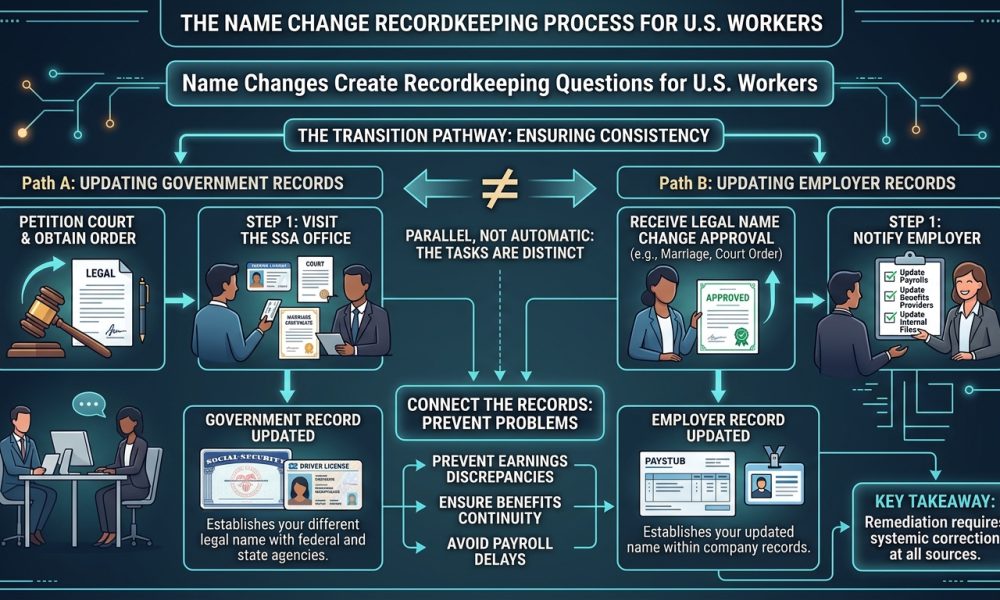
Consistent employment, payroll, and Social Security Information helps prevent administrative problems when workers begin using a newly approved legal name.
Washington, DC, October 20, 2026 — A newly approved legal name can require updates across several workplace systems, but changing an employee directory or Identification badge does not necessarily amend the payroll Information used to report wages to the federal government.
For workers, the transition can involve Social Security, human resources, payroll, benefit providers, and financial institutions, each maintaining records that may require separate notification or supporting evidence before the updated name appears consistently across essential services.
The challenge is to maintain accurate continuity for the same employee, ensuring earnings and benefits remain tied to the correct person. At the same time, the employer follows tax-reporting and employment-documentation rules.
Understanding these separate responsibilities can prevent confusion, especially when an employee begins using a new name socially or professionally before the Social Security Administration completes the corresponding update to the record used for federal wage reporting.
Workplace Records Do Not All Serve the Same Purpose
An employer may maintain a public directory, payroll database, personnel file, and benefits platform, so it helps to ask which records a name change request covers rather than assume one update automatically reaches every connected system.
A preferred or professional name displayed in workplace communications can serve a different purpose from the legal identifying Information required for payroll reporting, so people should understand the difference before treating it as an error.
Employees can ask human resources how the organization distinguishes those uses and what steps follow a completed legal change, especially when they want colleagues to use the updated name. In contrast, administrative verification is still being completed.
Clear communication about the transition can help prevent unnecessary confusion without implying that every department needs access to the underlying court order or the personal circumstances that led the employee to seek a different legal name.
Social Security Information Matters for Wage Reporting
The Internal Revenue Service’s employer guidance directs employers to record workers’ names and Social Security numbers as shown on their Social Security cards, making the federal record an important reference point for accurate wage reporting.
When the name on the card is no longer correct because of a legal change, the employee should request an updated card. Meanwhile, payroll follows the applicable reporting instructions until that documentation becomes available.
A routine name update ordinarily preserves the existing Social Security number, so an employee should not describe the request as obtaining another number unless the agency has actually approved that separate and exceptional administrative change.
Workers can notify payroll that an update is underway and ask what confirmation is needed afterward, allowing the employer to distinguish a pending request from a completed correction without assuming that the federal record changes immediately upon court approval.
Payroll Should Follow the Required Sequence
The IRS employer tax guide instructs employers to continue reporting wages under the former name until the employee presents an updated Social Security card showing the corrected name, providing a specific rule for managing that reporting transition.
This instruction concerns wage reporting and should not be interpreted as a universal requirement that coworkers, email systems, or every workplace document continue using the earlier name, because those uses can involve different organizational practices and considerations.
Employees should ask payroll when an approved update will appear in the relevant system and which forthcoming statements it affects, particularly when the organization uses an outside provider whose processing schedule differs from theemployer’ss internal personnel workflow.
After implementation, reviewing the next available payroll record can help identify a spelling error or incomplete update early. At the same time, the employee keeps appropriate confirmation rather than assuming that a revised workplace profile proves federal reporting Information has changed.
Previously Issued Wage Statements May Need Correction
A name change can get complicated when a worker has already received a Form W-2 under the earlier name, especially if another employer issued a statement using the name now recorded by Social Security.
The IRS addresses that situation directly, explaining that the worker reports all income on one return and contacts the employer that issued the earlier-name statement to request a correction. As a result, the reported earnings remain associated with the proper record.
Workers should therefore avoid treating the two names as belonging to separate taxpayers, since the administrative difference does not divide their annual income into unrelated personal histories or create a reason to file separate returns for each name.
Questions about a previously filed return or an incorrect wage statement should go to the employer or a qualified tax professional, so the reporting issue can be addressed without assuming every earlier document must be rewritten.
A Verification Mismatch Does Not Establish Misconduct
Social Security’s employer guidance explains that a name and number mismatch does not establish an employee’s immigration status or justify adverse action, so employers must investigate carefully before concluding a verification is unsuccessful.
The agency directs employers to compare the submitted Information with employment records, correct typographical errors, and ask the employee to check the Social Security card, with further agency assistance where theInformationn still does not match.
An employee experiencing a mismatch can ask which specific Information differs and what correction is requested, rather than assume the number is invalid or the legal name change wasn’t recognized.
Employers should handle those questions consistently and through the appropriate administrative process, because a discrepancy arising during a legitimate name update requires accurate review rather than speculation about the worker’s conduct or eligibility based on the mismatch alone.
Employment Verification Has Its Own Rules
Form I-9 serves a different purpose from wage reporting, and current USCIS guidance states that employers are not required to update the form solely because an existing employee has legally changed their name during the employment relationship.
A name change should therefore be distinguished from circumstances that independently require employment authorization reverification, with the employer consulting the applicable instructions rather than assuming that any difference in identifying Information automatically creates the same documentary obligation.
Workers who receive a request for additional records can ask which process the request concerns, helping distinguish payroll evidence, personnel administration, and employment verification instead of treating all Identification requests as interchangeable or governed by identical rules.
Employers handling more complex circumstances should seek guidance on the specific facts, particularly when a name update coincides with another event affecting employment documentation and the organization’s procedures must treat the two matters separately.
Banking and Payment Information Require Coordination
Updating the name in payroll does not mean the employee’s bank has updated its customer records, so the worker should ask the financial institution what evidence and procedures apply to the existing account.
A practical approach is to confirm the status of both updates and monitor the next payment, rather than assume a naming difference necessarily stops a deposit or that every financial institution processes the transition the same way.
Employees should also distinguish changing account holder Information from changing the account used for wages, because redirecting payment requires its own verification and should not be treated as an automatic consequence of the name update.
When an employee receives paper checks, reimbursements, or other payments outside the main payroll system, asking how those records will be updated can help identify an overlooked process before the individual has trouble using the payment.
Benefits Providers May Maintain Separate Records
Health coverage, retirement accounts. Outside organizations may administer health coverage, retirement accounts, and other workplace benefits; the employer may send the name update automatically, or the employee may need to contact each provider separately.
Workers can ask when the revised Information will appear and whether the provider will issue replacement cards or account confirmations, especially if an upcoming appointment or transaction requires the provider to match Identification with an existing benefit record.
A name update should also be distinguished from changes to beneficiaries, coverage selections, or dependent Information, since those decisions may require separate instructions and should not be assumed to accompany a correction to the employee’s identifying details.
Checking benefit statements after the transition can help confirm the account remains correctly associated with the worker. At the same time, raise any discrepancy with the responsible administrator rather than assuming payroll can amend every external record.
Marriage-Related Changes Involve Several Separate Decisions
When a name change follows marriage, employees may also consider changes to finances or benefits. Still, those related life events should follow their own procedures rather than being combined into one vaguely defined administrative request.
Investopedia’s reporting on marriage and credit records explains that marriage and a name change do not merge spouses’ credit histories, underscoring the importance of distinguishing personal status changes from the records and relationships separate institutions maintain.
At work, the same distinction means an employee should identify exactly which updates are requested and ask about any deadlines for additional elections, rather than assuming a surname change communicates every intended decision.
Employees whose name changes arise from other circumstances can use the same approach, separating the Identification update from any accompanying requests so the organization can process each matter accurately without inferring personal choices that were never submitted.
Professional History Should Remain Understandable
A worker may hold qualifications, references, or publications under a name. Ask how the employer will link those records to the employee’s current identity without confusing a name change with missing experience.
That issue can arise during recruitment, promotion or professional licensing, particularly when an outside verifier receives a new name while the institution holding the original record still indexes it under the name used when it was issued.
Employees can ask the relevant organization what evidence is needed to establish continuity, provide appropriate documentation through an accepted channel, and avoid broadly distributing sensitive records or assuming every historical certificate must be replaced immediately.
The same principle supports accurate employment records in the current workplace, where the goal is to link earlier service and current Information to the same individual rather than inadvertently creating a duplicate employee profile during the update.
Family Records and Privacy Need Thoughtful Handling
Employees updating dependent benefits or emergency contact Information should identify those requests separately, since a change to the worker’s own legal name does not automatically amend another family member’s records or establish that their circumstances have changed.
The broader importance of family Identification appears in Amicus International Consulting’s article on Mexico’s children’s passports and parental photographs. However, travel documentation remains distinct from the evidence an employer or benefit administrator needs for a particular workplace transaction.
When privacy or personal safety is a concern, the employee can ask who receives supporting documents and which systems display former names. Hence, the discussion focuses on specific disclosures rather than assuming all historical Information can disappear.
Employers can explain their recordkeeping responsibilities and available privacy arrangements, while distinguishing the Information needed for legitimate administration from the details coworkers or external contacts require for ordinary communication with the employee in their current role.
Completion Requires Checking the Result
A practical tracking record can identify which departments and outside providers were contacted, what documentation was supplied, and which updates remain pending, helping the worker distinguish a received request from a completed change across the relevant systems.
After the update, checking payroll statements, benefitInformationn,, andkeyt account details can reveal inconsistencies early,especiallyy when organizations complete work on different schedules or use Information transferred from another system during routine processing.
Historical documents may remain relevant even after current records are corrected, so keeping appropriate evidence securely available can help explain the connection between earlier and current names without requiring the employee to reconstruct the legal change repeatedly.
Consistent recordkeeping therefore depends on coordinated updates and accurate continuity, allowing the worker to use the newly approved name while preserving the connection to earnings, qualifications and benefits that remain part of the same employment history.




