
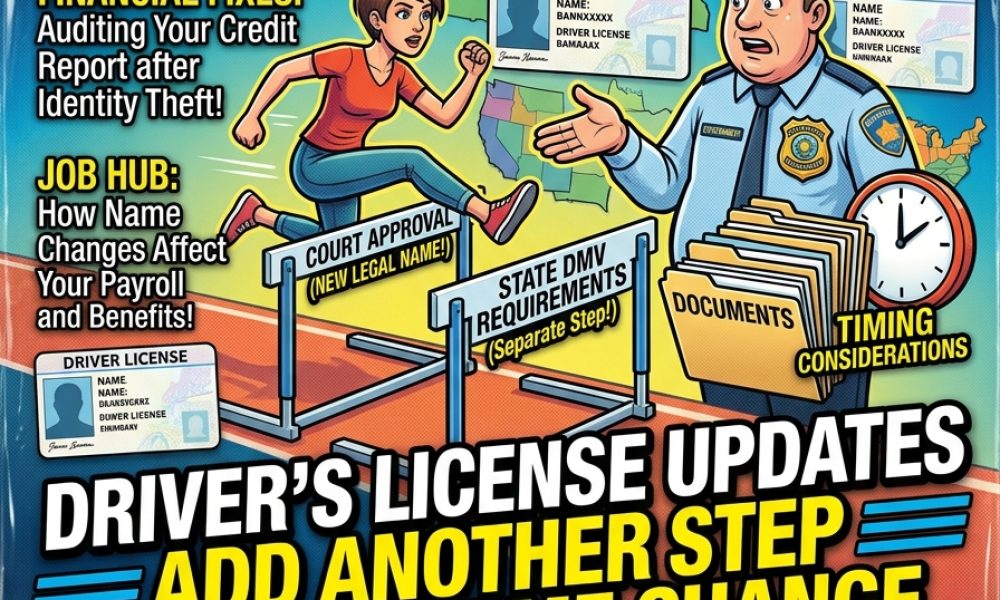
State Identification requirements may require separate documentation and have different timelines after a court approves an applicant’s new legal name.
Washington, DC, October 20, 2026 — A court order approving a legal name change does not automatically update a driver’s license; applicants must complete a separate state procedure to update the Identification document they use for driving and everyday transactions.
The process can involve supporting records, verification against other government Information, an office visit, and replacement fees, with requirements depending on the issuing jurisdiction, the type of credential, and the circumstances surrounding the applicant’s existing license.
Timing also matters because some states impose deadlines for reporting or completing a name change. At the same time, applicants may need another agency to update its records before the motor vehicle Authority can process the revised identifying Information.
For someone managing several document changes at once, the practical task is to identify the state’s current requirements early, prepare the correct evidence, and distinguish completion of an Application from receipt of the replacement Identification card.
The Court Order and License Serve Different Functions
A court order establishes the approved legal change. At the same time, the licensing agency maintains the driver record. It issues the credential, so the order supports a separate transaction rather than replacing the license itself.
Applicants should therefore check the instructions issued by the Authority responsible for their existing credential, rather than assume that the court sends a notification that automatically produces a revised card without any further action from the individual.
The distinction also applies to a state Identification card, because a person who does not drive may still need to update that credential through the issuing agency’s procedure even though no driving privilege is involved.
Starting with the required transaction can prevent confusion between a legal name update, an address change, a routine renewal, and a replacement for a lost card, each of which may have different eligibility requirements or submission options.
State Deadlines Should Be Checked Early
Texas provides a clear example of a jurisdiction with a specific timing requirement, directing applicants seeking a name change to visit a driver license office within thirty days and present acceptable documentation supporting the requested update.
The Texas Department of Public Safety’s name change instructions also identify replacement fees and documentary requirements, showing why applicants should review the relevant licensing procedure after obtaining a court order rather than waiting for the existing card to expire.
Florida similarly generally requires a replacement license or Identification card reflecting a legal name change within thirty days. However, its statutory framework includes exceptions and separate provisions that applicants must consider as they apply to their circumstances.
These examples are not a nationwide deadline, and anyone having difficulty getting an appointment or required document should contact the issuing agency promptly rather than assume an administrative delay automatically extends the applicable requirement.
Social Security Updates May Need to Come First
California directs applicants to update their names with the Social Security Administration before completing the corresponding license or Identification card change, because the DMV checks the Application Information against that federal record during verification.
That sequence demonstrates why separate government systems can create dependencies, even though updating Social Security does not itself submit the state Application, provide the required evidence, or cause the DMV to issue a replacement Identification card.
Applicants should distinguish confirmation that a federal request was received from confirmation that the relevant record was updated, particularly when the next agency relies on that Information to verify the name appearing on a new Application.
Confirm the appropriate sequence for the issuing state and credential involved, rather than assuming it from another applicant’s experience, especially when different eligibility categories or documentary circumstances affect how the state processes the requested change.
Supporting Documents Must Establish the Legal Change
States identify acceptable documents for different circumstances, with Texas listing a certified court order among the records supporting a name change unrelated to marriage and separately describing evidence applicable to marriage, divorce, or annulment situations.
Applicants should review what the document establishes, check the requested name and identifying particulars before presenting it, because an official record does not resolve a spelling error or an unexplained inconsistency within that record.
The form of the evidence also matters, since an ordinary photocopy may not satisfy requirements for an original or certified record, and an applicant should not assume that notarization makes every copy acceptable to the issuing agency.
If the relevant document was issued in another language, check translation requirements before the appointment to avoid an incomplete submission, especially because standards used by one state or agency may differ from those used elsewhere.
Earlier Name Changes Can Require Additional Evidence
An applicant whose current name differs from several older documents may need evidence connecting those records, rather than assume that the latest court order necessarily explains every change between the original identity document and the requested license.
California’s guidance expressly notes that applicants with earlier legal name changes may need proof of those changes, including events not previously reported to the DMV, making the full documentary sequence relevant in some cases.
A useful preparation step is to compare the names on the existing credential, identity evidence, and supporting orders, then ask the agency which connecting records it requires before you obtain additional certified documents or attend an appointment.
If an earlier record is unavailable, the issuing court or vital records Authority may be able to explain replacement options. At the same time, the licensing agency can identify whether another acceptable form of evidence addresses the particular gap.
Online Preparation May Still Require an Office Visit
An online Application does not necessarily mean the entire name change can be completed remotely, and California specifies that the process remains incomplete until the applicant visits a field office with the required documents.
That distinction can matter when an applicant receives an online confirmation and assumes the replacement card is already being produced, even though the confirmation may only indicate that Information has been entered for a later office transaction.
Before relying on an electronic submission, applicants should check whether they must schedule a visit, present original records, provide a photograph, or complete other steps that the agency requires before approving and issuing the updated credential.
Keeping the Application confirmation and appointment details together can make the visit easier to manage, while checking the location’s services helps avoid arriving at an office that cannot complete the particular transaction the applicant needs.
REAL ID Requirements Raise a Separate Question
Updating a name and obtaining a REAL ID-compliant credential are related but distinct tasks, so applicants should determine whether they are replacing an existing credential or requesting a different document type with additional evidence requirements.
Associated Press reporting on the start of REAL ID enforcement described the implementation of the federal Identification requirement in May 2025, highlighting why travelers should understand the status of their state credential rather than focus only on its printed name.
Applicants considering a REAL ID transaction should review the relevant state checklist for identity, residency, and other required evidence, rather than assuming that a court order establishing a new name proves every fact needed for that credential.
The choice should reflect the document’s intended uses and the applicant’s circumstances, with current official instructions determining what is required rather than a general assumption that every replacement license must involve the same documentation or federal Identification status.
Temporary Documents Have Limited Uses
A state may issue temporary documentation while producing the permanent card. Still, applicants should ask exactly what that document authorizes and how long it remains valid rather than assuming it is interchangeable with the finished credential.
This distinction matters for air travel because TSA guidance states that a temporary driver’s license is not an acceptable Identification document at the checkpoint, even when it serves a valid purpose under state licensing procedures.
Travelers awaiting a replacement card should therefore review TSA’s current acceptable Identification list and consider whether they have another qualifying document, such as a passport, rather than rely on the temporary paper credential as their planned Identification.
Other organizations may apply their own verification requirements, so anyone anticipating a significant transaction can ask beforehand what documents will be accepted during the transition instead of discovering the limitation only when Identification must be presented.
Vehicle Records May Require Additional Updates
Changing the name on a driver’s license should not be treated as confirmation that vehicle registration or title Information has also changed, because those records serve different functions and may require separate applications and supporting evidence.
California, for example, publishes a distinct procedure for changing a registered owner’s name, demonstrating that even records maintained by the same motor vehicle agency do not necessarily update together through a single license replacement transaction.
Applicants should also contact their insurer or vehicle lender when an update is needed and ask what documentation each organization requires, rather than assuming the state’s revised Identification card automatically updates a policy or financing record.
The objective is accurate continuity across the relevant documents, and a name update should be distinguished from transferring ownership, adding another owner, or modifying contractual rights, which can raise separate requirements beyond correcting the individual’s identifying Information.
Moving and Changing Names Can Create Overlapping Tasks
A person who relocates while changing their legal name may need to address both transactions, but should not assume that completing one notification satisfies the requirements for the other or that the same deadline necessarily applies.
Before submitting an Application, check your current residential and mailing details to prevent the replacement card from being sent to an unsuitable address, especially when other government records still contain Information associated with your earlier residence.
Applicants with personal safety concerns can ask about applicable address-confidentiality arrangements or restricted-disclosure procedures. Still, they should recognize that the availability and scope of those protections depend on the jurisdiction and the person’s eligibility under its rules.
Accurate Information remains essential, and you should resolve any question about using a substitute address through the authorized program or agency procedure, not by assuming a privacy concern permits unsupported Information on the Application.
Family and Travel Documents Remain Separate
A revised driver’s license may help establish a parent’s current identity. Still, it does not automatically amend a child’s records or explain every difference between the parent’s new name and Information appearing in older family documents.
The broader role of family Identification appears in Amicus International Consulting’s article on Mexico’s children’s passports and parental photographs. However, passport design and parental documentation remain separate matters from a state agency’s procedure for replacing a driver’s license.
Families should review each relevant document individually when preparing for travel or another transaction, and ask whether evidence connecting former and current names is required, rather than assuming the updated license resolves every question about relationships or Authority.
A United States passport also requires its own name-change procedure, so it helps to coordinate applications while keeping access to the identity documents needed for appointments, travel, and other activities during the period when replacements are being processed.
Receiving the Card Is an Opportunity to Verify
When the replacement credential arrives, promptly check the name, address, and other identifying details to catch any issues. At the same time, the Application records remain readily available, allowing the applicant to correct the issue before relying on the card elsewhere.
Applicants should also review the expiration date and credential type rather than assume a name-change transaction provides a full renewal period or changes every feature of the existing license, since state rules determine the applicable treatment.
If the card does not arrive within the agency’s stated delivery expectations, use the official status or contact procedure to clarify the situation. At the same time, the applicant must follow instructions for any temporary document and its remaining validity.
Completing the license update therefore requires more than presenting the court’s approval; it requires the correct state procedure, acceptable evidence, and timely follow-through. Hence, the revised credential accurately supports theindividual’ss continuing Identification and driving needs.




