
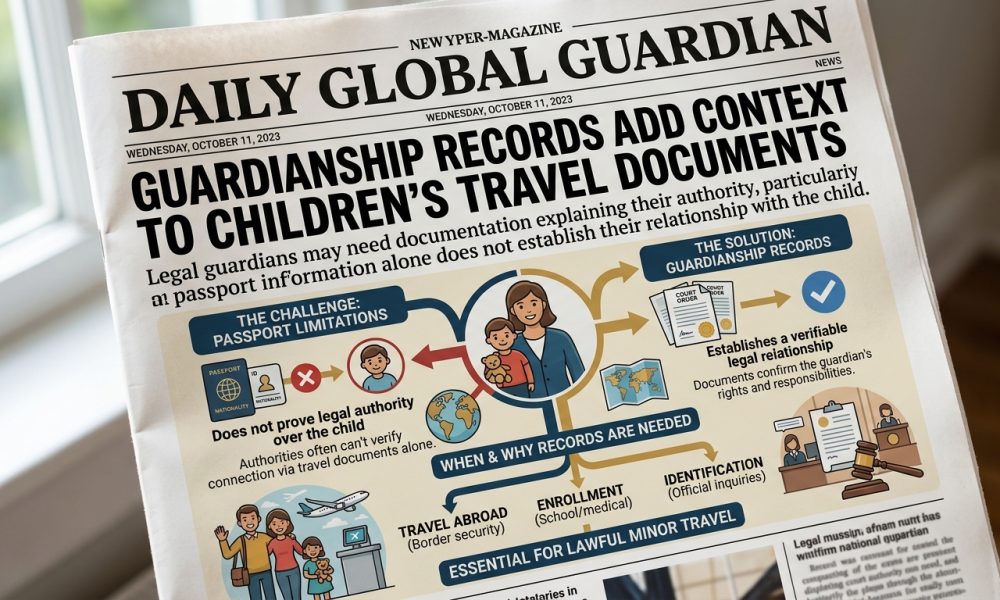
Legal guardians may need documentation explaining their authority, especially when passport Information alone doesn’t establish their relationship with the child.
WASHINGTON, DC, October 14, 2026 — Legal guardians accompanying children across international borders may need additional documentation showing their authority to make decisions for minors, especially when passports identify the child but do not explain the legal relationship between the traveler and the accompanying adult.
Government travel guidance from Canada, the United States, and the United Kingdom recognizes that passports, birth certificates, guardianship orders, and parental consent documents serve different legal purposes, requiring families and immigration authorities to distinguish identity verification from evidence of responsibility for a child.
These distinctions become especially important when children travel with court-appointed guardians, adoptive parents, relatives, temporary caregivers, or individuals whose legal responsibilities differ from those ordinarily associated with biological parentage.
Although a valid passport establishes essential Information about nationality and identity, it does not necessarily show that an accompanying adult has the legal authority to authorize international travel, decide on residence, or meet applicable guardianship requirements.
The growing complexity of international family arrangements underscores the importance of understanding how official guardianship records complement travel documents while protecting children and facilitating legitimate cross-border movement.
A Passport Identifies the Child but May Not Identify the Guardian
A passport is an internationally recognized travel document issued by a competent national authority, containing Identification Information that allows immigration officials to examine the holder’s nationality, photograph, document validity, and other particulars necessary for international travel.
For children, the passport generally serves the same Identification function as an adult travel document. However, issuing it may require additional procedures involving parents or legally recognized guardians, and a passport does not necessarily identify every adult with legal decision-making responsibility, particularly when guardianship was established after birth or through a judicial process that changed the child’s family circumstances.
An accompanying guardian may therefore hold valid Identification. At the same time, the child’s passport contains no Information connecting the two individuals, which can prompt immigration authorities to require supporting evidence of their relationship.
A court order, guardianship certificate, or comparable official document can help establish that connection, allowing authorities to assess the adult’s legal responsibilities without treating the absence of parental Information inside the passport as an irregularity.
The distinction shows why authorities may require both authentic travel documents and valid guardianship records, since each addresses a separate question about identity or legal authority.
Legal Guardianship Differs From Biological Parentage
Biological parentage and legal guardianship are related but distinct concepts: parentage generally concerns a legally recognized family relationship. In contrast, guardianship addresses responsibilities and decision-making powers conferred by applicable legislation or judicial authority.
In many jurisdictions, parents ordinarily have legal responsibilities for their children. Still, courts or other competent authorities may appoint guardians when parents cannot fulfill those responsibilities or when circumstances require alternative arrangements.
Guardianship may involve decisions about education, healthcare, residence, finances, or international travel, though the powers granted depend on the jurisdiction and the specific legal instrument establishing the arrangement.
A guardian may therefore have the authority to obtain Identification documents or authorize travel without being listed as a biological parent on the child’s original birth certificate.
Conversely, an adult who provides daily care or maintains a close family relationship does not necessarily possess every legal responsibility associated with guardianship, particularly where another individual retains authority over major decisions.
For international travel, officials may need to determine the accompanying adult’s specific legal powers rather than relying solely on family names, biological relationships, or informal caregiving arrangements.
Canada Recognizes Guardianship Documents as Supporting Travel Evidence
Canadian international travel guidance identifies court orders and other legal documents as potentially important supporting records when children travel abroad, especially when the accompanying adult’s decision-making authority isn’t apparent from the child’s passport.
According to the Government of Canada’s official guidance on travel documents for children, supporting paperwork may include birth certificates, consent letters, divorce records, custody orders, and other documents relevant to the child’s family circumstances.
These records help authorities distinguish the child’s identity from the accompanying adult’s legal responsibilities, particularly when a guardianship arrangement has been established through a court order or other recognized legal process.
Canadian guidance also recommends that children traveling without every parent or individual with decision-making responsibility carry a consent letter from those not accompanying them, where appropriate.
The recommendation does not create a universal Canadian legal requirement for consent letters. Still, it recognizes that immigration authorities and transportation operators may request supporting Information concerning the child’s travel arrangements.
For legal guardians, carrying relevant court documentation alongside the child’s passport can clearly show authority and help officials understand why the child’s family records may differ from conventional parental Identification documents.
Court-Appointed Guardians May Need to Demonstrate Their Authority
A court-appointed guardian derives legal responsibility from a judicial decision or another formally recognized legal process, so the relevant order may be important when demonstrating authority over a child’s international travel arrangements.
The order may identify the child, name the appointed guardian, describe the granted responsibilities, and set limitations or conditions on residence, international movement, or decisions requiring additional authorization.
These provisions matter because guardianship orders vary, and the authority to provide daily care does not necessarily include unrestricted permission to relocate a child or travel internationally.
When an order limits the guardian’s decision-making powers, the accompanying adult may need additional consent or judicial permission before leaving the country. Immigration officials may examine the operative provisions rather than simply confirming that a document contains the word guardianship or identifies the accompanying person.
Families should ensure that the supporting record accurately establishes the relevant authority and that the proposed travel complies with the order and any applicable national requirements.
Temporary Care Arrangements Require Particular Attention
Temporary caregiving arrangements can raise additional documentation questions because the adult supervising a child may have certain delegated responsibilities without permanent guardianship or exclusive decision-making authority.
These arrangements may arise when children live temporarily with relatives, participate in exchange programs, receive care through child welfare organizations, or travel under supervision arranged by their parents.
The legal authority of a temporary caregiver depends on the governing legislation and the specific arrangement, so it is inappropriate to assume that physical responsibility for the child automatically permits international travel.
Canadian guidance recognizes circumstances involving children in temporary care and recommends that the appropriate child welfare agency representative provide travel authorization when the agency holds the relevant responsibility.
Supporting documents may therefore include agency authorization, court orders, placement records, or other evidence establishing who possesses authority to approve the child’s journey.
The objective is to ensure that international travel arrangements reflect lawful decision-making responsibility while recognizing that temporary caregiving relationships differ from permanent parental or guardianship arrangements.
Parental Consent Remains Separate From Guardianship Identification
A guardianship document may establish that an adult has legally recognized responsibilities for a child. Still, those responsibilities do not automatically determine whether another person must approve a particular international journey.
Some guardianship arrangements allocate exclusive decision-making authority, while others preserve parental rights or require additional permission for significant decisions involving international movement.
Canada’s consent letter guidance recognizes this distinction by recommending written permission from individuals with decision-making responsibility who are not accompanying the child, even when existing parenting arrangements allow certain decisions to be made independently.
A consent letter can identify the child, accompanying adult, destination, travel dates, and the relevant authorizing individual, complementing the broader legal responsibilities established through guardianship records.
However, the letter cannot override a judicial restriction or confer authority on someone who lacks the legal right to grant permission.
Guardians should therefore consider both the powers established by their legal documents and any additional authorization requirements governing the intended international journey.
The United States Distinguishes Legal Relationships From Travel Permission
U.S. international travel guidance emphasizes the importance of carrying evidence of the legal relationship between children and accompanying adults, especially when the journey involves someone other than a parent.
The U.S. Department of State’s guidance on international travel with minors advises travelers to carry birth certificates or other evidence of the relationship. It explains that some destination countries require written authorization from parents or legal guardians.
American authorities also distinguish domestic passport and departure procedures from foreign requirements, recognizing that a child may possess a valid United States passport. At the same time, other governments require consent documentation.
The United States does not generally require proof of both parents’ permission for a minor to travel internationally. However, some foreign countries require notarized letters or evidence of sole legal custody.
For court-appointed guardians, relevant legal documentation may help establish the authority to accompany the child or approve the journey, depending on the destination’s requirements.
These distinctions reinforce the importance of reviewing the child’s legal circumstances and itinerary rather than assuming an authentic passport satisfies every requirement during international travel.
The United Kingdom Places Importance on Parental Responsibility
United Kingdom law provides another example of why guardianship records may matter during international travel, since the legal authority to take a child abroad can depend on parental responsibility and applicable judicial arrangements.
Official British guidance generally requires permission from everyone with parental responsibility or a court authorization before taking a child abroad, subject to recognized statutory exceptions and relevant court orders.
A guardian’s legal responsibilities may therefore affect whether additional permission is needed, particularly when several adults have legally recognized authority over the child’s welfare.
A court order may establish the relevant relationship or permit particular travel arrangements, but its practical effect depends on the powers granted and any restrictions imposed.
The rules also recognize circumstances involving child arrangements orders, illustrating how statutory exceptions may apply to some journeys without establishing unrestricted authority for every international movement.
For families traveling internationally, the key distinction is whether the accompanying adult has authority for the specific journey, not merely a close relationship with the child.
Adoption Documents May Establish a Different Legal Relationship
Adoption can create legally recognized parental relationships that differ from the Information appearing in a child’s original birth registration, making adoption records potentially important when authorities examine family relationships during international travel.
Depending on the jurisdiction, adoption may result in an amended birth certificate identifying the adoptive parents or a judicial order establishing their legally recognized status.
These documents can help explain why the child’s passport, original birth records, or earlier Identification documents contain different parental Information from the adults accompanying the child.
However, adoption and guardianship should not be treated as interchangeable because adoption can establish a permanent legal parent-child relationship. In contrast, guardianship arrangements may confer more limited or differently structured responsibilities.
International adoption cases may also involve records issued by several governments, creating additional considerations concerning translations, legal recognition, and the child’s nationality or immigration status.
Proper interpretation requires authorities to examine the legal effect of the relevant documents rather than assuming that differences between historical and current family records indicate an Identification problem.
Different Surnames Can Make Guardianship Evidence More Useful
Children and legal guardians may have different surnames because guardianship does not necessarily involve a legal name change or alteration of the child’s original civil registration records.
A grandparent, aunt, uncle, or unrelated court-appointed guardian may therefore accompany a child whose passport provides no immediate indication of their legal relationship.
These differences are not inherently suspicious, but they can make supporting documentation particularly useful when immigration officials need to understand why the adult is authorized to supervise or make decisions for the child.
A guardianship order can provide an official connection between the individuals, while additional Identification documents may help establish that the adult presenting the order is the person named within it.
If the guardian has since changed their name, marriage certificates or other official name-change records may also help explain differences between Identification documents.
This evidence clarifies lawful relationships without requiring children and guardians to share surnames or hold passports with identical family Information.
Mexico’s Electronic Passports Add Family Identification Features
Mexico’s electronic passport system illustrates a different administrative approach by incorporating additional Information concerning parents or legally recognized guardians into passports issued to minors.
The design can provide immigration authorities with Information linking a child to adults involved in passport issuance, including identifying details and photographs that may help during identity checks.
Amicus International Consulting examined these developments in Mexico’s Children’s Passports Include Parents’ Photos to Strengthen Travel Security, explaining how additional family Information complements modern passport security features.
However, Information recorded in a passport may reflect the circumstances at the time of issue, while guardianship arrangements can later change through judicial decisions or other legally recognized processes.
A passport containing guardian Information therefore cannot necessarily establish that the named adult retains every relevant legal power or that all conditions governing the proposed international journey have been satisfied.
Mexico’s approach demonstrates how additional family Identification can complement legal records without replacing the separate documentation necessary to establish current guardianship responsibilities.
Electronic Passport Authentication Cannot Verify Guardianship Rights.
Modern electronic passports incorporate contactless chips, digitally signed identity Information, and biometric security features intended to improve document Authentication and strengthen the reliability of international identity verification.
These technologies can help authorities determine whether protected passport data has been altered and whether the document matches the individual presenting it.
However, successful electronic Authentication does not, on its own, establish that an accompanying adult has guardianship rights or that existing judicial restrictions permit the child’s international journey.
A successful facial comparison between the child and the passport photograph similarly addresses identity rather than the legal relationship between the child and another traveler.
Even when guardian Information appears in the physical document, electronic passport checks should not be mistaken for a comprehensive review of current court records or family law responsibilities.
This distinction shows why governments still recognize supporting legal documentation despite advances in biometric Identification and secure electronic travel documents.
Dual Citizenship Can Introduce Additional Guardianship Questions
Children with multiple citizenships may face different requirements for guardianship, parental authority, and international departure, especially when the countries involved recognize different legal relationships or impose specific conditions on minors.
A guardianship arrangement established in one country may not automatically receive identical treatment in another jurisdiction, especially where foreign authorities require additional judicial recognition or documentary Authentication.
These circumstances become more complicated when a child holds passports issued by different governments or lives in a country other than where the guardianship order was granted.
The legal guardian may therefore need to establish both the child’s eligibility to travel and the recognition of their authority under the destination country’s rules.
Multiple citizenships do not independently eliminate these requirements, since nationality documentation and guardianship authority remain legally distinct considerations.
Families should therefore review the requirements of each relevant jurisdiction rather than assume that holding several passports resolves every question about the child’s international movement.
Guardianship Orders May Contain International Travel Restrictions
Court orders establishing guardianship can include restrictions on residence, relocation, parental contact, or international travel, so it’s important to review the specific provisions before arranging a trip.
An adult may have legally recognized responsibility for a child’s daily care while remaining subject to conditions that require court approval or another individual’s consent before international departure.
These limitations may be especially relevant where guardianship arose from contested proceedings or where a court established safeguards intended to preserve the child’s relationships with other legally responsible individuals.
A valid passport does not override such restrictions, and an accompanying guardian should not assume that physical possession of the document establishes unrestricted travel authority.
Where the relevant order is unclear, legal advice or judicial clarification may be necessary to determine whether the proposed journey complies with its terms.
Understanding these distinctions helps prevent misunderstandings between Identification requirements and the legal conditions imposed by competent courts concerning a child’s movement.
International Recognition of Guardianship Records Can Vary
Guardianship documents issued by one country may need additional formalities before authorities in another jurisdiction recognize their legal significance, particularly where the document originates from a different legal system or language.
Some countries may require certified translations, apostilles, legalization, or judicial recognition before accepting particular foreign legal records for purposes extending beyond routine identity examination.
These requirements can depend on the destination, the document’s intended purpose, and whether the relevant countries participate in applicable international legal arrangements.
A guardianship order that establishes authority domestically may therefore need additional examination before foreign authorities determine its effect within their own legal systems.
However, families should not assume every international journey requires formal recognition of a foreign guardianship order, since documentary requirements vary considerably by country.
The appropriate approach is to verify the destination jurisdiction’s requirements and determine which supporting documents are necessary for the specific circumstances of the journey.
Airlines and Immigration Authorities Have Different Responsibilities
Airlines review travel documents before transport to determine whether passengers appear to meet applicable entry requirements and the carrier’s operational obligations. At the same time, immigration authorities apply the legal rules governing international movement.
A legal guardian traveling with a child may therefore face documentary questions at airline check-in when the destination requires evidence of guardianship or parental permission.
However, airline acceptance does not guarantee that immigration authorities will consider every legal requirement satisfied, particularly where the child is subject to a judicial restriction or unusual guardianship arrangement.
Similarly, additional questions during boarding do not necessarily indicate that the child’s passport is invalid or that the guardian lacks lawful authority.
Supporting records can help explain the legal relationship, allowing officials to distinguish document Authentication from the separate question of authorization for the proposed travel.
Preparation can reduce uncertainty by ensuring that the child and guardian possess the appropriate documentation for the destination and circumstances.
Privacy Considerations Surround Guardianship Documentation
Guardianship records can contain sensitive Information about children, parents, family disputes, medical circumstances, or judicial prproceedingsand hahandling them carefullys imimportanthen prpresenting them duringnternational travel.
A court order may include considerably more Information than an immigration officer needs to establish the accompanying adult’s authority, creating legitimate concerns about unnecessary copying or disclosure.
Families should determine whether certified extracts, relevant pages, or other accepted forms of documentation can satisfy the applicable requirements without exposing unrelated private Information.
However, any disclosure limitation must remain consistent with the receiving authority’s rules, since some procedures require complete documents or formally authenticated copies.
Secure handling is especially important when families transmit documents electronically to airlines, travel organizations, or other service providers.
The objective is to provide sufficient evidence of lawful guardianship while respecting children’s privacy and the privacy of individuals identified in their legal records.
Advance Preparation Helps Families Avoid Travel Disruptions
Legal guardians preparing to travel internationally with children should determine which documents show their authority and whether the intended journey requires additional consent or judicial permission.
A valid passport remains essential, but guardianship orders, birth certificates, adoption records, and consent letters may provide supporting Information relevant to the particular family circumstances.
The appropriate combination depends on the child’s nationality, the guardian’s legal responsibilities, the destination’s requirements, and any existing judicial conditions affecting international travel.
Families should also consider whether foreign authorities require translations, original documents, certified copies, or other formalities before recognizing particular guardianship records.
If the legal effect of a guardianship arrangement is uncertain, professional advice may clarify the applicable requirements before the child leaves the country.
Careful preparation supports lawful international mobility while reducing the risk of avoidable delays caused by unclear documentary evidence or misunderstandings concerning the guardian’s authority.
Conclusion: Guardianship Records Complete the Legal Picture
Guardianship records add an important dimension to children’s international travel documentation because passports establish identity and nationality without necessarily explaining the legal relationship between a minor and the adult responsible for the journey.
Court orders, guardianship certificates, adoption records, and consent letters can provide additional Information concerning parental responsibilities and travel authorization, allowing authorities to examine matters that cannot be established through passport Identification alone.
Government guidance from Canada, the United States, and the United Kingdom demonstrates that children traveling under different family arrangements may require different supporting records, particularly when guardianship responsibilities extend beyond conventional biological parentage.
Mexico’s inclusion of additional parental and guardian Identification features shows how passport design can support family Identification. However, these features do not replace the legal records that govern guardianship and international travel authority.
Ultimately, reliable child travel security depends on recognizing the separate functions of passports and guardianship documents, ensuring that legitimate journeys proceed with appropriate authorization. In contrast, children’s legal rights and welfare remain protected.




