
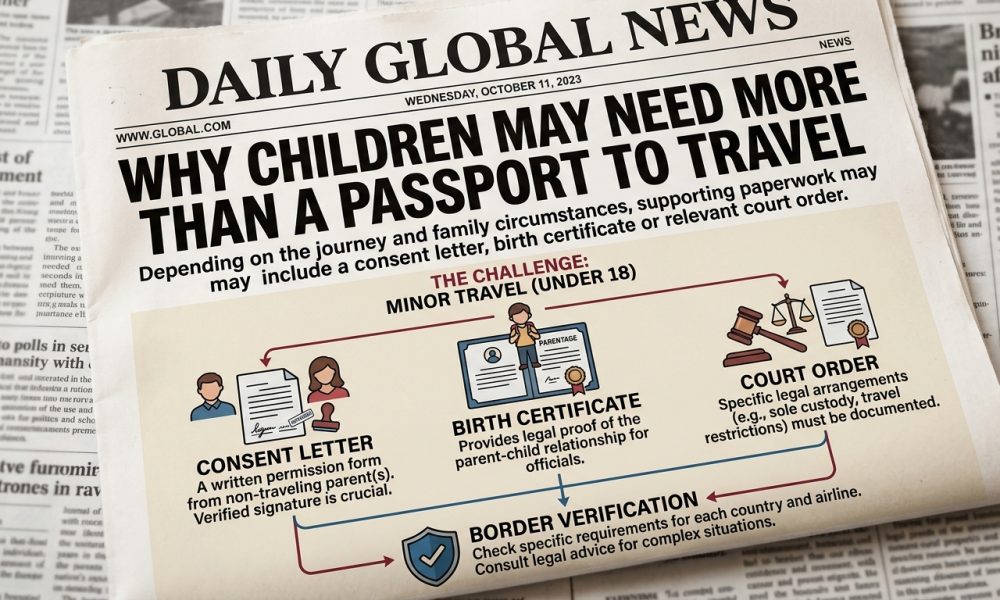
Depending on the journey and family circumstances, supporting paperwork may include a consent letter, birth certificate, or relevant court order.
WASHINGTON, DC, October 14, 2026 — Children traveling internationally may require additional documents beyond their passports, particularly when they are accompanied by only one parent, relatives, legal guardians, or unrelated adults, because immigration authorities must sometimes establish not only the child’s identity and nationality but also the legal authorization governing the journey.
Although passports provide internationally recognized Identification and support the examination of nationality, document Authenticity, and travel eligibility, they do not necessarily establish parental relationships, current guardianship responsibilities, or whether individuals possessing relevant legal rights have authorized the proposed international movement.
Government travel guidance from Canada, the United States, and the United Kingdom illustrates how different jurisdictions distinguish passports from supporting records, including birth certificates, parental consent letters, custody orders, adoption documents, and other evidence relevant to the lawful movement of minors.
These additional requirements do not apply the same way to every family or destination, so travelers should understand when authorities may request supporting documentation rather than assuming every child must carry the same set of documents.
For internationally mobile families, understanding the purpose of each record can help prevent avoidable travel disruption while supporting legitimate child Protection safeguards and respecting parents’ and guardians’ legal responsibilities.
A Valid Passport Does Not Answer Every Travel Question
A passport establishes an internationally recognized travel identity. It provides Information about the holder’s nationality, photograph, biographical details, issuing authority, and validity, allowing immigration officials to assess whether the individual has appropriate Identification for international travel.
For children, passport issuance generally involves additional administrative procedures because minors may lack the legal capacity to obtain travel documents independently, requiring the participation or authorization of parents, guardians, or other legally recognized representatives.
However, the authorization obtained when a passport was issued does not necessarily permit every subsequent journey, particularly when family circumstances change through divorce, separation, guardianship proceedings, or judicial restrictions on international movement.
A child may therefore hold a valid passport. At the same time, an accompanying parent must still show that the proposed trip complies with applicable legal responsibilities or a court order governing international travel.
These situations show why passport Authentication and travel authorization must be considered separately, since confirming a document belongs to its legitimate holder does not, by itself, resolve questions about parental consent.
This distinction matters most for families traveling internationally under shared parenting arrangements, where possession of the child’s passport may not show that one parent has unrestricted authority to approve departure or relocation.
Birth Certificates Establish Family Relationships
Birth certificates often provide supporting evidence for international travel because they record a child’s birth Information and, depending on the issuing jurisdiction, identify the parents listed in official civil registration documents.
Unlike passports, which primarily identify travelers and their nationality, birth certificates can help establish parentage when immigration authorities need to understand the relationship between a child and an accompanying adult.
These records may become particularly relevant when a child and parent have different surnames, since the passport may establish both travelers’ identities without explaining their legal or biological relationship.
A birth certificate can clarify the recorded connection, but adoption certificates, guardianship orders, and other legally recognized documents may provide stronger evidence when family arrangements have changed.
The United States Department of State advises families traveling internationally with minors to carry a copy of each child’s birth certificate or other evidence of the legal relationship between the accompanying adult and the child.
Nevertheless, a birth certificate does not automatically establish permission for international travel because identifying a parent and determining that individual’s legal authority over a particular journey are separate questions.
Parental Consent Letters Provide Evidence of Permission
A parental consent letter is a written statement indicating that an individual with relevant parental or legal decision-making responsibility has authorized a child to undertake a particular international journey without that person accompanying them.
Such letters typically identify the child, accompanying adult, destination, proposed travel dates, and the parent or guardian providing authorization, helping officials understand the nature and scope of the consent.
The Government of Canada’s official guidance on consent letters for children traveling abroad recommends that children traveling without one or more parents or legal guardians carry written authorization from the individuals who are not accompanying them.
Canadian authorities clarify that consent letters are not universally required under Canadian law, although immigration officials, airline representatives, and foreign border authorities may request them depending on the circumstances.
Some countries maintain their own prescribed forms or Authentication requirements, so a letter acceptable in one jurisdiction may not meet another government’s documentary rules.
Consequently, families should verify destination-specific requirements before departure, particularly where notarization, original signatures, or supporting Identification documents may be necessary.
Traveling With Only One Parent May Require Additional Documentation
International travel with only one parent can raise documentation questions when another person continues to exercise parental responsibilities, especially when separation, divorce, or shared guardianship arrangements affect decisions about a child’s international travel.
A passport may identify the child and remain valid throughout the journey. However, the accompanying parent may still need a consent letter, relevant court order, or other documentation addressing the legal authority to travel.
Specific requirements depend on the countries involved, since some jurisdictions recommend parental consent letters, while others require mandatory authorization procedures in certain circumstances.
The United States generally does not require proof of both parents’ permission for a minor to travel internationally. However, foreign governments may require additional documentation for children entering or departing their territory.
These differences show why departure requirements cannot be assumed to determine the destination’s documentary rules, especially when the itinerary involves multiple countries.
Parents should therefore distinguish between holding a passport and the legal authority governing international travel, and ensure they respect existing parenting arrangements and any relevant court conditions.
Divorce and Separation Can Affect International Travel
Divorce and separation may change the practical arrangements governing a child’s residence while leaving both parents with legally recognized responsibilities concerning major decisions, including travel, relocation, or the child’s place of residence.
A parenting agreement may specify notice periods, consent requirements, geographic restrictions, or conditions affecting international travel, so it’s important to review the legal terms rather than rely on informal understandings.
Physical custody and legal decision-making responsibility are not necessarily identical, since some jurisdictions distinguish between the parent responsible for daily care and the individuals authorized to make significant decisions concerning the child.
An accompanying parent may therefore hold the child’s passport and primary residential responsibility while still needing another parent’s consent before undertaking certain international journeys.
Conversely, an appropriate court order may authorize travel without additional consent, depending on the legislation and legal circumstances governing the particular family.
These differences show why families should review their parenting arrangements carefully before arranging international travel, especially when the journey involves extended stays or circumstances resembling relocation.
Court Orders May Establish Travel Authority
Court orders can provide important evidence when parental consent is unavailable, disputed, or legally unnecessary because a judicial decision has allocated relevant guardianship or decision-making responsibilities to a particular individual.
Such orders may address exclusive parental authority, permission for international travel, restrictions on removing a child from a jurisdiction, or conditions affecting the child’s residence and contact with another parent.
However, the legal effect of a court order depends on its wording and the jurisdiction that issued it, so an order concerning residence does not necessarily grant unrestricted authority to travel internationally.
Families should also recognize that foreign immigration officials may require copies or explanations of judicial documents, particularly when the document’s legal significance is not immediately apparent.
Where proceedings remain unresolved, a parent may need judicial clarification rather than assuming that possession of the child’s passport or birth certificate provides sufficient authority.
A court order can therefore serve a function that neither a passport nor a birth certificate can on its own, establishing legally recognized responsibilities relevant to the proposed journey.
The United Kingdom Maintains Specific Parental Permission Rules
The United Kingdom provides an example of a jurisdiction where the legal responsibility to obtain permission for international travel can extend beyond having valid passports or evidence identifying the accompanying parent.
Under official United Kingdom guidance on permission to take a child abroad, an individual generally must obtain authorization from everyone with parental responsibility or court permission before taking a child outside the country.
The guidance also recognizes exceptions, including when a child arrangements order provides that the child lives with a named individual, subject to statutory conditions and any additional judicial restrictions.
A signed letter from another person with parental responsibility may ordinarily provide evidence of permission, although the document’s legal sufficiency depends on the circumstances and applicable requirements.
These rules show that an adult may be a legally recognized parent but still need to obtain another individual’s authorization before taking the child abroad.
The United Kingdom’s approach therefore reinforces the distinction between identifying parental relationships and meeting the legal requirements for a specific international journey.
Grandparents and Other Relatives May Need Supporting Papers
Children frequently travel internationally with grandparents, siblings, aunts, uncles, and other relatives, creating situations where the accompanying adult may have a legitimate family relationship without parental decision-making authority.
When supporting documentation is recommended or required, a consent letter can show that the adults legally responsible for the child have authorized the proposed travel arrangements.
A birth certificate may help establish parentage, while additional records may be useful when the accompanying relative’s relationship to the child is not immediately apparent from ordinary Identification documents.
However, biological or extended family relationships do not independently establish guardianship, making it important to distinguish the authority to accompany a child during a journey from the broader legal responsibility for major decisions.
A grandparent supervising a holiday may have written parental permission for that trip without gaining permanent guardianship or unrestricted authority over the child’s future international travel.
Supporting documentation therefore clarifies legitimate travel arrangements while ensuring the child’s legally responsible parents or guardians remain appropriately involved.
School Groups and Organized Travel Require Special Preparation
International school excursions, athletic competitions, cultural exchanges, and organized youth activities often involve children traveling without their parents. Hence, additional documentation helps establish the authority of teachers, coaches, and group supervisors.
Depending on the countries involved, organizers may collect parental consent letters, emergency contact Information, medical authorizations, and copies of relevant Identification documents before departure.
These arrangements show that the accompanying adults have permission to supervise the children during the organized journey, but that permission does not automatically replace government immigration requirements.
Some destinations recognize particular procedures for organized youth groups, while others apply their ordinary minor travel requirements regardless of whether the child is participating in an educational or athletic activity.
Airlines may also require group documentation, supervision, and specific handling of children during connections or unexpected disruptions.
Effective preparation therefore requires organizers to understand both immigration rules and the responsibilities of supervising minors traveling temporarily without their parents.
Unaccompanied Minors May Face Additional Requirements
Children traveling internationally without an accompanying adult can face additional administrative requirements because immigration authorities and transportation operators may need Information concerning both the adults authorizing the journey and those responsible for receiving the child.
Depending on the destination, relevant documents may include a signed parental consent letter, a birth certificate, the responsible guardian’s Identification details, and Information about the person collecting the child upon arrival.
Airlines may operate unaccompanied minor programs with separate age limits and supervision procedures, requiring advance arrangements before accepting certain children for international transportation.
These commercial arrangements do not necessarily replace immigration requirements, since the airline’s responsibility for supervising a child during transportation differs from the legal permission required for international movement.
The person meeting the child at the destination may also need Identification or authorization paperwork, especially if the receiving adult is not a parent or legal guardian.
Families should confirm applicable government requirements and airline procedures before departure to ensure the child’s journey and arrival are properly documented.
Adopted Children May Need Additional Family Records
International travel involving adopted children can require supporting documents when the passport, birth certificate, or Identification records reflect family relationships established through legally recognized adoption procedures.
An adoption order or amended birth certificate may provide evidence identifying the adoptive parents, particularly where the child’s earlier registration records contain different parental Information.
These differences are not inherently suspicious because adoption may lawfully change who is recognized as a parent and what Information is recorded in subsequent government documents.
Some international adoption circumstances may also involve citizenship certificates, immigration approvals, or additional documentation establishing the child’s legal status in the receiving country.
A valid passport remains important for international Identification, but adoption records may also show the accompanying adult’s relationship to the child.
Understanding these documents helps families address legitimate Identification questions without treating differences between earlier and later family records as evidence of improper documentation.
Mexico’s Child Passports Include Additional Parental Identification
Mexico’s electronic passport system shows how governments can include additional Information about parents or guardians directly in travel documents issued to minors, supplementing the Identification details ordinarily associated with the passport holder.
The Mexican design includes parental or guardian Identification Information, offering authorities an additional official reference when examining documents presented by children traveling with their families.
Amicus International Consulting examined these features in Mexico’s Children’s Passports Include Parents’ Photos to Strengthen Travel Security, explaining how including parental photographs and identifying particulars complements the country’s broader electronic passport modernization.
Although these features may help establish the identity of parents or guardians associated with passport issuance, they do not independently determine whether a particular international journey satisfies applicable consent requirements or judicial restrictions.
Countries may also differ on whether they recognize Information printed inside a passport as sufficient evidence of parentage, so it’s important to consider the destination’s documentary requirements.
Mexico’s approach shows how enhanced passport Identification can complement separate legal safeguards without eliminating the need for additional records in complex family arrangements.
Dual Citizenship Can Complicate Child Travel Requirements
Children with more than one nationality may face additional documentary requirements because countries can impose different passport and departure rules on individuals they recognize as citizens.
A child traveling with two valid passports may be required to use a particular national passport when entering or departing a country of citizenship, regardless of the travel document used elsewhere.
Parental consent obligations can also differ between jurisdictions, creating circumstances in which the country of departure imposes additional conditions that are not apparent from the destination’s requirements.
These issues may become particularly important for families residing internationally, especially where parents hold different nationalities or the child has citizenship through both birthplace and descent.
Having an additional passport does not eliminate parental responsibilities or automatically override court orders governing the child’s international movement.
Families should therefore consider the legal requirements of each nationality and jurisdiction rather than assuming multiple passports provide interchangeable solutions to every travel authorization question.
Airlines and Border Authorities Perform Different Checks
Airlines examine documents to determine whether passengers appear to meet transportation and destination requirements, while government immigration authorities remain responsible for applying the legal conditions governing admission and departure.
An airline may request a consent letter or supporting family documentation when its procedures or applicable destination regulations require such evidence, even when the child possesses a valid passport.
However, airline acceptance does not guarantee that immigration authorities will consider every documentary requirement satisfied, particularly where additional questions arise concerning guardianship or applicable court restrictions.
Similarly, a government’s general recommendation to carry a consent letter does not necessarily mean that every airline must request one before boarding.
These differences can confuse families who complete an airline document check but face additional questions during immigration inspection.
Advance verification of carrier policies and government requirements remains important because each organization may examine different aspects of the child’s documentation.
Electronic Passport Security Cannot Establish Travel Consent.
Modern electronic passports incorporate sophisticated security features intended to authenticate documents and support identity verification, including contactless chips, digitally signed Information, and biometric Identification data.
These technologies can help establish whether the electronic Information recorded inside a passport has been altered and whether the document corresponds to the legitimate holder.
However, successful electronic Authentication cannot independently determine whether a non-traveling parent has approved the journey or whether an accompanying adult possesses the required legal authority.
Even where the passport includes parental photographs or identifying Information, the electronic document remains primarily an identity and nationality record rather than a comprehensive statement of current guardianship responsibilities.
A court order or consent letter may therefore address legal questions that a facial comparison or successful passport chip Authentication cannot resolve.
The distinction shows why authorities must consider physical and electronic passport security alongside family law documentation and appropriate immigration procedures when examining international travel involving minors.
Family Circumstances Can Change After Passport Issuance
A child’s passport may remain valid for several years while the legal relationships surrounding the child change considerably through divorce, separation, adoption, guardianship decisions, or the death of a parent.
Consequently, the Information recorded during the passport Application may remain historically accurate without describing every legal responsibility applicable at the time of a subsequent journey.
An accompanying adult may therefore need to present updated supporting records explaining changes in parental responsibilities or establishing why another individual’s consent is unnecessary.
These records may include court orders, adoption documents, death certificates, or other legally recognized evidence, depending on the circumstances.
The need for additional documentation does not necessarily mean the passport is defective, since its primary role remains identifying the child and recording the nationality issued by the issuing authority.
Understanding this distinction helps families prepare the right documents without expecting the passport itself to serve as a continuously updated record of family law arrangements.
International Child Protection Requires More Than Document Authentication
Child travel documentation procedures also support broader efforts to prevent unauthorized international movement, including circumstances involving disputed custody arrangements and potential international parental child abduction.
An individual may be the child’s biological parent and have authentic Identification but still lack the legal authority required for a particular international journey.
This possibility shows why establishing parental identity alone cannot determine whether travel complies with applicable guardianship arrangements or judicial restrictions.
Supporting documents can help authorities examine these issues, but no single consent letter, passport, or birth certificate guarantees that every underlying legal question has been resolved.
Effective child Protection therefore depends on combining appropriate Identification procedures with reliable legal Information and competent assessment of the circumstances surrounding international travel.
The objective is to facilitate lawful family mobility while ensuring that children are not transported internationally in violation of legally recognized parental responsibilities or protective court orders.
Families Should Verify Requirements Before Departure
Government guidance emphasizes reviewing the documentary requirements for the destination, departure country, child’s nationality, and family circumstances before finalizing international travel arrangements.
A family traveling with both parents may face different requirements than one traveling under a shared parenting agreement. At the same time, an unaccompanied minor may need documentation unrelated to a typical family holiday.
The documents appropriate for one journey may also differ from those required for another because destination regulations, guardianship arrangements, and the identity of accompanying adults can change.
Parents should consider whether the relevant authorities require original documents, certified copies, notarized signatures, or specific authorization forms rather than assuming that ordinary photocopies will always be accepted.
When an existing judicial order governs international travel, professional legal guidance may be necessary to determine whether the proposed itinerary complies with the court-imposed conditions.
Careful preparation supports efficient travel procedures while ensuring that Identification, parentage, and legal authorization questions are addressed through the documents appropriate to each issue.
Conclusion: Supporting Documents Protect Lawful Child Travel
Children may need more than a passport for international travel because identity, nationality, parentage, guardianship, and legal permission raise different questions that governments may address through separate official records.
A passport provides internationally recognized travel Identification, a birth certificate can help demonstrate parental relationships, and a consent letter may show that legally responsible adults have authorized the journey.
Court orders, adoption documents, and other supporting records can matter when family circumstances involve separation, sole decision-making responsibility, guardianship arrangements, or judicial restrictions on international movement.
Canada, the United States, the United Kingdom, and Mexico use different approaches that show how governments balance reliable Identification with legal safeguards meant to protect children during international travel.
Ultimately, effective child travel preparation requires understanding each document’s purpose, verifying applicable government requirements, and recognizing that even the most sophisticated passport cannot independently establish every legal permission for a minor’s international journey.




