
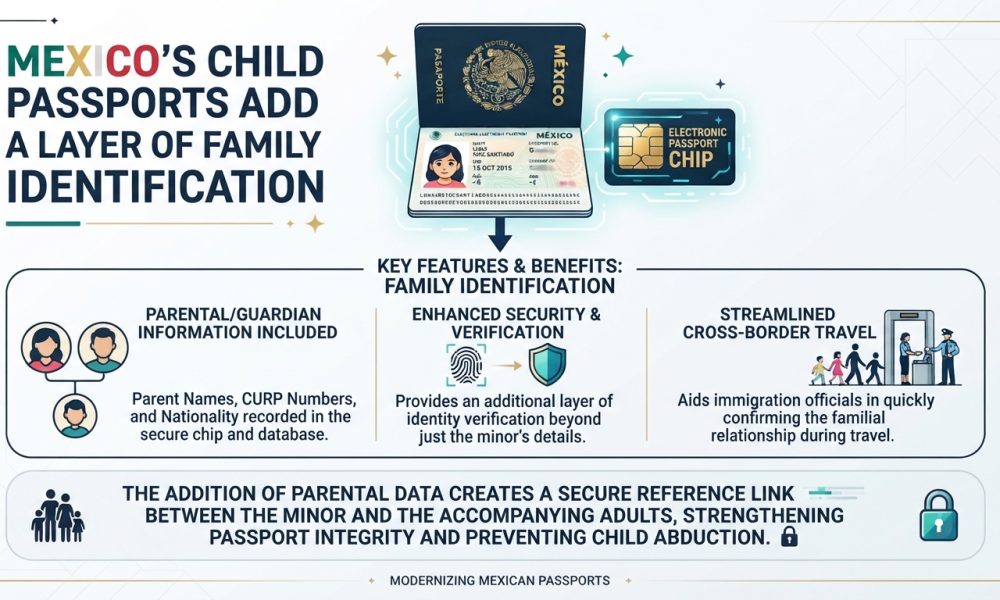
Parental Information in Mexican electronic passports for minors provides an additional reference for identifying the adults connected to the child’s passport issuance.
WASHINGTON, DC, October 14, 2026 — Mexico’s electronic passport system has introduced an additional dimension of family Identification into international travel documentation by incorporating parental and guardian Information into passports issued to minors, providing immigration officials and other authorized authorities with a visible reference connecting a child’s identity to the adults legally responsible for the passport Application.
This development reflects an evolving international approach to passport security in which governments increasingly recognize that verifying a child’s citizenship and personal identity is only part of the broader challenge of protecting minors during international travel, especially when questions arise about parental authority, guardianship, consent, or family relationships.
By including identifying Information about parents or legally recognized guardians within the passport booklet, Mexico has created an additional documentary reference that complements existing citizenship verification procedures, biometric security features, and administrative safeguards intended to strengthen confidence in the issuance and examination of travel documents.
Mexico Introduced Family Identification With Its Electronic Passport
Mexico began introducing its redesigned electronic passports in 2021, incorporating a polycarbonate Information page, an embedded electronic chip, and additional security features to strengthen document integrity and improve the reliability of identity verification at international borders and consular facilities.
During the official introduction, Mexico’s Ministry of Foreign Affairs emphasized that passports issued to children would incorporate Information about their parents or guardians, establishing a distinctive feature within the redesigned booklet that connected family Identification to the broader modernization of Mexican travel documents.
According to the Mexican Ministry of Foreign Affairs announcement introducing the electronic passport, the first interior page of passports issued to minors contains parental or guardian Information presented in color, reflecting the government’s intention to expand the Identification Information available within the physical document.
The initiative was presented as part of a broader government effort to improve passport reliability while providing additional Protection for children and certain individuals with disabilities who require legally recognized assistance in obtaining official Identification and travel documentation.
Although including parental photographs and identifying Information does not independently establish permission for every international journey, it creates a readily accessible record of the adults associated with the child’s passport issuance. It strengthens the documentary context available during an identity examination.
How the Parent Information Page Works
Unlike the principal passport Information page, which identifies the document holder and supports verification of nationality, identity, and document validity, the additional family Identification section provides Information concerning the individuals who exercise parental authority or legal guardianship over the minor.
Mexico’s published specifications for electronic passports include the relevant adult’s full name, nationality, population registration Information (where applicable), photograph, and signature, providing several identifying elements in a single official document associated with the child.
The resulting Information allows an authorized examiner to compare the printed details with other documents presented by an accompanying adult. However, any conclusion about legal authority must still account for applicable laws, current circumstances, and supporting evidence.
For example, when a child travels with a parent whose identity appears within the passport, an immigration officer may use the additional Information as a reference during a routine document examination, alongside the adult’s passport and any other documentation required for that journey.
When a child travels with a relative, school representative, family friend, or other accompanying adult, the printed Information may also provide useful Background on individuals connected with the passport Application, without establishing that those individuals have authorized the particular journey.
This distinction matters because a child’s passport contains Information, rather than substituting for parental consent, custody documentation, or destination-specific travel requirements.
A Different Approach to Child Passport Security
Traditional passport systems generally focus their primary Identification features on the document holder, combining biographical Information, a photograph, machine-readable Information, and increasingly sophisticated electronic Authentication capabilities to help authorities establish that a passport belongs to its legitimate bearer.
For children, however, the surrounding legal circumstances can be considerably more complex because the person holding the passport may lack the legal capacity to independently authorize its issuance or international travel, making parental consent and guardianship verification particularly important.
Mexico’s approach acknowledges this distinction by incorporating family Identification into the physical passport booklet, supplementing the personal Identification features that remain essential for confirming the child’s identity and the Authenticity of the document itself.
This additional Information may be particularly relevant when family names differ, parents hold different citizenships, or only one parent accompanies a child, since these circumstances can create legitimate questions that require clarification during international travel.
Nevertheless, different surnames, family arrangements, or travel patterns should not automatically be interpreted as suspicious, because lawful family relationships include adoption, remarriage, guardianship, blended households, and numerous other circumstances that may not be immediately apparent from a passport.
The purpose of an additional documentary reference is therefore to support informed examination rather than to replace the individualized Judgment of immigration officers or impose assumptions about how legitimate family relationships should appear.
Why Parental Photographs Provide Additional Context
Photographs remain among the most immediately recognizable forms of identity Information because they let human examiners compare a person’s visible appearance with an Image recorded during an official government procedure. However, photographs alone cannot conclusively establish legal identity.
In Mexico’s child passport design, including parental or guardian photographs provides a supplementary visual reference that officers can consider alongside names, signatures, population registration Information, and documents presented during the inspection process.
An officer examining a child’s passport may therefore have more Information available than would ordinarily appear in a travel document containing only the minor’s biographical data, potentially reducing uncertainty when the accompanying adult is one of the individuals recorded.
However, a printed photograph cannot establish that parental authority remains unchanged after issuance, because custody arrangements, guardianship orders, family circumstances, and other legally relevant relationships can change during the validity period of a passport.
Similarly, a visual resemblance between an accompanying person and a photograph should never be treated as conclusive proof of lawful travel authorization, particularly where other Information suggests that additional documentation or official verification is necessary.
Effective child travel security consequently depends on combining documentary Information with appropriate legal checks, recognized consent procedures, and professional assessment, rather than assuming that any single photograph or printed Identification field provides a complete answer.
The Electronic Chip Strengthens Document Authentication
Mexico’s electronic passport modernization also introduced an embedded contactless chip designed to store Information associated with the legitimate passport holder, allowing compatible inspection equipment to conduct electronic document checks using internationally recognized passport technologies.
These electronic capabilities serve a different purpose than the personal Information printed inside the booklet, since chip Authentication primarily verifies the integrity and origin of digitally stored passport data and supports the holder’s identity.
Under internationally recognized electronic passport standards, properly implemented passive Authentication can help determine whether electronically signed Information has been altered, provided the inspection system possesses and correctly uses the relevant trusted certificate Information.
This process does not automatically determine whether an accompanying adult possesses parental authority, nor does it establish that all family Information printed elsewhere in the booklet is electronically authenticated through the same mechanisms used for the passport holder.
The distinction illustrates how modern passport security increasingly combines physical document features, electronic Authentication, official population records, and supporting administrative procedures, with each component addressing a particular aspect of identity or document reliability.
For minors, the combined approach can offer broader assurance than any single security feature, provided authorities understand the capabilities and limitations of the Information available and apply relevant legal requirements during the inspection.
Mexico’s Official Specifications Establish the Information Requirements
Mexico’s published passport specifications provide the legal foundation for these additional Identification features and describe the physical characteristics, personalization requirements, and security elements incorporated into the electronic passport booklet introduced during the modernization program.
The official Mexican government agreement establishing electronic passport content specifically provides for printed Information for those exercising parental authority or guardianship, including identifying details, photographs, and signatures associated with eligible passport holders who require such representation.
This formal description matters because it distinguishes the family Identification feature from an optional visual addition, showing that the Information is part of the officially prescribed design of Mexico’s electronic passport system.
The regulations also explain why the Information appears in a separate section rather than replacing the principal Identification elements, which remain dedicated to the passport holder and the international requirements governing travel documents.
Mexico’s framework therefore shows how a government can add national security and administrative features while maintaining the internationally recognizable structure needed for passport examination, machine-readable processing, and electronic identity verification.
At the same time, an official specification should not be interpreted as guaranteeing that every passport issued under different historical formats, special circumstances, or transitional arrangements contains identical features or Information.
Parental Consent Begins Before the Passport Is Issued
The inclusion of parental Identification inside the completed passport represents only one stage of a broader administrative process, since Mexican authorities also establish requirements governing the Identification and consent of parents or persons exercising legal authority.
Applicants seeking a Mexican passport for a minor generally must establish the child’s nationality and identity while satisfying the applicable requirements concerning parental participation, legally recognized guardianship, and supporting Identification documents during the Application procedure.
Where both parents exercise parental authority, the applicable procedures ordinarily require their consent. However, Mexican regulations recognize alternative methods and specific legal circumstances that allow authorization to be provided remotely or through other accepted mechanisms.
These provisions are especially relevant to families living in different countries, parents unable to attend the same appointment, and circumstances involving judicial orders or exclusive parental authority, where authorities may require additional evidence before issuing the passport.
The identity Information ultimately printed inside the document should therefore be understood in the context of the issuance process, during which officials assess the documentation and legal authorization presented at the time of Application.
The passport’s subsequent use for international travel remains a separate matter. It may involve additional requirements imposed by Mexican authorities, foreign governments, airlines, or legal orders governing the child’s movement.
Child Protection and International Parental Abduction Concerns
International child Protection policies must account for the possibility that a minor may cross a border without a parent’s or guardian’s knowledge or legally required consent, even when the child has an authentic and otherwise valid passport.
Such situations can arise in disputes involving custody, parental authority, or international relocation, creating difficult questions for authorities who must distinguish legitimate family travel from circumstances involving potentially unlawful removal or retention of a child.
A passport containing parental Identification can provide an additional source of Information during these examinations. Still, it cannot establish whether a custody order exists, whether consent has been withdrawn, or whether a particular journey violates applicable legal restrictions.
For that reason, effective responses to possible international parental child abduction require cooperation among competent authorities, careful examination of available records, and consideration of relevant judicial decisions rather than reliance on the passport booklet alone.
Mexico’s design may nevertheless contribute to this wider security framework by making certain family Identification details immediately accessible within the document, potentially helping officials decide whether to request further Information or supporting records.
The feature’s value lies mainly in its ability to supplement established safeguards and improve documentary awareness, not in any claim that the additional Information can independently prevent unlawful international travel.
International Travel With One Parent or Another Guardian
Families traveling internationally often face differences between the documentary requirements of their country of citizenship, their country of departure, and the country they intend to enter, especially when minors travel without both parents.
A Mexican child’s passport displaying parental Information can help explain the child and an accompanying parent. Still, foreign immigration authorities can request additional evidence under their own laws and admission procedures.
Depending on the destination and circumstances, supporting documents may include a birth certificate, adoption documentation, guardianship order, notarized consent letter, or other evidence demonstrating that the accompanying adult possesses the necessary authority for the proposed journey.
Parents should also recognize that airlines may maintain documentary requirements to satisfy destination rules and transportation obligations, so a valid electronic passport does not necessarily resolve every predeparture question.
Families whose circumstances involve separation, divorce, shared custody, adoption, or international residence should therefore review relevant requirements before departure, particularly when the accompanying adult’s legal authority may not be evident from ordinary Identification documents.
The photographs in Mexico’s child passport should be treated as useful supplementary Identification rather than a guarantee that authorities elsewhere will never require supporting paperwork.
Privacy and the Handling of Family Identity Information
Adding identifying Information about adults to a child’s passport also raises privacy concerns because the document now contains personal data about individuals other than the passport holder, potentially increasing the consequences of loss, theft, or unauthorized copying.
Names, photographs, signatures, and official registration details can collectively provide substantial identifying Information, making careful handling especially important when passports are presented to commercial organizations, accommodation providers, or other entities requesting identity verification.
Although border authorities may have legitimate reasons to examine the complete document, unrelated organizations should avoid collecting unnecessary family Information, particularly when a transaction can be satisfied with less extensive identity verification.
Parents should exercise similar caution when submitting passport images through websites or messaging applications, because an Image of the additional family Information page may disclose personal details beyond those ordinarily associated with the child’s identity.
These concerns do not eliminate the feature’s security value. Still, they show the importance of balancing enhanced Identification capabilities against the principle that sensitive personal Information should be accessed and retained only for appropriate purposes.
A responsible passport security framework must therefore consider both the benefits of additional identity Information and the need to prevent that Information from becoming an unnecessary source of exposure for children and their families.
Implications for International Passport Design
Mexico’s integration of parental Identification into electronic passports shows that passport innovation does not have to focus exclusively on more sophisticated biometric technology, since meaningful improvements can also come from the careful presentation of legally relevant Information.
Governments evaluating child travel security may consider whether additional family Identification features could complement their administrative systems, though practical benefits depend on domestic family law, privacy safeguards, document design, and operational requirements.
Other jurisdictions may prefer to keep parental records exclusively in government databases or in separate supporting documents, reflecting different assessments of the balance between convenience, security, privacy, and legal verification.
Consequently, there is no basis to assume that Mexico’s approach will automatically become an international requirement, because passport specifications and procedures remain subject to national legislation and the technical standards governing internationally recognized travel documents.
Nevertheless, the Mexican example contributes to an important policy discussion about how identity documentation can better reflect the particular vulnerabilities and legal circumstances of children traveling across international borders.
Its broader significance may ultimately encourage governments to treat child Protection and family identity as connected elements within a comprehensive passport security strategy, rather than as entirely separate administrative concerns.
Amicus International Consulting Examines the Security Implications
For international mobility specialists, immigration professionals, and families managing cross-border documentation, the Mexican electronic passport provides a useful illustration of how changes in official document design can influence the Information available during identity and travel authorization examinations.
Amicus International Consulting examined this development in its related analysis, Mexico’s Children’s Passports Include Parents’ Photos to Strengthen Travel Security, which explores the relationship between parental photographs, family Identification, electronic passport modernization, and the safeguards associated with international travel involving minors.
Understanding these distinctions matters especially for families with multiple citizenships, internationally recognized guardianship arrangements, or complex residency circumstances, because holding several valid travel documents does not remove obligations related to parental consent and lawful international movement.
Professional review of passport documentation should therefore consider not only the document’s technical Authenticity but also its issuing authority, relevant Identification procedures, and the legal circumstances governing the traveler’s entitlement to use it.
The growing sophistication of electronic passports reinforces the importance of distinguishing document Authentication from the separate legal questions that can arise when a minor passport holder travels with an adult.
A Broader Standard for Protecting Children’s International Travel
Mexico’s decision to include parental and guardian Identification in children’s electronic passports represents an additional layer of documentary Information within an increasingly sophisticated international travel security environment, connecting modern passport Authentication with the legal relationships surrounding minors.
The feature does not eliminate the need for supporting documentation, current parental authorization, or professional Judgment. Still, it provides authorities with an additional official reference that may help clarify family Identification during appropriate passport examinations.
As governments continue developing electronic travel documents, Mexico’s approach demonstrates the potential value of combining established biometric and physical security technologies with carefully selected Information that addresses the distinctive circumstances of vulnerable passport holders.
Ultimately, the effectiveness of modern child passport security depends on integrating reliable identity documents, lawful issuance procedures, appropriate family protections, and informed border examinations into a coherent system that facilitates legitimate travel while safeguarding children.




