
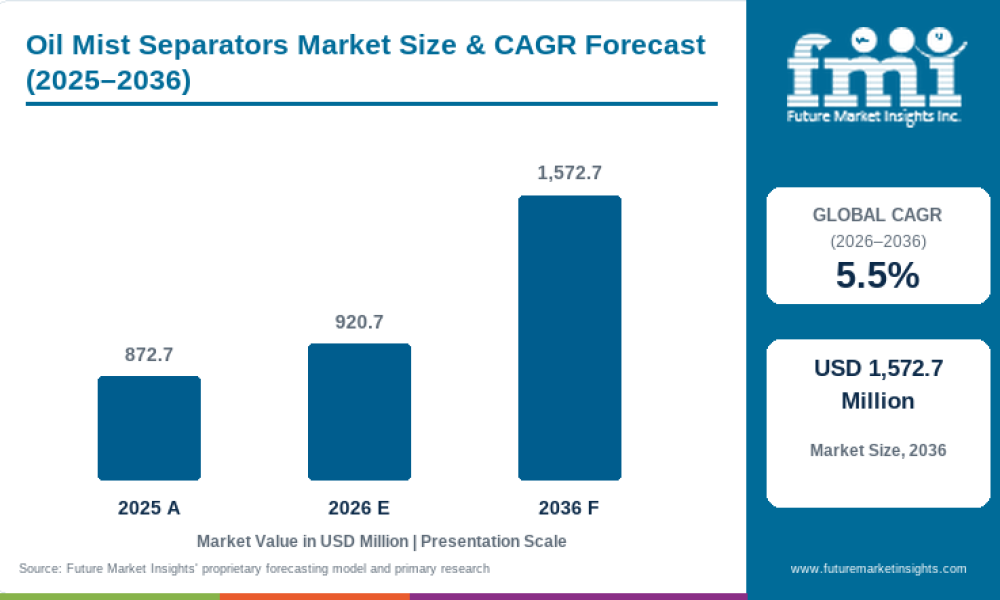
The global oil mist separators market is projected to increase from USD 872.7 million in 2025 to USD 920.7 million in 2026, reaching USD 1,572.7 million by 2036 at a 5.5% CAGR from 2026 to 2036. Demand is being supported by machining operations that generate oil and coolant aerosols, prompting manufacturers to integrate extraction and filtration equipment into production-line specifications.
As machining speeds and coolant pressures increase, aerosol capture is becoming an important consideration in enclosed work zones. Oil mist separators help collect airborne oil and coolant particles generated during metalworking, supporting cleaner production environments and reducing the accumulation of mist around machinery. Equipment selection increasingly depends on airflow requirements, filtration performance, recovery capability, installation constraints, and ease of maintenance.
Evidence of project-scale procurement points to opportunities for suppliers with established industrial extraction systems. Absolent Air Care Group reported in June 2025 that Filtermist secured its largest unit order for a single oil mist project. The order covered centrifugal extraction equipment for a major Asian manufacturer, illustrating how oil mist control can become a repeat specification across large industrial installations.
What Are the Key Segments in the Oil Mist Separators Market?
The oil mist separators market is shaped by separator technology, airflow capacity, machining application, end-use requirements, and equipment sourcing channels.
- Centrifugal Oil Mist Separators – 28.0% share: Centrifugal separators are projected to lead the separator-type segment in 2026, supported by their ability to separate and recover liquid from mist generated during wet-machining operations.
- Below 500 m³/h Units – 22.0% share: Smaller-capacity units are expected to represent the leading airflow-capacity category, reflecting demand from compact machines that require dedicated source capture.
- CNC Machining – 36.0% share: CNC machining is projected to lead the application category, supported by enclosed cutting processes that generate recurring oil and coolant aerosol loads.
Get detailed market forecasts, competitive benchmarking, and pricing trends:
https://www.futuremarketinsights.com/reports/sample/rep-gb-35397
Other separator technologies include electrostatic, coalescing, HEPA-assisted, and compact machine-mounted systems. Airflow capacities range from below 500 m³/h to above 5,000 m³/h, allowing manufacturers to match equipment to individual machines or larger production environments. Applications also include grinding, cold heading, die casting, and metal forming.
Which Countries Are Growing Fastest in the Oil Mist Separators Market?
Italy is projected to record the highest CAGR among the profiled countries at 6.3% through 2036. Demand is linked to industrial machining requirements and investment in equipment that supports source-level aerosol control. Suppliers can target opportunities by aligning separator performance, mounting configurations, and maintenance access with individual machine specifications.
Mexico is expected to expand at a 5.8% CAGR, supported by manufacturing activity and the need to equip machining operations with suitable extraction systems. Equipment suppliers can evaluate demand across new installations and upgrades to existing production lines.
Poland is projected to grow at a 5.4% CAGR, reflecting opportunities associated with industrial production and the adoption of machine-level mist control. Compact separators and appropriately sized extraction systems can address facilities with varied machine configurations.
The United States is expected to record a 5.1% CAGR. Demand depends on machining investment, equipment replacement cycles, and manufacturers’ decisions about incorporating extraction systems into production machinery.
Germany is projected to expand at a 4.9% CAGR, supported by its manufacturing and precision-machining base. Supplier selection is influenced by equipment integration, filtration performance, and the ability to maintain consistent operation under demanding production conditions.
France is expected to grow at a 4.7% CAGR. Investment decisions are influenced by industrial output, capital expenditure priorities, and the timing of equipment replacement at established manufacturing facilities.
Japan is projected to record a 4.4% CAGR through 2036. Demand depends on the requirements of existing machining installations, new equipment specifications, and investment in production efficiency and workplace air management.
How Are Industrial Investment Cycles Affecting Oil Mist Separator Demand?
The need for oil mist control does not always translate directly into immediate equipment purchases. Manufacturing plants may continue operating at stable production rates while postponing replacement of extraction systems or delaying upgrades to existing machinery. This makes capital expenditure timing an important factor in supplier sales.
France illustrates the influence of industrial investment conditions. INSEE reported in February 2026 that French machinery-and-equipment output stood at an index of 103.53 in December 2025. While this figure provides context for industrial activity, purchasing decisions for oil mist separators also depend on equipment age, operating conditions, maintenance priorities, and plant-level investment budgets.
For suppliers, identifying where extraction equipment is included in new machine specifications can be as important as tracking broader manufacturing output. Early involvement in machine design and facility planning can help manufacturers select suitable airflow capacity and mounting arrangements before production begins.
What Is Driving Demand for Oil Mist Separators?
Enclosed CNC Machining Increases the Need for Source Capture
CNC machining is projected to account for 36.0% of the application segment in 2026. Enclosed cutting operations can generate recurring oil and coolant aerosols, creating a need for extraction systems designed around machine airflow and operating conditions.
Machine-level capture allows manufacturers to address aerosol generation close to its source. Separator selection depends on the type of coolant or oil, expected mist load, enclosure design, and required extraction rate.
Centrifugal Separation Supports Liquid Recovery
Centrifugal oil mist separators are projected to hold 28.0% of the separator-type segment in 2026. Their ability to separate liquid from airborne mist supports applications involving repeated wet machining.
Recovery performance and maintenance requirements can influence total operating costs. Manufacturers therefore assess not only initial filtration performance but also the reliability of liquid separation, service access, and compatibility with production equipment.
Compact Units Address Individual Machine Requirements
Units with airflow capacity below 500 m³/h are expected to account for 22.0% of the airflow-capacity segment in 2026. Compact systems can be suitable for dedicated extraction at individual machines, particularly where available installation space is limited.
Proper sizing remains essential. A separator’s rated capacity must align with enclosure airflow and aerosol generation to deliver effective source capture under actual operating conditions.
Large Industrial Projects Create Repeat-Specification Opportunities
The Filtermist order reported by Absolent Air Care Group in June 2025 demonstrates the potential for large projects to generate substantial equipment demand. When extraction systems are specified across multiple machines or production areas, suppliers can benefit from repeat orders and standardized installation requirements.
These projects also place greater emphasis on consistent equipment performance, installation planning, serviceability, and coordination with machinery manufacturers.
Drive Your Business Growth Strategy: Checkout the Report for Key Insights!
https://www.futuremarketinsights.com/checkout/35397
What Are the Key Challenges in the Oil Mist Separators Market?
One challenge is matching extraction capacity to the actual aerosol load. An undersized system may not provide adequate source capture, while an oversized or poorly integrated installation can increase energy use and operating costs. Manufacturers must evaluate airflow, enclosure design, separator technology, and coolant characteristics before finalizing specifications.
Maintenance access is another consideration. Filters, collection components, and other serviceable parts need to be accessible without causing unnecessary production interruptions. Difficult maintenance procedures can weaken the economic case for a separator, particularly when operating budgets are tightly controlled.
Capital expenditure cycles can also delay adoption. Established plants may postpone equipment replacement even when extraction upgrades could improve operating conditions. Suppliers must therefore demonstrate the practical value of their systems through clear installation requirements, predictable maintenance intervals, and performance suited to the customer’s operating environment.
What Opportunities Exist for Oil Mist Separator Manufacturers?
Suppliers can strengthen their market position by working with machine-tool manufacturers and plant engineers early in the equipment specification process. Integrating separators into machine packages can simplify installation and help ensure that extraction capacity matches the intended machining application.
There are also opportunities to differentiate through compact designs, accessible service points, liquid recovery, and solutions tailored to different coolant types and duty cycles. Standardized configurations can support repeat installations across production lines, while retrofit offerings can address plants that need to upgrade existing extraction equipment.
Manufacturers that provide application guidance and lifecycle support can also help customers evaluate total operating costs rather than focusing only on the initial purchase price. This approach is particularly relevant when plants need to balance air-quality objectives with maintenance budgets and production uptime.
What Does the Analyst Say About the Oil Mist Separators Market?
Nikhil Kaitwade, Principal Consultant at Future Market Insights, states:
“Plant engineers increasingly judge oil mist separators as part of the machine package because enclosure airflow determines whether rated filtration translates into source control. Suppliers gain repeat business when mounting access and service intervals remain predictable under the customer’s actual coolant and duty cycle.”
The assessment highlights the importance of equipment integration and serviceability in procurement decisions. Suppliers that align separator capacity with actual machining requirements and make maintenance predictable can strengthen their position in new installations and repeat industrial projects.
What Is the Oil Mist Separators Market Outlook Through 2036?
The oil mist separators market is projected to reach USD 1,572.7 million by 2036, advancing at a 5.5% CAGR from 2026 to 2036. Demand is expected to remain connected to CNC machining, wet-metalworking operations, and manufacturers’ efforts to integrate aerosol extraction into production equipment.
Italy leads the profiled countries with a projected 6.3% CAGR, while Japan records the lowest growth rate at 4.4%. Across markets, suppliers will need to demonstrate effective source capture, appropriate airflow sizing, practical maintenance access, and compatibility with machine-level requirements.
About Future Market Insights
Future Market Insights (FMI) is a market research and consulting firm providing syndicated and customized research, market forecasts, competitive intelligence, and strategic analysis across global industries. FMI combines primary research, secondary research, and forecasting methodologies to support business planning and investment decisions.



