
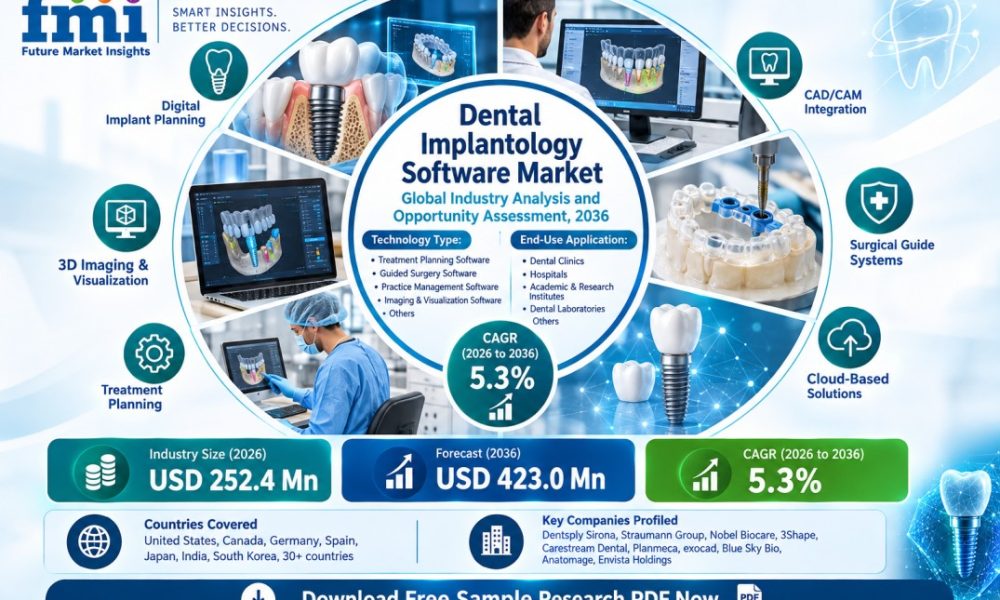
Newark, Del. — The global dental implantology software market is projected to grow from USD 252.4 million in 2026 to USD 423.0 million by 2036, registering a compound annual growth rate (CAGR) of 5.3%, according to Future Market Insights (FMI). Growth is being supported by wider use of cone-beam computed tomography (CBCT), digital implant planning and software that connects dental clinics with specialists and dental laboratories.
Cloud-based software is expected to account for 57.0% of the deployment market in 2026, while subscription licenses are projected to represent 54.0% of license-model demand. Complete integrated solutions are forecast to hold a 44.4% share, reflecting demand for platforms that bring imaging review and implant planning into a connected workflow.
👉 Get Detailed Market Forecasts, Competitive Benchmarking, and Pricing Trends:
https://www.futuremarketinsights.com/reports/sample/rep-gb-15172
Why Dental Implantology Software Demand Is Growing
Dental implant planning increasingly involves multiple digital inputs, including CBCT images, intraoral scans, implant libraries and surgical guide designs. Software platforms help clinicians combine these materials to assess implant positioning, plan prosthetic outcomes and prepare cases before surgery.
As dental groups expand across locations, cloud-based tools can also support shared case reviews between clinicians and external laboratories. Subscription models offer access to software updates and support, while integrated platforms can reduce the need to transfer files between separate systems.
Interoperability remains important. Software vendors must ensure that their platforms work reliably with imaging equipment, scanners, implant libraries and guide-design workflows. For clinics, compatibility can influence the time required to prepare cases and the practical cost of adopting digital planning.
Where Growth Is Fastest
FMI projects that India will record the fastest growth among the countries covered in its outlook, followed by Japan, Canada and Spain.
- India — 6.7% CAGR: A large dental workforce and expanding private-clinic base are expected to support wider adoption of digital implant planning.
- Japan — 6.2% CAGR: Restorative treatment needs and demand for digital planning are expected to support market expansion.
- Canada — 5.9% CAGR: Growth is projected to benefit from dental-care access initiatives and demand for digital treatment-planning tools.
- Spain — 5.7% CAGR: Private dentistry and prosthetic care are expected to support adoption.
- United States — 5.4% CAGR: Dental service organizations and specialist practices are expected to continue investing in shared digital workflows.
- Germany — 5.1% CAGR: Clinics are expected to prioritize reliable software, data security and imaging-system compatibility.
- South Korea — 4.6% CAGR: A mature implant-treatment market is expected to support continued upgrades and selective adoption of new features.
What Leads the Market
FMI’s 2026 projections identify several segments positioned to shape software demand:
- Cloud-based software — 57.0%: Shared access and remote case review support adoption among multi-location practices and collaborating specialists.
- Subscription licenses — 54.0%: Regular updates and access to support are expected to encourage recurring software agreements.
- Complete integrated solutions — 44.4%: Clinics are seeking connected imaging and planning workflows within a single platform.
- Guided surgery planning — 41.0%: Digital guide design and virtual implant positioning make this a leading application.
- Hospitals — 35.0%: Complex cases and specialist planning requirements support the hospital segment.
These shares describe different market categories and should not be added together. Each reflects a separate segmentation of the dental implantology software market.
The Hurdle: Compatibility, Cost and Clinical Workflow
Adoption depends on more than software functionality. Clinics need tools that work with their existing imaging systems and transfer data reliably between practitioners and laboratories. File conversion problems or incompatible implant libraries can add time and complexity to treatment preparation.
Smaller practices may also face budget and training constraints when moving from established workflows to digital planning. Subscription fees, staff training and the need to maintain compatible hardware can influence purchasing decisions.
For vendors, demonstrating practical workflow benefits and offering dependable implementation support will be important to winning and retaining customers. Data security and appropriate management of patient records are additional considerations for cloud-based deployments.
👉 Access the Complete Report in PDF Format:
https://www.futuremarketinsights.com/reports/brochure/rep-gb-15172
Industry Investment and Recent Developments
Product launches and technology partnerships illustrate the market’s focus on integrated imaging, guided planning and connected clinical workflows.
- March 2025 — Carestream Dental and Straumann: Carestream Dental announced a collaboration connecting CS Imaging version 8 with Straumann’s AXS platform for virtual implant planning and surgical guide design.
- June 2025 — ZimVie: The company launched its RealGUIDE Dental Implant Software Suite and Implant Concierge service in Japan.
- June 2025 — Planmeca: The company introduced Romexis 7 dental imaging software with AI-powered implant-planning features.
- October 2025 — Carestream Dental: The company launched CS 3D Imaging Premium, featuring AI Auto Implant and case-sharing capabilities.
These developments point to continued investment in software that connects imaging and planning tasks. For dental practices, the value of new features will depend on their ability to integrate into existing clinical workflows and support consistent case preparation.
Analyst Perspective
Sabyasachi Ghosh, Principal Analyst for Healthcare at Future Market Insights, said: “The dental implantology software market is expected to evolve from a planning aid into a daily clinical control tool. Clinics are likely to favor platforms with reliable CBCT viewing and strong implant libraries. Vendors with stronger scanner links are anticipated to protect client relationships as practices reduce rework between clinics and labs.”
What This Means for Software Vendors and Dental Practices
For software vendors, the forecast highlights the importance of building reliable connections between scanners, imaging platforms, implant libraries and surgical guide-design tools. Cloud access and subscription services offer opportunities to support multi-site practices, while integrated solutions can appeal to clinics seeking a more consolidated planning process.
Dental practices evaluating software should consider compatibility with installed equipment, data-sharing requirements, implementation costs, staff training and the level of technical support available. A platform’s practical value depends on how well it fits the clinic’s treatment process, not simply on the number of features it offers.
With the market projected to reach USD 423.0 million by 2036, vendors that combine dependable imaging support with effective planning and collaboration tools will be positioned to compete as digital implant workflows become more established.
Read the full report: https://www.futuremarketinsights.com/reports/dental-implantology-software-market
Report Scope
Future Market Insights’ Dental Implantology Software Market report covers the 2026–2036 forecast period and analyzes the market by:
- Solution type: Complete integrated solutions, modular implant planning solutions and stand-alone implant planning solutions.
- Imaging type: 3D imaging solutions and 2D imaging solutions.
- End user: Hospitals, ambulatory surgical centers, individual dental clinics, multi-practice dental networks, dental laboratories and academic institutes.
- Deployment mode: Cloud-based software and on-premise software.
- Application: Guided surgery planning, prosthetic planning, case sharing, treatment simulation and patient communication.
- License model: Subscription licenses, perpetual licenses and service bundles.
- Regions: North America, Latin America, Europe, East Asia, South Asia and Pacific, and the Middle East and Africa.
About Future Market Insights
Future Market Insights, Inc. (FMI) is an ESOMAR-certified market research and consulting firm headquartered in Delaware, USA, with offices in the United Kingdom, the United Arab Emirates and India. FMI delivers syndicated and custom research across food and beverage, healthcare, chemicals, technology, packaging, consumer goods and industrial sectors.
Media Contact
Future Market Insights, Inc.
Phone: +1-347-918-3531



