
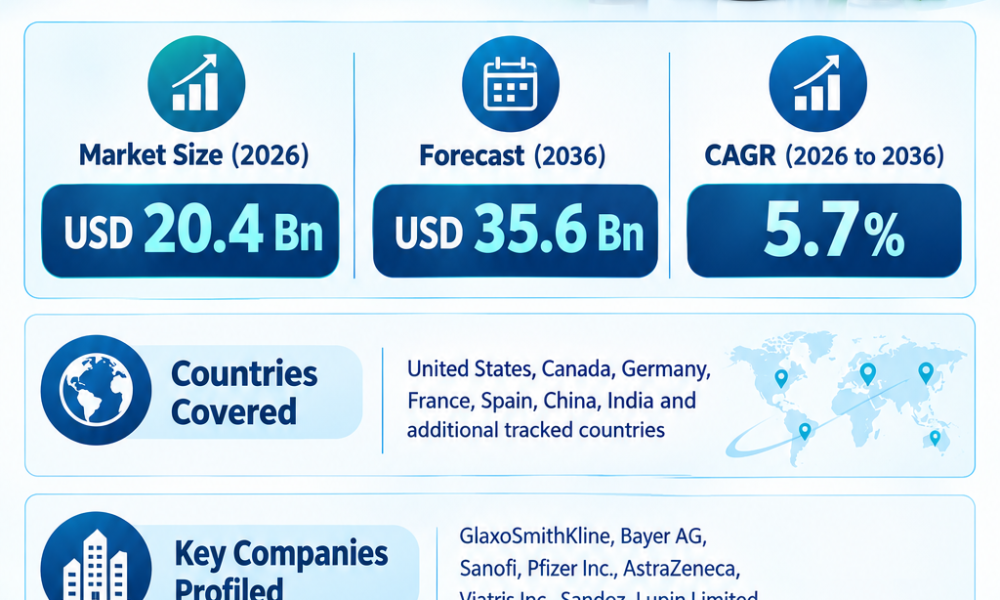
Newark, Del.— The global nasal sprays market is projected to grow from USD 20.4 billion in 2026 to USD 35.6 billion by 2036, expanding at a compound annual growth rate (CAGR) of 5.7%, according to Future Market Insights (FMI). The market was valued at USD 19.3 billion in 2025, with demand supported by recurring allergic rhinitis, nasal congestion and the wider use of intranasal delivery for selected prescription therapies.
Decongestant sprays are expected to account for 46.1% of product demand in 2026. Aqueous-based formulations are projected to represent 54.1% of formulation demand, while pump bottles are forecast to hold 78.0% of packaging demand. Retail sales are expected to account for 71.0% of distribution, reflecting the importance of pharmacies in routine nasal care.
👉 Get Detailed Market Forecasts, Competitive Benchmarking, and Pricing Trends:
https://www.futuremarketinsights.com/reports/sample/rep-gb-13112
Why the Nasal Sprays Market Is Growing
Nasal sprays remain a familiar option for people managing recurring congestion and allergy symptoms. Seasonal demand supports repeat purchases of decongestant, steroid and antihistamine products, while established pharmacy channels help consumers access both branded and generic formulations.
The market is also extending beyond conventional symptom relief. Prescription products delivered through the nose are gaining attention in selected emergency and acute-care settings. The US Food and Drug Administration approved epinephrine nasal spray for anaphylaxis in August 2024, while Milestone Pharmaceuticals received FDA approval for CARDAMYST (etripamil) nasal spray in December 2025 for adults with paroxysmal supraventricular tachycardia.
These developments illustrate the expanding range of uses for intranasal delivery. For manufacturers, product performance increasingly depends on reliable dose delivery, clear instructions and packaging suited to the intended treatment setting.
Where Growth Is Fastest
FMI’s country forecasts show stronger projected growth in India and China than in several established markets. Selected country outlooks for 2026–2036 include:
- India — 7.5% CAGR: Wider availability of branded nasal sprays across urban and semi-urban pharmacies is expected to support market expansion.
- China — 6.7% CAGR: Expanding city pharmacy networks and access to intranasal products are projected to support growth.
- Canada — 5.8% CAGR: Recurring seasonal allergy care and community pharmacy access underpin the forecast.
- Spain — 5.8% CAGR: Seasonal allergy demand and established retail pharmacy purchasing are expected to support sales.
- France — 5.5% CAGR: Routine use of nasal therapies in allergy care is projected to sustain demand.
- Germany — 4.7% CAGR: Established pharmacy distribution is expected to support measured growth.
- United States — 4.2% CAGR: Mature retail access and competition between branded and generic products are expected to temper growth.
What Leads the Market
FMI identifies several segments expected to shape the market’s 2026 revenue mix:
- Decongestant sprays — 46.1%: Their role in short-term relief from nasal blockage supports demand across retail channels.
- Aqueous-based formulations — 54.1%: Familiar liquid formulations and pump delivery systems support their projected leading position.
- Pump bottles — 78.0%: Metered packaging remains widely suited to routine household use.
- Multi-dose formats — 74.0%: Repeat allergy and congestion treatment supports demand for products used across multiple days.
- Retail sales — 71.0%: Pharmacy shelves remain a central access point for common nasal spray products.
- Allergic rhinitis — 38.0%: Recurrent symptoms and seasonal treatment patterns support demand in this indication.
The Hurdle: Pricing Pressure and Safe Use
Competition from generic products can constrain pricing for established active ingredients. Manufacturers must also address appropriate product use, particularly for decongestant sprays containing xylometazoline or oxymetazoline. Overuse can cause rebound congestion, making clear labeling, pharmacist guidance and patient education important parts of responsible product positioning.
Prescription products present a different set of challenges. Developers must ensure that formulation, spray device and dose delivery work together reliably, especially when a product is intended for urgent use. Market expansion therefore depends not only on new indications, but also on consistent product quality, regulatory execution and dependable supply.
👉 Access the Complete Report in PDF Format:
https://www.futuremarketinsights.com/reports/brochure/rep-gb-13112
Industry Investment and Recent Developments
Recent developments point to activity across delivery devices, generic products and prescription therapies:
- October 2024 — Aptar Pharma: The company acquired device technology assets from SipNose, expanding its intranasal drug-delivery portfolio for local and systemic delivery.
- July 2025 — Lupin Limited: Lupin launched ipratropium bromide nasal solution in 0.03% and 0.06% strengths in the United States for rhinorrhea relief.
- December 2025 — Milestone Pharmaceuticals: The company received FDA approval for CARDAMYST (etripamil) nasal spray for adults with paroxysmal supraventricular tachycardia.
Companies active in the broader market include GlaxoSmithKline, Bayer AG, Sanofi, Pfizer Inc., AstraZeneca, Merck & Co., Boehringer Ingelheim, Viatris, Sandoz, Lupin Limited, ARS Pharmaceuticals, Milestone Pharmaceuticals and Aptar Pharma.
Their roles span established consumer and prescription brands, generic products, specialty intranasal medicines and drug-delivery technologies.
Analyst Perspective
Anurag Sharma, Principal Analyst at Future Market Insights, said: “The nasal sprays market is changing because the same route is now serving two markets at once. Everyday pharmacy sprays keep the volume base stable, while single dose prescription products show that intranasal delivery can carry higher value therapies.”
What This Means for Manufacturers and Buyers
For manufacturers, the forecast points to two complementary priorities: maintaining dependable supply of high-volume products for routine allergy and congestion care, and developing differentiated delivery systems for prescription applications. In faster-growing markets such as India and China, distribution reach and affordability are likely to remain important considerations.
For pharmacies and healthcare buyers, product selection will continue to depend on therapeutic suitability, clear instructions, reliable availability and price. In specialty applications, device performance and the intended use environment become additional considerations.
The projected growth suggests a continuing role for everyday nasal sprays alongside selected prescription products. However, market performance will depend on safe use, competitive pricing, product quality and the ability to meet distinct needs across consumer and clinical channels.
Read the full report: https://www.futuremarketinsights.com/reports/nasal-spray-market
Report Scope
Future Market Insights’ Nasal Sprays Market report covers the 2026–2036 forecast period and analyzes the market by:
- Product: Nasal decongestant sprays, nasal steroid sprays, nasal antihistamine sprays, nasal cromolyn sodium sprays, nasal anticholinergic sprays, nasal triamcinolone sprays and others.
- Formulation: Aqueous-based, hydroalcoholic-based, non-aqueous-based solutions, suspensions, emulsions, dry powder and microparticles.
- Packaging: Pump bottles and pressurized canisters.
- Dosage: Multi-dose, bi-dose and single-unit dose.
- Distribution channel: Retail sales and institutional sales.
- Indication: Allergic rhinitis, nasal congestion, sinusitis, nonallergic rhinitis and other inflammatory nasal conditions.
- Regions: North America, Latin America, East Asia, South Asia and Pacific, Western Europe, Eastern Europe, and the Middle East and Africa.
About Future Market Insights
Future Market Insights, Inc. (FMI) is an ESOMAR-certified market research and consulting firm headquartered in Delaware, USA, with offices in the United Kingdom, the United Arab Emirates and India. FMI delivers syndicated and custom research across food and beverage, healthcare, chemicals, technology, packaging, consumer goods and industrial sectors.
Media Contact
Future Market Insights, Inc.
Phone: +1-347-918-3531



