
The global mass notification systems market is projected to grow from USD 26.4 billion in 2026 to USD 187.4 billion by 2036, representing a compound annual growth rate (CAGR) of 21.7%, according to Fact.MR. The market was valued at USD 21.7 billion in 2025. The report identifies government agencies, educational institutions, healthcare facilities, transportation operators and commercial enterprises as important users of systems that distribute urgent messages across multiple communication channels.
The expansion reflects increasing demand for coordinated emergency communication, enterprise safety management and public warning infrastructure. Organizations are adopting platforms that combine mobile messaging, voice calls, email, digital signage and public address systems. These capabilities allow administrators to distribute alerts across facilities and workforce groups through centralized communication systems.
Get detailed market forecasts, competitive benchmarking, and pricing trends:https://www.factmr.com/connectus/sample?flag=S&rep_id=7282
Why integrated emergency communication matters
Organizations increasingly need to reach people through multiple channels rather than depend on a single alert method. Fact.MR identifies the expansion of smart city infrastructure, greater emphasis on disaster preparedness and the adoption of enterprise safety platforms as key demand drivers.
Two frameworks cited in the report are the Federal Emergency Management Agency’s Integrated Public Alert and Warning System (IPAWS) and the National Fire Protection Association’s NFPA 72: National Fire Alarm and Signaling Code, 2022 edition. The report identifies these frameworks as influences on emergency communication system design. IPAWS is referenced in a 2023 Federal Emergency Management Agency bibliography entry, while NFPA 72 is cited in its 2022 edition.
For buyers, the practical challenge is to select systems that work with existing communication networks, support the required alert channels and meet applicable organizational and regulatory requirements.
Where growth is fastest
Fact.MR projects growth across the United States, China, the United Kingdom, Japan and South Korea through 2036.
- United States — 20.3% CAGR: Demand is supported by emergency communication infrastructure, public safety technology adoption and enterprise security platforms. The report also identifies deployment across government agencies and educational institutions as a growth driver.
- China — 19.5% CAGR: Expanding smart city infrastructure and public safety communication networks support market development.
- United Kingdom — 19.4% CAGR: Emergency alert infrastructure, public safety programs and enterprise risk management systems contribute to demand.
- Japan — 19.4% CAGR: Disaster preparedness, public alert programs and communication infrastructure support adoption.
- South Korea — 18.5% CAGR: Connected urban infrastructure and established digital capabilities support continued deployment.
The United States has the highest projected CAGR among the five profiled countries. China follows, while the United Kingdom and Japan share the same projected growth rate.
Gain Full Access to Market Forecasts and Key Drivers:https://www.factmr.com/report/mass-notification-systems-market
What leads the market
Fact.MR identifies large enterprises and solution platforms as the leading segments in its 2026 analysis.
- Organization size — Large enterprises: Expected to account for approximately 70% of market share in 2026. Multi-site operations and complex organizational structures increase the need for centralized alert distribution and coordinated emergency communication.
- Component — Solutions: Expected to represent approximately 65% of market share in 2026. These platforms provide the software infrastructure for alert distribution, communication workflows and incident response coordination.
The report also covers professional services, managed services, emergency response, business continuity management, public warnings and alerting. Cloud and on-premises deployment models are included in the market assessment.
The hurdle: Integration costs and cybersecurity
Deployment complexity and system pricing remain important considerations for prospective buyers. Modern notification platforms may need to connect with existing enterprise communication networks, public address infrastructure, digital displays and emergency management systems. Integration requirements can increase implementation costs and complicate deployment.
Cybersecurity and reliable message delivery also influence purchasing decisions. Smaller organizations may face greater difficulty absorbing the cost of software infrastructure and system integration. Buyers therefore need to assess implementation requirements alongside platform functionality, scalability and ongoing service costs.
Fact.MR identifies system reliability, message delivery speed, regulatory compliance and integration capabilities as important factors influencing competition. Government agencies, universities and large enterprises may also use multi-vendor strategies to reduce dependence on a single platform.
Industry investment and reported activity
The report identifies several government initiatives and company activities associated with country-level market development. The following dates are reported on the Fact.MR page; specific announcements should be verified against their original sources before publication.
- February 2025 — South Korea: The report associates initiatives involving the Ministry of the Interior and Safety with national emergency alert infrastructure.
- March 2025 — United Kingdom: The report identifies national emergency alert programs associated with the Cabinet Office.
- August 2025 — United States: The report identifies expansion of critical event management platforms by Everbridge as a factor supporting market development.
Other activities mentioned include public safety communication technology expansion by Huawei in China, public communication system development by NEC Corporation in Japan, and emergency communication platform deployment by Motorola Solutions in the United Kingdom.
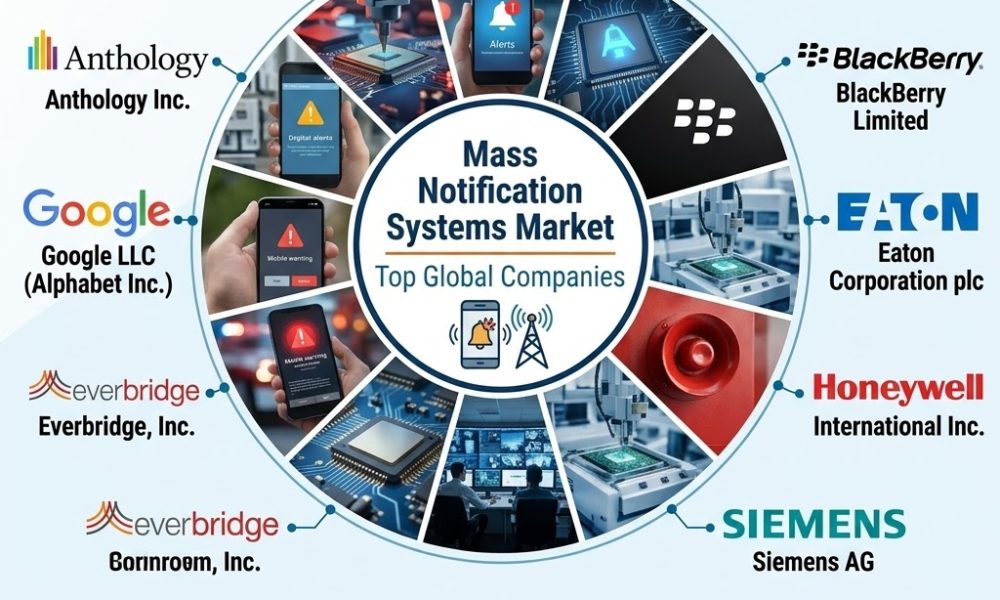
The companies profiled in the report are Motorola Solutions, Inc.; International Business Machines Corporation; BlackBerry Limited; Eaton Corporation plc; Honeywell International Inc.; Siemens AG; Everbridge, Inc.; Google LLC; Anthology Inc.; and OnSolve, LLC.
These companies participate in different parts of the communication, software and safety technology ecosystem. Their inclusion in the report does not imply endorsement by Fact.MR.
Analyst opinion
Shambhu Nath Jha, Principal Consultant at Fact.MR, said:
“In this updated edition of the Mass Notification Systems Market report, industry participants will observe that organizations increasingly deploy integrated communication platforms capable of delivering real time alerts across multiple channels. Mass notification systems support emergency response coordination and operational communication across public institutions and corporate infrastructure. Companies providing scalable and reliable alert management platforms will maintain stronger positions within the emergency communication technology market.”
What this means for enterprise buyers
For procurement leaders, public-sector agencies, technology integrators and enterprise risk managers, the report points to three practical priorities.
- Evaluate total deployment costs. Compare software licensing, integration work, managed services and ongoing maintenance. Assess whether the proposed system can connect with existing communication infrastructure before committing to a large deployment.
- Test multi-channel delivery and resilience. Evaluate how the platform distributes alerts through mobile messaging, voice calls, email and digital displays. Confirm that the system supports the organization’s communication requirements and operational continuity plans.
- Include compliance and cybersecurity in procurement. Review applicable emergency communication frameworks, access controls, system integration requirements and message-delivery reliability. These criteria should be assessed alongside price and functionality.
The report’s findings suggest that buyers should prioritize operational fit and dependable communication over feature counts alone. Vendors, meanwhile, have an opportunity to address integration complexity and the needs of organizations with limited implementation resources.
Report coverage
Fact.MR’s Mass Notification Systems Market report examines market forecasts from 2026 to 2036, component and organization-size segments, deployment models, applications, regional growth, competitive positioning and factors affecting adoption.
Top Trending Reports:
Precursor Crystallization Tanks Market
About Fact.MR
Fact.MR is a market research and consulting firm providing market intelligence, industry analysis and strategic research across sectors. Its research supports businesses evaluating market opportunities, competitive developments and growth strategies.



