
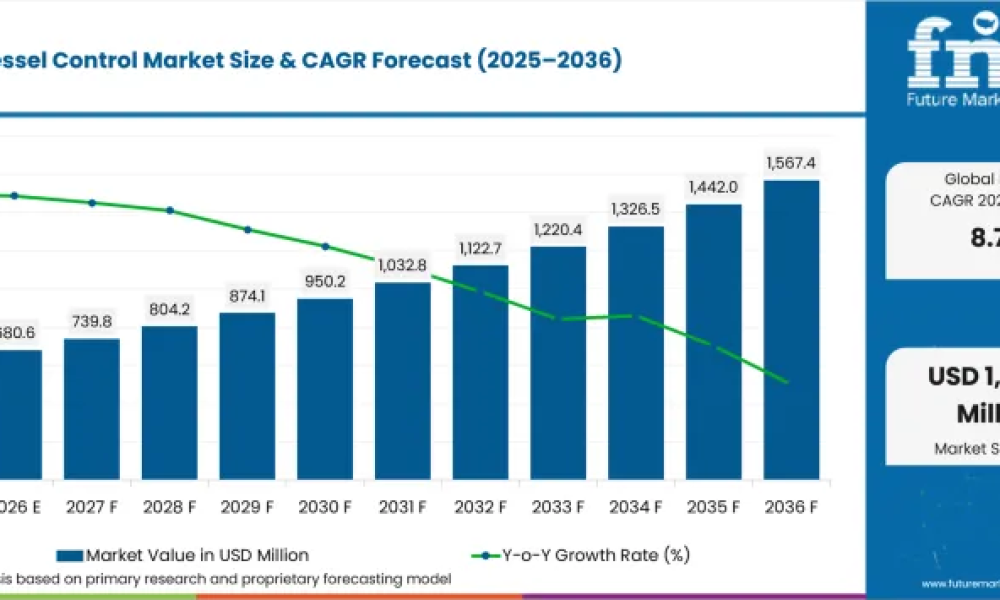
The global remote vessel control market is projected to grow from USD 680.6 million in 2026 to USD 1,567.4 million by 2036, registering a CAGR of 8.7% over the forecast period. Demand is supported by the adoption of shore-based vessel supervision, remote helm technologies, and integrated control systems designed to improve operational oversight and manage hazardous or repetitive maritime tasks.
Remote vessel control systems allow operators to manage selected vessel functions from a remote location through connected helm, propulsion, navigation, and mission-control interfaces. As the industry moves beyond isolated pilot projects, vessel owners are placing greater emphasis on functional safety, communications resilience, cybersecurity, and the ability to transfer command authority between onboard personnel and shore-based teams.
In May 2026, the International Maritime Organization adopted the non-mandatory Maritime Autonomous Surface Ships (MASS) Code, which took effect on July 1, 2026. The Code establishes expectations covering navigation, connectivity, remote operations, cybersecurity, and human oversight. Although the framework does not eliminate class or flag approval requirements, it provides vessel owners with a more consistent basis for specifying remote-control capabilities and evaluating system readiness.
These developments are influencing procurement decisions. Buyers increasingly assess how systems respond to network loss, sensor disagreement, and operator handover. Integration with existing steering and propulsion interfaces is also important, particularly when remote-control functionality is added to an operating vessel rather than installed during new construction.
What Are the Key Segments in the Remote Vessel Control Market?
The market is segmented by control type, connectivity, vessel type, operation mode, and sales channel. Segment performance reflects the need to balance remote access with reliable command authority and practical deployment conditions.
- Remote helm control — 26.0% share: Remote helm control leads the control-type category because it extends the operator’s position while preserving direct human authority over vessel movement.
- Cellular connectivity — 27.0% share: Cellular leads the connectivity category because nearshore and port operations can use commercial network capacity where coverage, latency, and operating costs are suitable.
- Workboats — 25.0% share: Workboats lead the vessel-type category as recurring utility missions provide practical applications for remote supervision and retrofit-oriented control systems.
- Line-of-sight operation — 24.0% share: Line-of-sight leads the operation-mode category because it limits communications uncertainty while allowing immediate operator oversight.
- Autonomy integrators — 34.0% share: Autonomy integrators lead the sales-channel category because vessel-specific command chains require coordinated engineering, interface integration, and validation.
Get detailed market forecasts, competitive benchmarking, and pricing trends:
https://www.futuremarketinsights.com/reports/sample/rep-gb-35121
Which Countries Are Showing the Strongest Growth in the Remote Vessel Control Market?
South Korea is projected to record the fastest growth among the profiled countries, with a 9.5% CAGR from 2026 to 2036. The country has established a statutory route for autonomous ship demonstrations and regulatory exceptions. This framework supports the development and evaluation of remote vessel control systems while creating a pathway for suppliers to demonstrate system performance within defined operating conditions.
Norway is expected to expand at a 9.0% CAGR. The country is progressing from trials toward remote vessel applications in offshore operations, supported by class-reviewed remote vessels and shore-control capabilities. Buyers are likely to focus on reliable communications, vessel-system integration, and evidence that remote command functions remain dependable in demanding operating environments.
Finland is projected to register an 8.6% CAGR. Communications reliability is an important consideration as maritime automation develops. Hybrid use of terrestrial and satellite systems can help address differing connectivity requirements, making communications architecture, link resilience, and operational continuity relevant to system selection.
The Netherlands is expected to grow at an 8.4% CAGR. Market development is associated with the requirements of maritime operations that need coordinated vessel control, dependable connectivity, and integration with existing systems. Suppliers must demonstrate that remote-control packages can function within the technical and operational conditions of each deployment.
The United Arab Emirates is projected to record an 8.2% CAGR. Demand opportunities are linked to the application of remote vessel control across commercial maritime and utility operations. Buyers must assess communications availability, system compatibility, and the suitability of remote-control capabilities for their intended operating environment.
The United States is expected to expand at an 8.0% CAGR. Remote vessel control adoption depends on demonstrating reliable command authority, safe responses to communications interruptions, and compatibility with existing steering and propulsion systems. Integration and validation requirements remain important considerations for operators moving from trials to wider use.
Japan is projected to record the lowest growth rate among the profiled countries, at a 6.7% CAGR. The country is progressing through formal technology qualification and staged vessel demonstrations. This approach places emphasis on technical validation, operating limits, and the ability to establish confidence in remote-control performance before broader deployment.
How Is the Competitive Landscape Evolving?
The remote vessel control market includes technology developers and maritime systems providers that combine vessel interfaces, communications, monitoring, and shore-based operating capabilities. Key participants include Sea Machines Robotics, Avikus / HD Hyundai, Kongsberg Maritime, Marine AI, Buffalo Automation, Robosys Automation, Ocean Infinity, and Fugro.
Competition is increasingly shaped by system integration rather than the availability of an individual remote-control device. Remote helm interfaces must work with vessel steering, propulsion, sensors, and mission systems. Suppliers must also establish how command authority is transferred, how operators are alerted to abnormal conditions, and what the vessel does when communication becomes unreliable.
Autonomy integrators play an important role because remote-control installations are often vessel-specific. They coordinate hardware, software, communications, and operational procedures to deliver a validated package. This can be particularly important for retrofit projects, where existing vessel architecture may limit the available integration options.
Connectivity is another competitive factor. Cellular networks can support nearshore and port operations, while satellite or hybrid configurations may be necessary where terrestrial coverage is insufficient. System selection therefore depends on the operating area, required response time, communications redundancy, and the consequences of losing the remote link.
What Does the Analyst Say About the Remote Vessel Control Market?
Future Market Insights Principal Consultant Nikhil Kaitwade observes:
“Remote operation is commercially credible when the system explains what happens during network loss, sensor disagreement and operator handover. Buyers need controlled degradation and a retrofit path into existing steering and propulsion systems before they expand the operating envelope.”
Drive Your Business Growth Strategy: Checkout the Report for Key Insights!
https://www.futuremarketinsights.com/checkout/35121
What Is Driving Demand for Remote Vessel Control?
Shore-based supervision of vessel operations
Remote vessel control allows shore-based teams to supervise selected vessel functions without requiring the operator to remain at the conventional helm position. The approach can support repetitive utility missions and operations where remote supervision is practical. Adoption depends on demonstrating that control authority, situational awareness, and operating procedures remain clear throughout the mission.
Regulatory frameworks and system validation
The adoption of the IMO MASS Code provides a common reference for important areas of autonomous and remotely operated shipping. However, individual deployments still require the relevant approvals and validation. Suppliers must demonstrate functional safety, cybersecurity, communications behavior, and compatibility with the vessel’s intended operating conditions.
Communications resilience and safe handover
Remote operation depends on a dependable link between the vessel and the shore-based operator. Buyers assess how systems behave when connectivity deteriorates, how command authority is transferred, and whether the vessel can enter a controlled state if remote commands are interrupted. These capabilities influence system qualification and the scope of missions that operators are willing to approve.
Retrofit integration
Many operators need to add remote-control functions to vessels already in service. Retrofit opportunities depend on whether the system can connect with existing steering, propulsion, and onboard interfaces without requiring extensive vessel modification. Suppliers that offer documented integration paths and practical validation support can reduce technical barriers for fleet operators.
What Are the Key Market Restraints?
Certification and approval requirements can extend deployment timelines, particularly when remote-control systems alter how vessel command and supervision are performed. Vessel owners must establish that the system meets the applicable technical and operational requirements, including those governing communications, cybersecurity, human oversight, and safe operation.
Communications limitations can also restrict the operating envelope. Cellular coverage varies by location, while satellite and hybrid systems introduce additional architecture and integration considerations. Operators must evaluate the consequences of a lost connection and establish appropriate fallback procedures before expanding remote missions beyond closely supervised conditions.
What Opportunities Exist for Remote Vessel Control Providers?
Opportunities are emerging in integrated remote helm packages, shore-control stations, communications management, and retrofit solutions for workboats and other commercial vessels. Systems that support clear command handover and documented responses to network interruptions can help operators move from limited demonstrations toward more repeatable deployments.
Suppliers can also differentiate through vessel-specific integration and service support. Combining remote controls with steering and propulsion interfaces, connectivity systems, and operational monitoring can simplify validation for vessel owners. Hybrid communications architectures may create further opportunities where operators need to maintain control across different coverage conditions.
How Is the Remote Vessel Control Market Segmented?
The market is segmented by Control Type, Connectivity, Vessel Type, Operation Mode, and Sales Channel.
- By Control Type: Remote helm control and other remote command functions used to manage vessel operations.
- By Connectivity: Cellular and other communications options that connect vessels with remote operators.
- By Vessel Type: Workboats and other vessel categories with differing mission requirements.
- By Operation Mode: Line-of-sight and other modes based on the degree of direct operator oversight.
- By Sales Channel: Autonomy integrators and other routes through which remote-control systems are specified, integrated, and procured.
These segments are interconnected. A workboat may initially use line-of-sight remote helm control through a suitable radio or cellular connection, then add monitoring or supervised autonomy as communications performance and approvals support a wider operating envelope.
What Is the Outlook for the Remote Vessel Control Market?
The remote vessel control market is projected to reach USD 1,567.4 million by 2036, advancing at a CAGR of 8.7% from 2026 to 2036. Regulatory developments, shore-based supervision, and demand for integrated vessel-control packages are supporting market expansion.
South Korea is expected to lead the profiled countries with a 9.5% CAGR, followed by Norway at 9.0%, while Japan is projected to grow at 6.7%. Across markets, suppliers that demonstrate reliable communications, safe control handover, cybersecurity, and compatibility with existing vessel systems will be better positioned to address commercial deployment requirements.
About Future Market Insights
Future Market Insights (FMI) provides market research and consulting services, delivering market forecasts, competitive intelligence, and industry analysis to support business planning and strategic decisions across global markets.



