
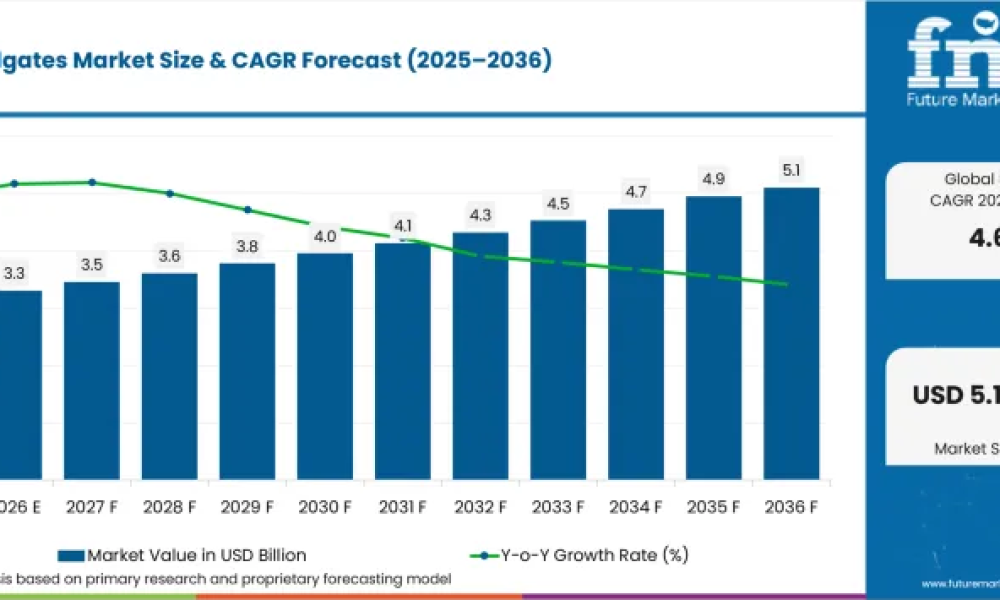
The global refuse tailgates market is projected to grow from USD 3.3 billion in 2026 to USD 5.1 billion by 2036, registering a 4.6% CAGR over the forecast period. Demand is supported by refuse-body production, municipal fleet renewal, and replacement of high-cycle tailgate assemblies that experience repeated loading, compaction, sealing, and discharge operations.
Tailgates are integral to refuse-body performance, supporting loading hoppers and discharge closures while incorporating wear surfaces, seals, locking mechanisms, hydraulic cylinders, and safety controls. Their condition directly affects vehicle availability and collection schedules. As waste collection fleets operate for extended shifts and retain vehicles over long service lives, purchasing teams are evaluating tailgates based on durability, serviceability, parts availability, and compatibility with existing body systems—not only initial purchase price.
Natural Resources Canada reported in April 2026 that Toronto is converting 60 waste collection trucks to hybrid natural gas-electric operation. The city’s larger waste trucks operate on 10-hour shifts, and vehicles can remain in service for up to 15 years. These operating conditions reinforce the need for components that support uptime while accommodating changes to auxiliary-power systems. Tailgate demand can therefore emerge from both new refuse-body installations and refurbishment of existing vehicles.
What Are the Key Segments in the Refuse Tailgates Market?
The market is shaped by tailgate configuration, material selection, vehicle architecture, purchasing channel, and end-user requirements. The leading segments in 2026 reflect the importance of reliable loading and discharge operations across municipal waste collection fleets.
- Rear-loader tailgates — 34.0% share: Rear-loader configurations lead the tailgate-type segment because the assembly is closely integrated with the hopper, loading process, and discharge cycle.
- Abrasion-resistant steel — 42.0% share: This material leads the material segment because wear-critical tailgate and hopper surfaces require durability while manufacturers and fleets remain attentive to overall body weight.
- Rear-loader refuse trucks — 38.0% share: Rear-loader vehicles lead the vehicle-type segment because their operating cycle relies directly on a high-duty rear tailgate assembly.
- Body OEMs — 43.0% share: Original equipment manufacturers lead the sales-channel segment because structures, locks, sensors, and hydraulic systems can be validated together during the initial refuse-body build.
- Municipal fleets — 39.0% share: Municipal operators lead the end-use segment as route continuity, maintenance consistency, and predictable vehicle availability influence procurement decisions.
Get detailed market forecasts, competitive benchmarking, and pricing trends:
https://www.futuremarketinsights.com/reports/sample/rep-gb-35118
Which Countries Are Showing the Strongest Growth in the Refuse Tailgates Market?
Canada is projected to record the fastest growth among the profiled countries, with a 5.7% CAGR from 2026 to 2036. Municipal fleet renewal, extended operating shifts, and hybrid vehicle conversion programs are supporting demand for tailgate systems that can be integrated into existing refuse-body architectures. Retrofit compatibility and dependable service support are important considerations for fleets seeking to limit downtime.
Mexico is expected to expand at a 5.4% CAGR. Market development is linked to refuse collection vehicle procurement and the need for durable rear-body components that can support repeated loading and discharge cycles. Tailgate suppliers able to provide practical maintenance access and reliable replacement parts can address fleet requirements across new installations and existing vehicles.
Brazil is projected to register a 5.1% CAGR. Demand is associated with municipal waste collection requirements and the operational needs of refuse truck fleets. Tailgate durability, hydraulic reliability, sealing performance, and the availability of replacement components influence purchasing decisions.
The United States is expected to grow at a 4.7% CAGR. Municipalities are assessing zero-emission refuse trucks against route-completion requirements and charging availability before expanding replacement programs. Tailgate designs must accommodate evolving chassis and auxiliary-power configurations while maintaining dependable collection performance.
Germany is projected to record a 4.4% CAGR. Public fleets are adding charging capacity alongside electric collection vehicles, creating additional integration considerations for rear-body equipment. Tailgate suppliers must account for vehicle packaging, weight, hydraulic or electric actuation, and compatibility with the refuse-body control system.
France is expected to grow at a 4.1% CAGR. Demand is influenced by fleet replacement and the requirements of waste collection operators seeking reliable, maintainable body systems. Procurement decisions depend on the ability to support established vehicle configurations while accommodating changes in fleet technology.
Japan is projected to record a 3.7% CAGR. Municipalities are introducing fuel-cell refuse trucks for compact urban service, making weight, auxiliary power, packaging, and control integration important considerations. Tailgate systems must preserve loading and discharge performance within the constraints of the selected vehicle platform.
How Is the Competitive Landscape Evolving?
Competition in the refuse tailgates market is closely connected to refuse-body manufacturing and the ability to supply integrated rear-body systems. Key manufacturers include Heil Environmental, McNeilus, Labrie Enviroquip (part of Hiab), New Way Trucks, Dennis Eagle, FAUN, ZOELLER-KIPPER, Pak-Mor, Haul-All Equipment, and Bridgeport Manufacturing.
Suppliers compete through structural durability, abrasion resistance, sealing reliability, hydraulic performance, locking safety, and access to service parts. Integration with the refuse body is particularly important because tailgate structures and controls must work with the loading hopper, compaction mechanism, and discharge process. Body OEMs benefit from validating these components as a coordinated assembly during vehicle production.
Changes in refuse truck propulsion are adding another dimension to supplier evaluation. Hybrid, battery-electric, and fuel-cell platforms can introduce different weight and auxiliary-power requirements. Manufacturers that demonstrate compatibility with the target chassis and body architecture can help reduce integration work for fleet operators. Serviceability remains equally important because repairs that extend beyond planned maintenance can disrupt collection routes.
What Does the Analyst Say About the Refuse Tailgates Market?
Future Market Insights Principal Consultant Nikhil Kaitwade observes:
“A refuse tailgate is bought as part of a working body system, so the winning design has to survive repeated cycles, seal reliably and be serviceable without keeping a route off the road. Electrification adds another test because weight and auxiliary power now matter more.”
What Is Driving Demand for Refuse Tailgates?
Long operating hours and repeated duty cycles
Refuse trucks perform frequent loading, compaction, and discharge operations, placing repeated demands on tailgate structures, seals, locks, and hydraulic components. Fleets operating long shifts need assemblies that maintain performance throughout demanding collection schedules. Wear resistance and predictable maintenance intervals therefore remain important purchasing criteria.
Fleet renewal and refurbishment
Vehicles that remain in service for many years create two potential demand streams: factory-installed tailgates on new refuse bodies and replacement assemblies for existing trucks. Refurbishment can extend vehicle service life, but worn seals, damaged surfaces, unreliable locking mechanisms, or hydraulic problems may require component replacement. Suppliers that provide parts access and practical repair support can help reduce vehicle downtime.
Integration with alternative-power vehicles
Hybrid and zero-emission refuse trucks are changing the packaging and power requirements of rear-body systems. Tailgate suppliers must account for the chassis design and available auxiliary power while maintaining safe locking and discharge operations. Lighter architectures and compatible controls can create opportunities where fleets are transitioning to new vehicle platforms.
What Are the Key Market Restraints?
Tailgate replacement can be delayed by the cost and complexity of fitting assemblies to existing refuse bodies. Differences in body geometry, hydraulic arrangements, locking systems, sensors, and control interfaces can complicate installation. Fleet operators must also balance replacement costs against the risk of continued operation with worn or unreliable components.
Downtime presents another constraint. Removing a truck from a collection route for repair or installation can disrupt scheduled service. Suppliers therefore need to support accurate fitment, accessible replacement parts, and maintenance procedures that minimize the time required to return a vehicle to operation.
Drive Your Business Growth Strategy: Checkout the Report for Key Insights!
https://www.futuremarketinsights.com/checkout/35118
What Opportunities Exist for Refuse Tailgate Manufacturers?
Opportunities are emerging in retrofit-compatible assemblies, serviceable designs, and tailgates developed for electric and alternative-power refuse trucks. Manufacturers that address weight, auxiliary-power requirements, and control compatibility can support fleet transitions without compromising the basic functions of loading, sealing, locking, and discharge.
There is also scope for aftermarket support that improves component availability and simplifies refurbishment. Fleet managers can benefit from clear fitment documentation, replaceable wear components, and service arrangements designed around municipal operating schedules. For body OEMs, integrated designs that combine tailgate structures, hydraulic components, sensors, and safety controls can simplify validation and procurement.
How Is the Refuse Tailgates Market Segmented?
The market is segmented by Tailgate Type, Material, Vehicle Type, Sales Channel, and End Use.
- By Tailgate Type: Rear-loader tailgates and other tailgate configurations used across refuse-body architectures.
- By Material: Abrasion-resistant steel and other materials selected according to durability, corrosion resistance, weight, and fabrication requirements.
- By Vehicle Type: Rear-loader refuse trucks and other refuse collection vehicle configurations.
- By Sales Channel: Body OEMs and replacement or aftermarket supply channels.
- By End Use: Municipal fleets and other waste collection operators.
Each segment reflects different operating priorities. Tailgate requirements vary with waste type, collection frequency, chassis packaging, payload considerations, and maintenance practices. Suppliers must match assembly design and service support to the requirements of each vehicle and fleet application.
What Is the Outlook for the Refuse Tailgates Market?
The refuse tailgates market is projected to reach USD 5.1 billion by 2036, growing at a 4.6% CAGR from 2026 to 2036. Demand is expected to remain connected to municipal fleet renewal, refuse-body production, replacement of high-cycle components, and the need to maintain reliable collection operations.
Canada leads the profiled countries with a projected 5.7% CAGR, while Japan records the lowest forecast growth rate at 3.7%. Across markets, manufacturers that combine durable construction, reliable sealing and locking, serviceability, and compatibility with evolving vehicle platforms will be better positioned to address fleet procurement requirements.
About Future Market Insights
Future Market Insights (FMI) provides market research and consulting services, delivering market forecasts, competitive intelligence, and industry analysis to support business planning and strategic decisions across global markets.



