
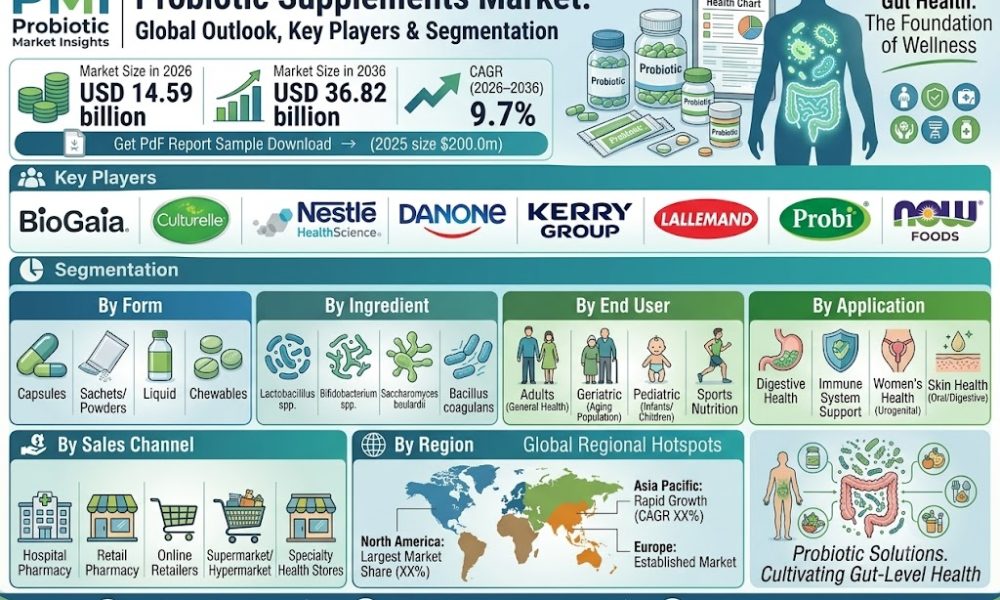
NEWARK, Del., October 9, 2026. — The global probiotic supplements market is estimated at USD 14.59 billion in 2026 and is projected to reach USD 36.82 billion by 2036, expanding at a CAGR of 9.7% from 2026 to 2036, according to Future Market Insights (FMI). The market stood at USD 13.30 billion in 2025.
The growth outlook is being shaped by increasing consumer focus on digestive health, daily wellness and life-stage nutrition. FMI identifies demand for convenient probiotic formats and clearly defined health applications as key market drivers. Consumers are paying greater attention to named probiotic strains, viable counts and intended uses, while capsules, powders, gummies and baby drops are providing convenient options for different age groups and consumption routines.
Strain transparency and product quality shape consumer confidence
Product information and quality assurance are becoming important considerations in the probiotic supplements market. According to the National Institutes of Health (NIH), probiotic supplement labels may identify the genus, species, strain and colony-forming units (CFUs). A higher CFU count does not necessarily indicate greater health benefits, making strain selection and intended use important considerations for consumers.
FMI highlights that manufacturers offering clearly identified strains, appropriate dosing information and products that maintain probiotic viability through expiry can strengthen consumer confidence and encourage repeat purchases.
👉 Get Detailed Market Forecasts, Competitive Benchmarking & Pricing Trends: https://www.futuremarketinsights.com/reports/sample/rep-gb-613
Where growth is fastest
- South Korea — 11.4% CAGR: Demand is expected to benefit from an established health functional food industry and consumer interest in probiotic products. FMI cites USDA data indicating that South Korea’s health functional food industry reached USD 3.7 billion in 2024, with imported products accounting for 28.4% of the market and probiotics representing 15.9% of sales.
- Japan — 10.9% CAGR: A mature functional food industry and a large older population support demand for products addressing digestive health and everyday wellness. Product evidence and manufacturing records remain important considerations under Japan’s Foods with Function Claims framework.
What leads the market
- Digestive health support — 38.0% share in 2026: Recognizable digestive wellness needs and regular supplement use support its position as the leading functional application.
- Baby products — 28.0% share in 2026: Life-stage-specific formulations and established purchasing routines among caregivers support demand for infant and baby-oriented probiotic products.
- Capsules — 36.0% share in 2026: Measured dosing, portability and convenient storage support capsules as the leading product form.
The hurdle
Maintaining product viability and communicating benefits clearly remain key challenges. FMI highlights the importance of strain identification, appropriate dosage, intended use and viable counts. Manufacturers must also ensure that probiotic products maintain their viability through expiry and provide reliable product information. Differences in regulatory requirements across markets can add complexity to product registration, quality documentation and international expansion.
For full coverage of the Probiotic Supplements Market, including forecasts by functionality, customer orientation, form, region and country, visit the FMI report: https://www.futuremarketinsights.com/reports/probiotic-supplements-for-kids-market
Key market trends and developments
The probiotic supplements market is benefiting from growing interest in digestive wellness and products designed for specific consumer needs:
- Daily digestive health: Regular use of probiotics for digestive support is encouraging demand for products with clearly communicated purposes and strain information.
- Life-stage nutrition: Baby-oriented probiotic products are addressing specific consumer needs through age-appropriate formats and purchasing routines.
- Convenient product formats: Capsules, powders, gummies and baby drops provide different options for portability, measured dosing and ease of consumption.
- Quality-focused product development: Maintaining viable counts through expiry and providing clear product information are becoming important considerations for manufacturers seeking repeat demand.
- Regional market expansion: South Korea and Japan offer growth opportunities, although manufacturers must account for differences in ingredient recognition, product evidence and quality requirements.
FMI identifies BioGaia, Culturelle, Nestlé Health Science, Danone, Kerry Group, Lallemand, Probi and NOW Foods among the notable companies in the probiotic supplements market. These companies represent a mix of probiotic specialists, nutrition businesses and broader food and supplement manufacturers.
Analyst perspective
“In my experience, strain-defined products will receive wider preference as consumers compare purpose and viable count. Products maintaining viability through expiry will create stronger repeat demand.”— Nandini Roy Choudhury, Principal Consultant, Future Market Insights.
What this means for supplement manufacturers and probiotic brands
- Prioritize strain-specific product information. Clearly communicating the probiotic strain, viable count, recommended dosage and intended use can help consumers compare products and make informed choices.
- Protect probiotic viability. Formulation, packaging and storage considerations should support the maintenance of viable microorganisms throughout the stated shelf life.
- Develop products for specific consumer needs. Digestive health applications and life-stage-specific formulations offer opportunities to address distinct purchasing routines and wellness requirements.
- Adapt to regional regulatory requirements. Manufacturers expanding into South Korea and Japan should account for local ingredient recognition, product evidence and manufacturing documentation requirements.
- Focus on convenient formats. Capsules, powders, gummies and baby drops can help brands serve different consumer preferences and daily supplementation routines.
About Future Market Insights
Future Market Insights, Inc. (FMI) is an ESOMAR-certified market research and consulting firm headquartered in Delaware, USA, with offices in the United Kingdom, the United Arab Emirates and India. FMI delivers syndicated and custom research across food and beverage, healthcare, chemicals, technology, packaging, consumer goods and industrial sectors.
For Press & Corporate Inquiries
Rahul Singh
AVP – Marketing and Growth Strategy
Future Market Insights, Inc.
+91 8600020075
For Sales: [email protected]
For Media: [email protected]
For Web: https://www.futuremarketinsights.com/



