
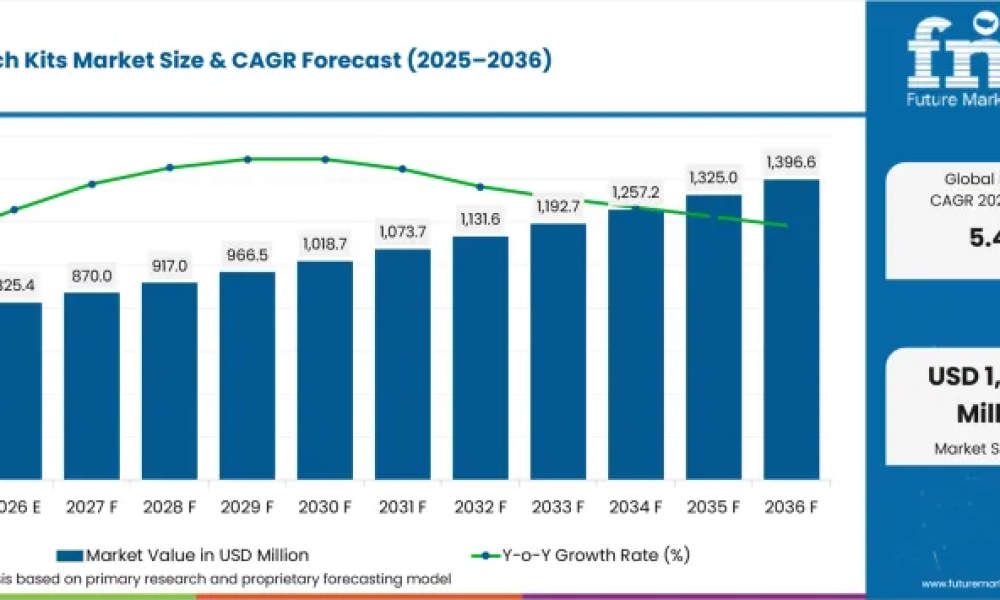
The global drive clutch kits market is projected to expand from USD 825.4 million in 2026 to USD 1,396.6 million by 2036, advancing at a 5.4% CAGR from 2026 to 2036. Demand is supported by clutch wear, tire changes, towing loads, and performance modifications that can alter engine speed, belt loading, and CVT operating behavior.
Drive clutch kits provide a practical route for owners and technicians to restore or modify clutch calibration when vehicle operating conditions change. The broader continuously variable transmission systems market establishes the technology base, as drive-clutch calibration influences belt engagement and ratio behavior under changing loads.
Replacement demand is also linked to the expanding model-year population of powersports vehicles. Polaris announced its 2027 snowmobile lineup in February 2026, increasing the number of vehicle configurations that replacement and tuning brands may need to support with accurate clutch references.
What Are the Key Segments in the Drive Clutch Kits Market?
- Primary Clutch Kits — 29.0% share: Primary clutch kits lead the kit-type segment in 2026 because complete drive-side replacement can restore a known mechanical baseline.
- UTVs — 34.0% share: UTVs account for the leading vehicle-type share as work and recreational applications expose clutches to changing loads, terrain, and operating conditions.
- Aftermarket Distributors — 36.0% share: Aftermarket distributors lead the sales-channel segment because established fitment records can help technicians identify compatible clutch components.
- OEM Replacement: OEM replacement kits address vehicles requiring restoration of original operating characteristics without introducing a higher-performance calibration.
- Trail Performance and Heavy-Duty Towing: Performance levels vary according to intended operating conditions, with different spring and weight combinations used to manage engine speed and belt engagement.
Get detailed market forecasts, competitive benchmarking, and pricing trends:
https://www.futuremarketinsights.com/reports/sample/rep-gb-35040
Which Countries Are Showing the Strongest Growth in the Drive Clutch Kits Market?
Sweden is projected to record the highest CAGR among the profiled countries at 6.4% through 2036. The country’s powersports and recreational vehicle environment supports demand for clutch service and tuning products, particularly where vehicles operate across seasonal and variable terrain conditions.
Australia is expected to expand at a 6.1% CAGR, supported by off-road recreational and utility applications. ATV and UTV use across demanding terrain can create recurring requirements for clutch inspection, replacement, and calibration adjustments.
Mexico is projected to register a 5.8% CAGR. Growth is supported by expanding recreational and utility vehicle applications, with aftermarket distributors playing an important role in supplying vehicle-specific clutch components and adjustment kits.
Canada is expected to grow at a 5.4% CAGR. Snowmobiles and other powersports platforms provide an established addressable market, while seasonal operation and demanding terrain create opportunities for replacement and performance-oriented clutch products.
The United States is projected to record a 5.0% CAGR. The country’s large powersports and off-highway vehicle population provides a substantial installed base for replacement and tuning products. The U.S. Consumer Product Safety Commission estimated 578,700 OHV-related emergency-department injuries during 2020–2024 in its May 2026 report. The figure measures injuries rather than sales or market value, but it indicates sustained use of off-highway vehicles across the country.
How Is Regional Demand Shaping the Drive Clutch Kits Market?
Drive clutch kit demand follows installed vehicle use and application requirements rather than a single modification pattern. UTVs, ATVs, snowmobiles, side-by-sides, and utility carts can operate under substantially different load conditions, requiring clutch kits to match the vehicle’s tire size, engine characteristics, terrain, and intended use.
The aftermarket therefore depends heavily on application-specific fitment information. A kit that works effectively with the original tire diameter may require a different weight or spring combination after tire upsizing or a change in towing requirements. Suppliers able to document these relationships can improve installation accuracy and reduce returns.
What Is Changing the Competitive Landscape?
The competitive landscape includes EPI Performance, Dalton Industries, TEAM Industries, CVTech-IBC, Comet Industries, Hilliard Corporation, Polaris Inc., and Kawasaki Motors Corp., U.S.A. These companies compete through clutch hardware, tuning components, model coverage, application-specific calibration, and aftermarket distribution.
Primary clutch kits remain an important product category because replacing the complete drive-side assembly can provide technicians with a defined mechanical baseline. This can simplify restoration work when a clutch has accumulated wear or when modifications have moved the original calibration outside its intended operating range.
Performance applications create additional differentiation. Trail riding, racing, mud and sand riding, and heavy-duty towing can impose different requirements on clutch engagement and engine-speed management. Suppliers therefore compete on their ability to match springs, weights, and clutch components to the intended operating profile.
Model-year coverage is another competitive consideration. New vehicle introductions add fitment requirements for aftermarket brands, while established platforms require long-term availability of replacement references. Maintaining accurate application databases can therefore become as important as the underlying clutch hardware.
What Does the Analyst Say About the Drive Clutch Kits Market?
“Drive clutch kits sell on setup accuracy because tire diameter and operating load determine whether a calibration restores useful engine speed. Strong aftermarket offers pair exact fitment records with adjustment guidance that limits returned parts and repeated installation work.”
— Nikhil Kaitwade, Principal Consultant, Future Market Insights
What Is Driving Demand for Drive Clutch Kits?
Tire Upsizing and Vehicle Modifications
Larger tires can alter the effective gearing and load placed on a CVT system. When vehicle owners change tire dimensions, the original clutch calibration may no longer provide the desired engine-speed behavior, creating demand for weights, springs, or complete clutch kits.
Towing and Utility Loads
UTVs and other utility-oriented vehicles can experience substantial changes in operating load when used for towing or work applications. Clutch kits designed for heavier duty cycles can help adapt belt engagement and engine-speed behavior to these requirements.
Powersports Vehicle Expansion
New snowmobiles, UTVs, ATVs, and side-by-sides increase the addressable installed base for future maintenance and tuning. New model-year launches also require replacement suppliers to maintain current fitment information across evolving vehicle platforms.
Performance and Calibration Demand
Performance-oriented riders may seek different acceleration characteristics or higher-RPM operation. This creates a specialized market for tuning kits that combine springs, weights, and clutch components according to a defined performance objective.
What Are the Key Market Restraints?
Calibration complexity remains a significant constraint. Tire diameter, engine output, vehicle weight, terrain, and intended duty cycle can all influence clutch behavior. A configuration suitable for trail riding may not provide the same results during towing, mud riding, or high-RPM racing.
Fitment errors can also increase aftermarket costs. Incorrect weights, springs, or clutch assemblies can lead to poor performance, repeated installation work, and returned products. Suppliers must therefore provide accurate vehicle references and clear adjustment guidance.
Drive Your Business Growth Strategy: Checkout the Report for Key Insights!
https://www.futuremarketinsights.com/checkout/35040
What Opportunities Exist for Drive Clutch Kit Manufacturers?
Digital fitment catalogs represent an important opportunity for aftermarket suppliers. Vehicle-specific search tools can help dealers and technicians match kits to model year, engine, tire configuration, and application, reducing errors during ordering and installation.
Manufacturers can also expand specialized product ranges for towing, trail performance, racing, and off-road applications. Offering clearly differentiated calibration packages can help suppliers serve customers seeking specific engine-speed and belt-loading characteristics.
How Is the Drive Clutch Kits Market Segmented?
The market is analyzed by kit type, vehicle type, sales channel, performance level, application, and region.
By Kit Type
Primary clutch kits, clutch tuning kits, complete clutch upgrade kits, spring/weight kits, and heavy-duty clutch kits represent key product categories.
By Vehicle Type
UTVs, ATVs, snowmobiles, side-by-sides, and golf or utility carts form the principal vehicle segments.
By Sales Channel
Aftermarket distributors, powersports dealers, e-commerce/direct channels, and OEM or service-parts channels represent major routes to market.
By Performance Level
OEM replacement, trail performance, heavy-duty towing, and racing/high-RPM configurations address different operating requirements.
By Application
Belt engagement tuning, acceleration improvement, load compensation, and mud or sand riding represent major applications.
What Are the Drivers, Restraints and Opportunities in the Drive Clutch Kits Market?
Drive clutch kit demand is shaped by the need to maintain or modify CVT behavior when vehicle load, tire size, terrain, or operating conditions change.
- Driver: Tire upsizing, towing, and powersports use create recurring clutch calibration requirements.
- Restraint: Vehicle-specific calibration makes incorrect component selection costly and can increase installation time.
- Opportunity: Digital fitment records and application-specific tuning packages can reduce returns while expanding aftermarket coverage.
What Is the Drive Clutch Kits Market Demand Outlook?
The market is expected to benefit from a growing installed base of CVT-equipped powersports vehicles and continued demand for replacement and performance tuning. UTVs remain particularly important because their mixed recreational and utility applications expose clutch systems to changing loads.
Suppliers that combine accurate fitment information with clearly defined calibration guidance can strengthen aftermarket positioning. As new model years enter the market, maintaining coverage across vehicle-specific clutch configurations will remain an important requirement for replacement brands.
Which Countries Are Growing Fastest in the Drive Clutch Kits Market?
Sweden leads the profiled countries with a 6.4% CAGR, followed by Australia at 6.1%, Mexico at 5.8%, Canada at 5.4%, and the United States at 5.0% through 2036. The country outlook reflects differences in powersports use, off-road vehicle adoption, seasonal operating conditions, and demand for replacement and performance-oriented clutch calibration.
About Future Market Insights
Future Market Insights (FMI) is a leading provider of market research and consulting services, offering syndicated and customized research across automotive, powersports, mobility, energy, industrial, and related industries. FMI provides market forecasts, competitive intelligence, strategic analysis, and data-driven insights to support business and investment decisions across global markets.



