
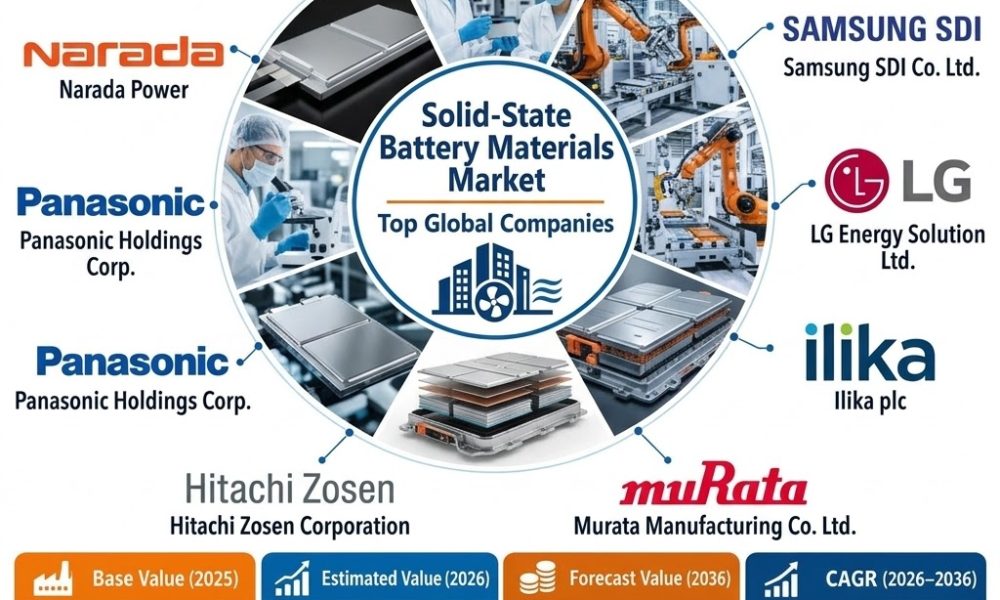
The global solid-state battery materials market is valued at USD 1.20 billion in 2025 and is projected to reach USD 1.56 billion in 2026 before expanding to USD 22.25 billion by 2036, representing a 30.4% CAGR from 2026 to 2036. The market is expected to create an incremental opportunity of USD 20.69 billion during the forecast period. Growth is being supported by automotive OEM commitments to solid-state battery vehicle launches before 2030, which are accelerating electrolyte material qualification timelines and encouraging multi-year supply agreements with ceramic and sulfide powder producers. The report also cites the International Energy Agency’s April 2025 Global EV Outlook 2025 among its reference sources for battery technology and supply-chain trends.
Get detailed market forecasts, competitive benchmarking, and pricing trends: https://www.factmr.com/connectus/sample?flag=S&rep_id=11802
Global Segment Leaders
- Lithium-based solid-state batteries — 82.5% share: Lithium-based batteries lead the battery-type category because of their established research base, strong ionic conductivity performance, energy-density characteristics, and applicability across automotive and portable-electronics applications.
- Sulfide-electrolyte systems — 46.0% share within lithium-based batteries: Sulfide systems lead the lithium-based subsegment, supported by automotive OEM adoption for high-density electric vehicle platforms and room-temperature ionic conductivity characteristics.
- Automotive — 41.4% share: Automotive applications lead end use as electric vehicle production, vehicle safety priorities, zero-emission mandates, and demand for extended driving range accelerate adoption of advanced battery materials.
- Energy storage systems — 25.6% share: Energy storage represents the next-largest end-use category, supported by grid integration requirements, renewable energy deployment, and demand for long-duration storage capabilities.
- Consumer electronics — 18.7% share: Portable-device applications sustain demand because they require compact batteries with high energy density.
- Aerospace & defense — 7.9% share: Specialized military and aviation applications support this segment through stringent safety and performance requirements.
Country-Level Performance
| Country | CAGR, 2026–2036 | Key Growth Driver |
| China | 31.1% | Extensive electric vehicle industrialization, Made in China 2026 policy support, and comprehensive battery-material supply-chain development; the report also cites State Council policy support for solid-state battery technology. |
| India | 30.7% | Renewable-energy grid integration and electric-mobility programs, supported by government renewable-energy targets and electric-vehicle incentive frameworks. |
| United States | 30.4% | Department of Energy funding programs, electric-vehicle manufacturing expansion, and automotive OEM technology partnerships supporting solid-electrolyte research and production. |
| Brazil | 29.8% | Solar-storage integration, renewable-energy expansion, grid-stability requirements, and electric-vehicle assembly localization initiatives. |
| Germany | 29.2% | EU decarbonization mandate implementation and automotive OEM adoption of sulfide electrolyte technologies. |
| United Kingdom | 28.9% | Government innovation grants, solid-state pilot-plant development, and emerging automotive battery projects. |
| Japan | 27.8% | Automotive research programs, ceramic-electrolyte commercialization, and technology development aligned with Japanese battery-manufacturing quality standards. |
The country ranking above follows the report’s dedicated “Top Country Growth Comparison” table and subsequent country analysis. The page contains an earlier summary with different country CAGR figures; therefore, the dedicated country-analysis table is used here to avoid mixing two inconsistent data sets.
Regional Context
Fast-growing markets: China, India, and the United States are positioned among the fastest-growing markets. China benefits from electric vehicle industrialization, domestic battery-material supply chains, and government-backed production programs. India is gaining momentum from renewable-energy storage deployment and electric mobility, while the United States is supported by Department of Energy funding, expanding electric-vehicle manufacturing, and automotive technology partnerships.
Intermediate-growth markets: Brazil and Germany are also expanding rapidly but at lower rates than China, India, and the United States. Brazil’s growth is linked to solar-storage projects, grid stability requirements, and vehicle electrification, while Germany benefits from EU decarbonization targets and automotive OEM adoption of sulfide electrolyte systems.
Mature/slower-growth markets: The United Kingdom and Japan record the lowest CAGRs among the seven profiled countries. The United Kingdom’s market is supported by government innovation funding and pilot manufacturing, while Japan’s established automotive and electronics research base emphasizes ceramic-electrolyte commercialization and material-quality optimization.
The broader report covers Asia Pacific, North America, Europe, Latin America, and the Middle East & Africa, with seven countries profiled individually in the country-analysis section.
Competitive Landscape
The competitive landscape includes QuantumScape Corporation, Toyota Motor Corporation, Solid Power Inc., Samsung SDI Co. Ltd., LG Energy Solution Ltd., Ilika plc, Murata Manufacturing Co. Ltd., Hitachi Zosen Corporation, Panasonic Holdings Corp., and Narada Power. The report identifies approximately 15–20 meaningful players and states that competition centers on electrolyte performance, manufacturing scalability, and automotive OEM collaboration. QuantumScape holds the highest reported market share at 14.8%, while Toyota Motor Corporation holds 13.6%.
Among developments identified on the page, Narada Power launched 783 Ah solid-state cells in 2025 for renewable energy storage, representing a product-development move aimed at stationary storage applications. The report also highlights continuing collaboration between material developers and automotive manufacturers, including QuantumScape’s joint electric-vehicle programs with Volkswagen.
Top Trending Reports:
About Fact MR
(Fact MR) is a leading provider of market research and consulting services, offering syndicated and customized research across industries including automotive, energy storage, and chemicals and materials.



