
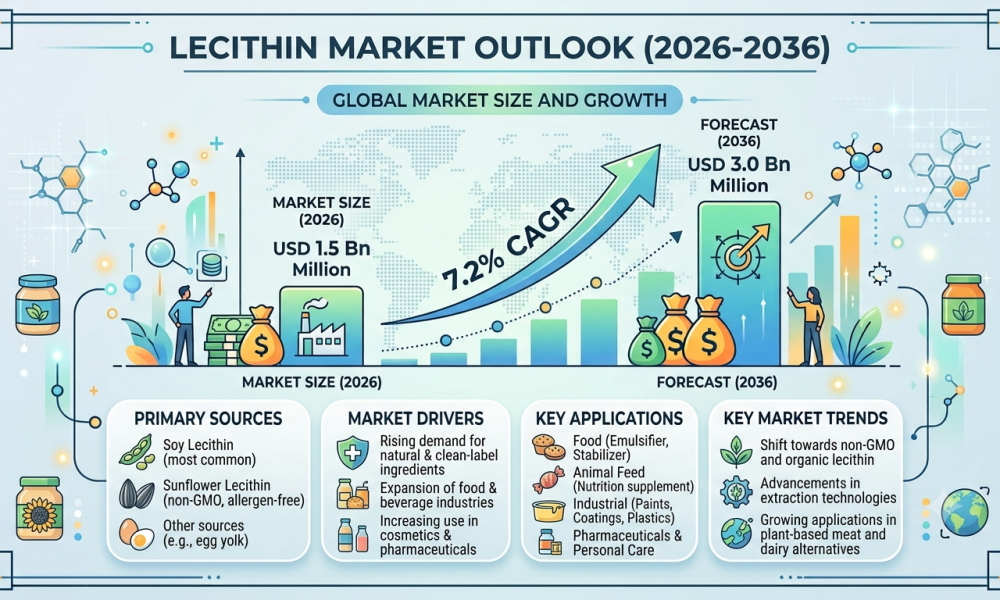
The global lecithin market is projected to grow from USD 1.5 billion in 2026 to USD 3.0 billion by 2036, registering a 7.2% CAGR during the forecast period. Demand is supported by the continued use of lecithin as an emulsifier and dispersing agent across food processing, animal feed, nutraceuticals, cosmetics, and pharmaceutical applications. Manufacturers value lecithin for its ability to support formulation consistency while fitting into established production processes. Food manufacturers also rely on it for functional performance in bakery, confectionery, and other processed food products.
The market is shaped by demand for reliable ingredient specifications, consistent processing performance, and clear documentation of botanical origin. Fluid lecithin is expected to account for 60.1% of product-type revenue in 2026, while soy-based lecithin is projected to hold 68.3% of source revenue. The food application segment is anticipated to lead with a 30.3% share in 2026. At the same time, interest in alternative botanical sources, including sunflower and rapeseed, is creating opportunities for suppliers serving manufacturers with specific labeling and formulation requirements.
Get detailed market forecasts, competitive benchmarking, and pricing trends: https://www.futuremarketinsights.com/reports/sample/rep-gb-17199
Global Segment Leaders
- Product Type – Fluid: 60.1% in 2026. Fluid lecithin benefits from established liquid dosing systems and its suitability for high-volume commercial formulations.
- Source – Soy: 68.3% in 2026. Familiar specifications and established sourcing practices support repeat use across food and industrial applications.
- Application – Food: 30.3% in 2026. Routine requirements for emulsification and dispersion support lecithin use across food manufacturing processes.
Country-Level Performance
The United States is projected to record the fastest growth among the profiled countries, with an 8.6% CAGR through 2036. Demand is supported by established food ingredient applications and the continued use of lecithin in commercial formulations. The UK is forecast to grow at a 7.2% CAGR, supported by established food additive approval frameworks and demand for functional ingredients.
South Korea is expected to expand at a 6.9% CAGR, while Japan is projected to record a 6.3% CAGR. In both markets, ingredient specifications and regulatory documentation remain important factors in supplier qualification. Germany is forecast to grow at a 5.3% CAGR, reflecting demand from established food processing and specialty ingredient industries.
Regional Context
North America and Western Europe remain important markets for lecithin suppliers serving established food processing and specialty ingredient applications. The United States leads the profiled countries in forecast growth, while the UK offers continued opportunities through routine ingredient use and established food additive requirements.
East Asia also presents growth opportunities, with South Korea and Japan recording projected CAGRs of 6.9% and 6.3%, respectively. Across these markets, manufacturers are evaluating botanical origin, ingredient consistency, and labeling requirements when qualifying new suppliers. Germany’s projected 5.3% CAGR reflects continued demand within established food and ingredient manufacturing systems.
The full report covers North America, Latin America, Western Europe, Eastern Europe, East Asia, South Asia and Pacific, and the Middle East and Africa, with country-level analysis across the United States, the UK, South Korea, Japan, Germany, and additional markets.
Access full Report in PDF Format@ https://www.futuremarketinsights.com/reports/brochure/rep-gb-17199
Competitive Landscape
The competitive landscape includes Cargill, Incorporated, ADM, Bunge Global SA, Lasenor Emul S.L., Sonic Biochem Extractions Pvt. Ltd., American Lecithin Company, Wilmar International Limited, Patanjali Foods Limited, and Lipoid GmbH. These companies operate across integrated oilseed processing, food-grade lecithin production, specialty emulsifier supply, and phospholipid applications.
Competition is shaped by botanical-source availability, product form, consistent ingredient specifications, and technical support during customer qualification. Suppliers offering fluid, de-oiled, and modified lecithin grades can address different processing requirements, while specialty manufacturers serve applications requiring more specific composition and performance characteristics.
Recent developments include Bunge Global SA’s completion of its acquisition of IFF’s soy protein concentrate and lecithin businesses in March 2026, expanding its lecithin supply capabilities. In August 2025, Lipoid GmbH reported progress at its Cologne site, with logistics and quality areas ready as production-building commissioning approached. In July 2025, Lasenor Emul S.L. introduced its RELISER SC range for continuous sliced-cheese production, using soy or sunflower lecithin with vegetable oils.
About Future Market Insights (FMI)
Future Market Insights, Inc. (ESOMAR certified, recipient of the Stevie Award, and a member of the Greater New York Chamber of Commerce) offers profound insights into the driving factors that are boosting demand in the market. FMI stands as the leading global provider of market intelligence, advisory services, consulting, and events for the Packaging, Food and Beverage, Consumer Technology, Healthcare, Industrial, and Chemicals markets. With a vast team of over 400 analysts worldwide, FMI provides global, regional, and local expertise on diverse domains and industry trends across more than 110 countries.



