
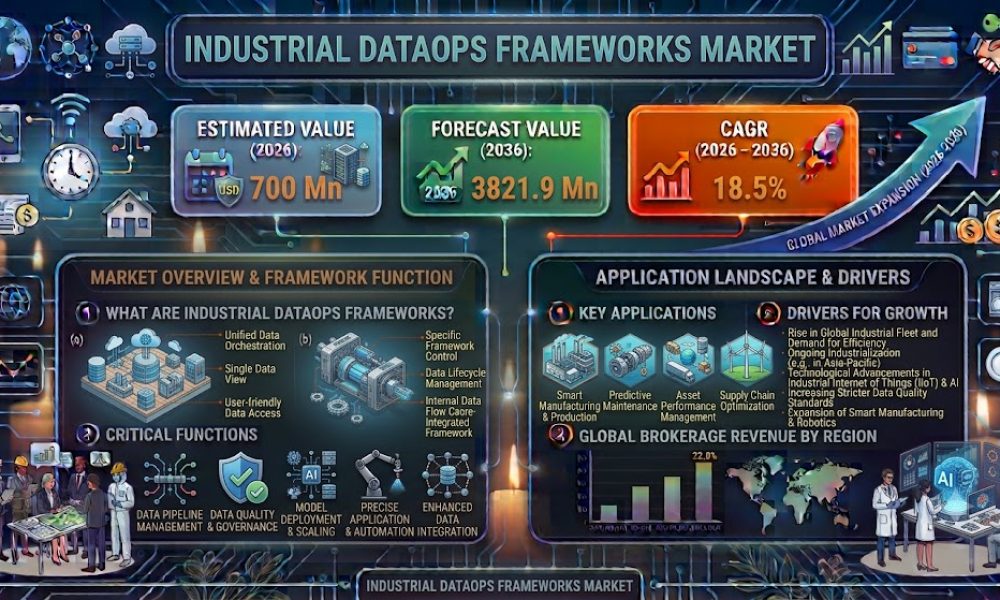
The global Industrial DataOps Frameworks Market is projected to grow from USD 700 million in 2026 to USD 3.82 billion by 2036, expanding at a 18.5% CAGR during the forecast period. The market was valued at USD 590.7 million in 2025 and is expected to create an absolute opportunity of USD 3.12 billion through 2036.
Industrial DataOps frameworks help manufacturers collect, normalize, contextualize, govern, and deliver data from plant-floor systems. Demand is rising as factories connect controllers, historians, Manufacturing Execution Systems, sensors, and asset records with enterprise analytics and AI applications. Manufacturers are increasingly looking for common data models that can work across multiple plants instead of relying on one-off data integrations.
Get Detailed Market Forecasts, Competitive Benchmarking, and Pricing Trends: https://www.factmr.com/connectus/sample?flag=S&rep_id=15469
Global Segment Leaders
- Historian Data leads the data-source segment with 31.0% share in 2026, as historians remain a trusted source for process and time-series records.
- Hybrid Cloud accounts for 38.0% share, allowing manufacturers to keep sensitive control data close to the plant while sending approved datasets to enterprise applications.
- Data Contextualization holds 34.0% share, reflecting the need to connect raw machine tags with assets, production lines, and batches before analytics can be applied.
- Open Platform Communications Unified Architecture (OPC UA) represents 32.0% share, supported by demand for interoperable machine-to-enterprise data.
- Manufacturers hold 40.0% share among buyer types because plant owners control spending on operational data projects.
Plant Data Standardization Becomes a Core Market Driver
Manufacturers are moving away from isolated tag extraction and manual data mapping. Industrial DataOps frameworks provide a governed route from machine data to business applications, helping plants create reusable operational models.
Fact.MR estimates that plant data standardization contributes 3.9 percentage points to CAGR, making it the strongest identified growth driver. Hybrid cloud architecture contributes 3.2 percentage points, while AI model pipeline readiness adds 2.8 percentage points.
AI projects are also increasing the need for clean and labeled industrial data. Factory AI models require consistent asset information and historical process data before manufacturers can scale predictive or production-focused applications. This positions DataOps as an important data foundation before wider AI deployment.
The scale of industrial automation further supports this need. The International Federation of Robotics reported 542,076 industrial robots installed globally in 2024, increasing the volume of operational data generated across automated production environments.
Historian Modernization and Edge Templates Create Opportunities
Fact.MR identifies historian modernization packages as a major opportunity, with an estimated 3.0 percentage point impact on CAGR. Suppliers can combine connectors, asset models, and governance functions to make existing historian data easier to reuse.
Edge data templates are another opportunity, with a 2.5 percentage point potential CAGR impact. Repeatable templates can help system integrators deploy similar data flows across plants that use different controllers and network configurations.
Data compliance workflows contribute another 2.2 percentage points to potential CAGR impact. The European Commission’s Data Act applies from September 12, 2025, increasing the importance of clear access rules for connected product and industrial data.
At the same time, brownfield plants present a significant challenge. Legacy tag structures have an estimated negative 2.2 percentage point impact on CAGR. Plant cybersecurity approval, asset naming gaps, OT data skill shortages, and validation delays can also slow deployment.
Country-Level Performance
- India: The market is projected to grow at a 21.1% CAGR, the fastest rate among the countries covered. Manufacturing technology programs are expanding the potential buyer base, while DataOps provides a data foundation for AI and digital-twin projects.
- China: Expected to expand at a 20.4% CAGR. Large volumes of automated production create substantial machine-data flows that need contextualization before analytics teams can compare production lines.
- United States: Forecast to grow at 18.9% CAGR, supported by multi-site manufacturers and industrial software investment. High automation density across manufacturing also supports demand for governed operational data.
- South Korea: Projected to register an 18.7% CAGR, with electronics and automotive plants generating high volumes of production and inspection data.
- Germany: Expected to advance at 18.3% CAGR, supported by factory automation and European data governance requirements.
- Japan: Forecast to expand at 17.8% CAGR, as established automation users increasingly move historian data into analytics workflows while maintaining strict validation practices.
- United Kingdom: Expected to record 17.2% CAGR, supported by manufacturing technology programs and grant-backed adoption.
Competitive Landscape
The competitive landscape includes industrial software providers, industrial data specialists, analytics companies, and automation technology vendors. Fact.MR profiles HighByte, Cognite, Litmus, AVEVA, Siemens, Rockwell Automation, and Seeq.
HighByte focuses on industrial DataOps and asset-context modeling, while Cognite provides industrial data fusion and AI workflow capabilities. Litmus connects edge data with cloud workflows for manufacturing environments.
AVEVA brings historian and operations-data capabilities through its PI portfolio. Seeq connects process data with analytics workflows. Siemens and Rockwell Automation extend their industrial software ecosystems into plant-data management and enterprise analytics.
The competitive focus is shifting toward connector breadth, semantic modeling, data governance, and reusable deployment templates. Suppliers that can connect operational technology with governed analytics workflows are positioned to address manufacturers seeking repeatable data architectures across multiple plants.
Analyst Perspective
Shambhu Nath Jha, Senior Analyst at Fact.MR, states:
“I see industrial DataOps as a buying decision about trust more than software volume. Plant teams already have data inside controllers, historians and Manufacturing Execution Systems. The problem is that each plant names assets differently and stores context in separate tools.”
This perspective highlights the central issue facing industrial software buyers. Data availability alone does not guarantee that information can be reused across production lines or plants. Standardized asset naming, governed pipelines, and consistent data context are becoming important parts of industrial analytics architecture.
Report Coverage
The Fact.MR study covers industrial DataOps frameworks used to ingest, normalize, contextualize, govern, and deliver operational data. The analysis includes PLC and SCADA data, historian data, MES data, sensor data, and asset metadata.
Deployment models covered include edge, hybrid cloud, on-premise, and managed cloud. Use cases include data contextualization, condition monitoring, production analytics, and AI model pipelines. Connectivity assessment includes OPC UA, MQTT, Modbus, historian connectors, and REST APIs.
The report covers 100+ sources, 40+ company portfolios, 25+ countries, and 20+ interviews. Forecasting combines industrial automation intensity, software deployment evidence, provider validation, and buyer research.
Explore More Related Studies Published by Fact.MR Research:
Inulin-FOS Pectin Blends Market
Graphene-Coated Cathode Materials Market
About Fact.MR
Fact.MR is a global market research and consulting firm, trusted by Fortune 500 companies and emerging businesses for reliable insights and strategic intelligence. With a presence across the U.S., UK, India, and Dubai, we deliver data-driven research and tailored consulting solutions across 30+ industries and 1,000+ markets. Backed by deep expertise and advanced analytics, Fact.MR helps organizations uncover opportunities, reduce risks, and make informed decisions for sustainable growth.



