
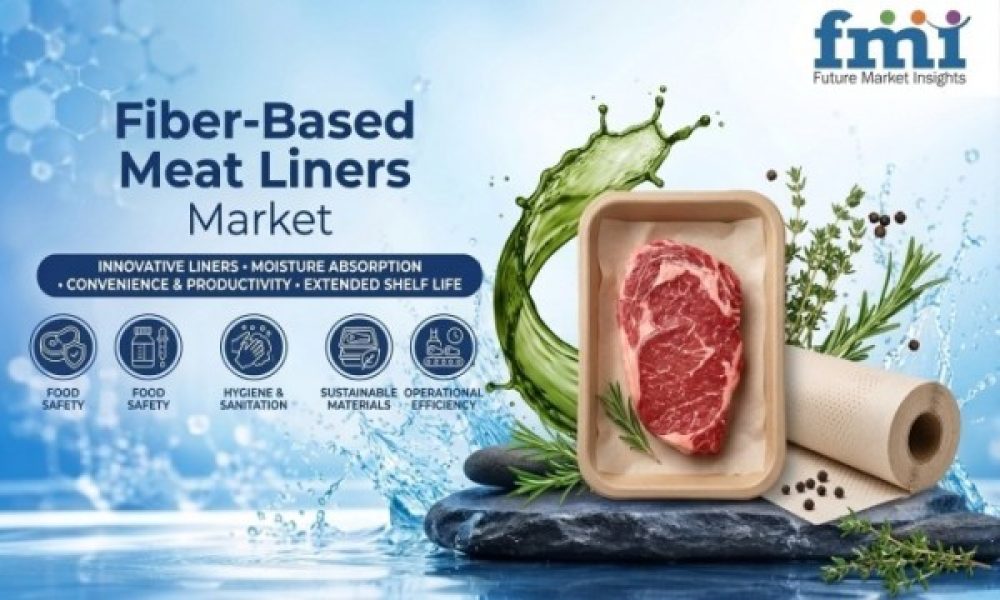
The global Fiber-Based Meat Liners Market is projected to grow from USD 282.0 million in 2026 to USD 544.5 million by 2036, registering a 6.8% CAGR over the forecast period, according to Future Market Insights (FMI).
Fiber-based meat liners are becoming an important component in fresh-protein packaging systems where processors need consistent fluid control, seal protection, and reliable insertion during high-speed production. Every approved pack requires a defined liner specification, creating recurring demand across meat, poultry, seafood, and processed-meat applications.
Recurring production of fresh protein supports repeated liner consumption. Packaging engineers must match absorption capacity with product weight, purge levels, tray geometry, storage conditions, and production speed.
Get detailed market forecasts, competitive benchmarking, and pricing trends:
https://www.futuremarketinsights.com/reports/sample/rep-gb-34656
The market is also responding to changing requirements around material composition and recovery. Manufacturers are evaluating fiber-rich structures that can provide required absorbency while offering clearer material classification and documented food-contact credentials.
According to the supplied FMI analysis, Airlaid Absorbent Liners are projected to hold a 32.0% share in 2026, supported by adjustable basis weight, absorbency, and compact pack geometry. Airlaid Cellulose is estimated to account for 34.0% of the material category, while Drip & Purge Absorption is forecast to represent 40.0% of the function category.
Direct relationships with processors are also central to market development. Direct-OEM supply is forecast to account for 46.0% in 2026, reflecting the technical qualification required to match liners with tray dimensions, sealing conditions, and automated insertion systems.
Qualification remains a key market consideration
The technical performance of a liner in laboratory conditions does not automatically translate to performance inside a moving chilled pack. Product weight, insertion speed, tray configuration, compressed retention, and purge characteristics can all affect commercial performance.
Food-contact documentation is another important consideration. Complete formulation records become particularly relevant when coatings, bonded layers, or material structures change. The FDA’s January 2025 action concerning 35 PFAS-related food-contact notifications further highlights the need for clear formulation and compliance records during supplier and coating reviews.
The market also presents opportunities for fiber-rich structures. Bagasse-agri-fiber is expected to record the fastest material growth from a smaller base, as manufacturers examine alternatives to plastic-rich constructions. Simpler structures with defensible material classification may support processor qualification and recurring supply programs.
Regional outlook shows varied growth rates
FMI’s country analysis identifies different growth trajectories across major protein-packaging markets.
Brazil is projected to record the fastest CAGR at 7.2%, followed by the United Kingdom at 6.7%, Germany at 6.6%, the United States at 6.2%, and Japan at 5.4% through 2036.
Brazil’s outlook reflects high-volume beef and poultry programs, while the United Kingdom is influenced by retailer specifications and packaging reporting requirements. Germany combines a large industrial processing base with increasing attention to practical material recovery. United States processors emphasize dependable insertion across established case-ready operations. Japan’s compact retail formats place greater emphasis on dimensional control and stable liner performance.
Competitive landscape
The Fiber-Based Meat Liners Market includes absorbent-core manufacturers, converted-pad producers, and regional food-pad specialists.
Companies profiled in the FMI report include Cellcomb AB, McAirlaid’s Vliesstoffe GmbH, Coppice Alupack Ltd (Sirane), Novipax LLC, Elliott Absorbent Products Ltd, Tite-Dri Industries, Pomona Company Sp. z o.o., and MAGIC S.p.A.
Recent developments also illustrate investment and consolidation across the sector. In July 2026, MAGIC S.p.A. placed an order with ANDRITZ for a food pad eXcelle production line incorporating airlaid forming technology at its Oleggio, Italy site. Commissioning is scheduled for the first quarter of 2027.
In June 2025, Cellcomb announced the acquisition of Finnish company Fatex through its parent company Löftet Holding AB. In August 2024, Coppice Alupack Ltd acquired the business and certain assets of Telford-based Sirane Limited.
Analyst perspective
“Fiber-based meat liners earn approval by matching purge behavior with tray geometry and production speed. Strong manufacturers document every layer and prove compressed retention during commercial line trials to secure recurring orders.”
— Nandini Roy Choudhury, Principal Consultant, Future Market Insights
Report Scope
The FMI study covers the Fiber-Based Meat Liners Market by product type, material, function, application, end use, sales channel, and region. Product categories include airlaid absorbent liners, molded fiber tray liners, nonwoven cellulose liners, interleaving sheets, and others.
The study covers North America, Latin America, Europe, East Asia, South Asia and Pacific, and the Middle East and Africa, with country-level analysis including Brazil, the United Kingdom, Germany, the United States, Japan, and more than 20 additional countries.
The market assessment uses primary and secondary research with market triangulation. Revenue is measured in USD million, with forecasts covering 2026 to 2036.
Access the Full FMI Report
Industry professionals seeking detailed segment analysis, country forecasts, competitive benchmarking, market drivers, restraints, opportunities, and methodology can access the Fiber-Based Meat Liners Market report from Future Market Insights.
https://www.futuremarketinsights.com/reports/fiber-based-meat-liners-market
FMI Custom Research: Strategic Intelligence for Confident Decision-Making
In today’s rapidly evolving business environment, leadership teams need more than market data—they need clear, actionable intelligence tailored to their strategic objectives. FMI’s Custom Research solutions are designed around the specific business questions organizations need answered, enabling executives to evaluate growth opportunities, validate investments, assess competitive dynamics, and reduce uncertainty before making critical decisions. By combining deep industry expertise, primary research, and proprietary market intelligence, FMI delivers insights that help organizations move from assumptions to evidence-based strategies with greater speed and confidence.
Business Impact
FMI helps organizations transform market complexity into strategic clarity, enabling leadership teams to identify growth opportunities faster, optimize resource allocation, strengthen competitive positioning, and make high-stakes business decisions with confidence.
To explore how FMI Custom Research can support your strategic priorities, please connect with our team at – [email protected]
About Future Market Insights (FMI)
Future Market Insights, Inc. (FMI) is an ESOMAR-certified, ISO 9001:2015 market research and consulting organization, trusted by Fortune 500 clients and global enterprises. With operations in the U.S., UK, India, and Dubai, FMI provides data-backed insights and strategic intelligence across 30+ industries and 1200 markets worldwide.



