
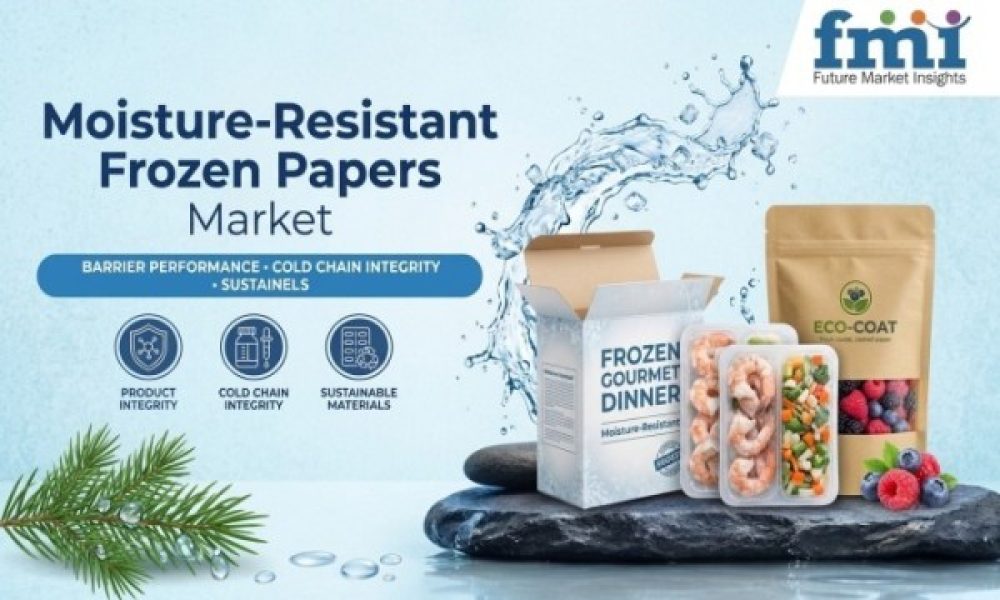
The global Moisture-Resistant Frozen Papers Market is projected to grow from USD 409.5 million in 2026 to USD 740.3 million by 2036, registering a 6.1% CAGR during the forecast period, according to Future Market Insights (FMI).
The market is being shaped by frozen-food brands evaluating paper-based packaging formats that can provide moisture protection while supporting recyclability objectives. Paper grades must withstand condensation, freezer conditions, sealing requirements, and routine converting speeds before they can replace selected plastic-heavy structures.
A recent product development illustrates this shift. Lecta introduced Metalvac Ice Cream in December 2025 with a water-vapor barrier designed for frozen cone packaging. The development reflects efforts to use paper-based solutions on existing packaging lines while maintaining freezer performance.
Get detailed market forecasts, competitive benchmarking, and pricing trends:
https://www.futuremarketinsights.com/reports/sample/rep-gb-34692
Moisture performance is becoming a commercial qualification factor
Frozen-food processors are placing greater attention on whether paper maintains its structural integrity after exposure to condensation. Wet-strength kraft papers are therefore projected to account for 34.0% of the market in 2026, supported by their ability to retain tensile performance across frozen-food handling applications.
By material, virgin kraft is estimated to hold 42.0% share in 2026. Consistent fiber strength supports coating and converting qualification, while predictable surface characteristics can assist food-contact documentation and repeat production.
Standard WVTR grades are expected to lead the barrier-level segment with a 40.0% share in 2026. These grades address mainstream moisture requirements without the additional coating weight and conversion complexity associated with more demanding barrier structures.
Frozen food cartons and sleeves are forecast to account for 30.0% of the application segment in 2026. Their established workflow within retail food packaging makes stiffness after condensation and compatibility with existing packing systems important approval considerations.
Regulation adds another layer to paper selection
Packaging regulation is increasingly influencing barrier-paper decisions. European packaging rules are placing greater attention on recycling and material circularity, while producer-responsibility fees can affect the economics of alternative packaging structures.
The United Kingdom provides a relevant example. PackUK set 2025-2026 base fees with paper and card at less than half the rate applied to plastic and below the rate applied to fibre-based composite packaging. Such fee differences can increase the commercial appeal of paper-led structures when moisture resistance, sealing performance, and frozen-food protection can be maintained.
Qualification remains a key challenge. Coatings may improve water-vapor resistance but can complicate sealing or recovery classification. This can extend plant trials before a material progresses from testing to recurring orders.
Regional growth presents different market conditions
Among the profiled countries, Brazil is forecast to record the highest CAGR at 6.5% through 2036, followed by the United Kingdom at 6.0%, Germany at 5.9%, the United States at 5.5%, and Japan at 4.7%.
The differences reflect varying packaging regulations, recovery infrastructure, qualification requirements, and conversion economics.
In the United States, PFAS reformulation is an important consideration for barrier chemistry. In Germany, established paper-recovery infrastructure supports attention to repulpable structures. Japan’s established collection routes place greater emphasis on controlled material substitution and consistent print and barrier performance.
In the United Kingdom, recyclability economics have become part of packaging design decisions. Brazil’s market outlook is supported by domestic conversion and localized frozen-food application trials, although price sensitivity remains a consideration.
Analyst perspective
“Frozen-paper economics depend on the complete pack specification, not the lowest paper price or barrier rating. Repeat business goes to grades matching WVTR and sealing behavior to the freezer cycle without weakening food-contact or recovery requirements.”
— Nandini Roy Choudhury, Principal Consultant, Future Market Insights
Competitive landscape
The competitive environment includes integrated paper producers, specialty functional-paper suppliers, and packaging networks. The verified company set includes Billerud, Mondi, Sappi, Smurfit Westrock, UPM Specialty Papers, Koehler Paper, Ahlstrom, and Cascades.
Recent developments include UPM Specialty Papers and Orkla Suomi’s six-month Finnish retail pilot using barrier paper and cold-seal lacquer on existing flow-pack equipment in March 2025. Ahlstrom inaugurated the PMZ5 parchmentizer in France in May 2025 to increase capacity and flexibility for grease- and water-resistant vegetable parchment. Koehler Paper also reported commercial chewing-gum packaging using Koehler NexCoat Smart M in December 2025.
Report scope
The FMI study covers the market by product type, material, barrier level, application, end use, sales channel, and region. Product categories include wet-strength kraft papers, dispersion-coated papers, PE-alternative barrier papers, wax-alternative papers, and others.
The report covers North America, Latin America, Europe, East Asia, South Asia and Pacific, and the Middle East and Africa, with Brazil, the United Kingdom, Germany, the United States, Japan, and more than 20 countries included in the full study.
Discover the Full Details in Our Report—Read More Now!
https://www.futuremarketinsights.com/reports/moisture-resistant-frozen-papers-market
FMI Custom Research: Strategic Intelligence for Confident Decision-Making
In today’s rapidly evolving business environment, leadership teams need more than market data—they need clear, actionable intelligence tailored to their strategic objectives. FMI’s Custom Research solutions are designed around the specific business questions organizations need answered, enabling executives to evaluate growth opportunities, validate investments, assess competitive dynamics, and reduce uncertainty before making critical decisions. By combining deep industry expertise, primary research, and proprietary market intelligence, FMI delivers insights that help organizations move from assumptions to evidence-based strategies with greater speed and confidence.
Business Impact
FMI helps organizations transform market complexity into strategic clarity, enabling leadership teams to identify growth opportunities faster, optimize resource allocation, strengthen competitive positioning, and make high-stakes business decisions with confidence.
To explore how FMI Custom Research can support your strategic priorities, please connect with our team at – [email protected]
About Future Market Insights (FMI)
Future Market Insights, Inc. (FMI) is an ESOMAR-certified, ISO 9001:2015 market research and consulting organization, trusted by Fortune 500 clients and global enterprises. With operations in the U.S., UK, India, and Dubai, FMI provides data-backed insights and strategic intelligence across 30+ industries and 1200 markets worldwide.



