
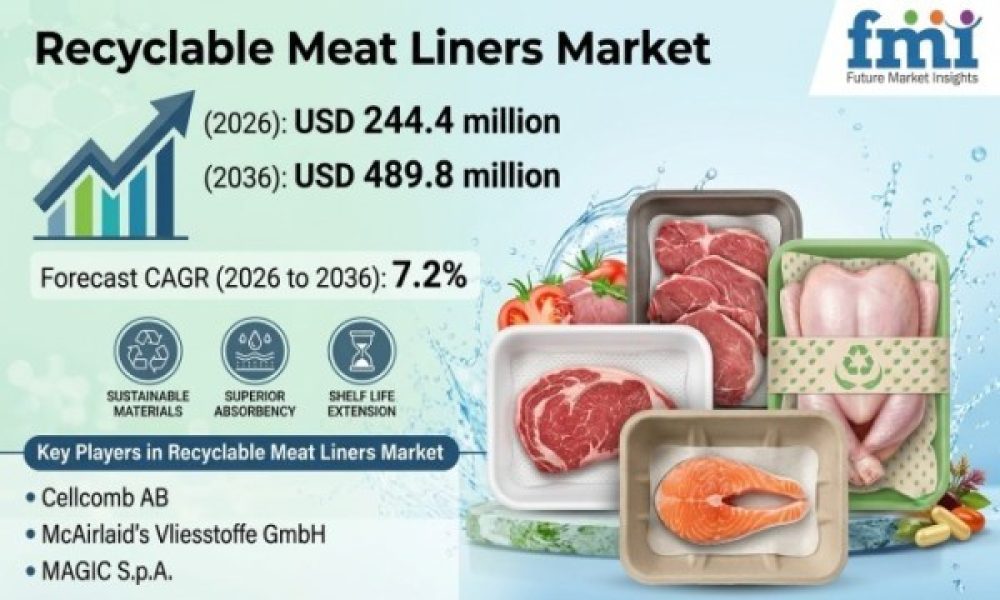
The global Recyclable Meat Liners Market is projected to reach USD 489.8 million by 2036, up from USD 244.4 million in 2026, advancing at a 7.2% CAGR during the forecast period, according to Future Market Insights (FMI).
The market is being shaped by a practical shift in meat packaging procurement. Processors are evaluating liners not only for purge retention and pack performance, but also for material classification, recyclability evidence, and the suitability of the liner within local recovery systems.
Packaging compliance costs are becoming a more visible factor in purchasing reviews. PackUK published packaging base fees in June 2025 for material placed on the United Kingdom market during the first reporting year. Such fees give obligated producers a measurable cost signal and bring smaller meat-packaging components into formal material assessments.
For processors, a recyclable liner must therefore perform on the packing line before it can become a recurring specification. Trials typically assess purge control, compression retention, dimensions, material classification, and compatibility with the intended tray and production equipment.
Get detailed market forecasts, competitive benchmarking, and pricing trends:
https://www.futuremarketinsights.com/reports/sample/rep-gb-34664
Leak Control Remains Central to Liner Selection
Leak control is projected to account for 36.0% of function demand in 2026, making it the leading function segment. Retained liquid can reduce packaging rejects and product loss during chilled distribution.
Dry absorbency alone does not establish commercial suitability. A liner may absorb liquid under laboratory conditions but release captured purge when exposed to tray pressure or handling. Processors consequently compare uptake speed and rewetting performance under compression before approving a construction for routine production.
Nandini Roy Choudhury, Principal Consultant at Future Market Insights, explains:
“Recyclable meat liners earn approval at the packing line because purge retention and disposal evidence must pass together. Manufacturers should prioritize compression testing and local recovery documentation before extending one construction across several processor sites.”
Product and Material Choices Influence Qualification
Uncoated paper liners are projected to represent 32.0% of product type demand in 2026. Their simpler fiber construction supports interleaving and moderate purge loads across standardized fresh-food packaging formats. However, longer dwell times and tray pressure can affect wet strength.
Virgin fiber is estimated to account for 34.0% of material demand in 2026. Controlled formation and predictable absorption support food-contact qualification across high-volume processor programs. Plant teams can reduce fiber weight once compression testing confirms stable retention for the intended purge load and equipment.
The market also includes dispersion-coated repulpable liners, mono-material film liners, recyclable absorbent liners, recycled fiber, mono PE-PP, and airlaid cellulose.
Regulation Creates Both Pressure and Opportunity
The EU Packaging and Packaging Waste Regulation entered into force in February 2025 and generally applies from August 2026. Recyclability is becoming a design consideration for barrier packaging components rather than simply a material preference.
Food contamination remains a key restraint. A liner may use a technically compatible material but still face practical recovery limitations after contact with purge and fat. Changes to coatings or absorbent cores can also extend qualification because they affect exposure conditions and disposal claims.
The commercial opportunity lies in constructions that demonstrate both performance and a credible recovery route. Paper-based designs need adequate wet strength without creating repulping losses, while mono PE-PP constructions require an accepted collection pathway.
Brazil Leads the Five Country Forecasts
Brazil is projected to record the highest CAGR among the five profiled countries at 7.6%, followed by the United Kingdom at 7.1%, Germany at 7.0%, the United States at 6.6%, and Japan at 5.8%.
Brazil’s outlook reflects large-scale meat processing and demand for liners suited to export-oriented chilled distribution. The United Kingdom is influenced by producer fee exposure and retailer-led packaging approval. Germany places greater emphasis on documentation during packaging development, while large United States processors can apply specifications across multiple case-ready facilities. Japan’s market remains influenced by cautious specification changes and varied collection routes.
Competitive Landscape
The market includes cellulose and airlaid specialists, food-pad converters, and regional protein-pad manufacturers. Notable companies profiled by FMI include Cellcomb AB, McAirlaid’s Vliesstoffe GmbH, Coppice Alupack Ltd T/A Sirane, Novipax LLC, Elliott Absorbent Products Ltd., POMONA Company Ltd., Wuhu Qicheng New Material Co., Ltd., and MAGIC S.p.A.
Recent developments include MAGIC S.p.A.’s order for a food pad eXcelle line with integrated airlaid forming technology announced by ANDRITZ in July 2026. Cellcomb AB also acquired Fatex in June 2025 and announced home-and-garden compost certification for Cellsorb CIRCULAR in March 2025.
Report Scope
The FMI study covers the market by product type, material, function, application, end use, sales channel, and region. Regions covered include North America, Latin America, Europe, East Asia, South Asia and Pacific, and the Middle East and Africa. The forecast period extends from 2026 to 2036, with market sizing presented in USD million.
The research uses primary and secondary research, market triangulation, market sizing and forecasting, and data validation. FMI analysts gathered input from manufacturers, technology developers, distributors, procurement teams, end users, and subject-matter experts, alongside government statistics, regulatory publications, trade data, technical literature, company information, and other credible sources.
Gain Comprehensive Knowledge—Read the Entire Report Now!
https://www.futuremarketinsights.com/reports/recyclable-meat-liners-market
FMI Custom Research: Strategic Intelligence for Confident Decision-Making
In today’s rapidly evolving business environment, leadership teams need more than market data—they need clear, actionable intelligence tailored to their strategic objectives. FMI’s Custom Research solutions are designed around the specific business questions organizations need answered, enabling executives to evaluate growth opportunities, validate investments, assess competitive dynamics, and reduce uncertainty before making critical decisions. By combining deep industry expertise, primary research, and proprietary market intelligence, FMI delivers insights that help organizations move from assumptions to evidence-based strategies with greater speed and confidence.
Business Impact
FMI helps organizations transform market complexity into strategic clarity, enabling leadership teams to identify growth opportunities faster, optimize resource allocation, strengthen competitive positioning, and make high-stakes business decisions with confidence.
To explore how FMI Custom Research can support your strategic priorities, please connect with our team at – [email protected]
About Future Market Insights (FMI)
Future Market Insights, Inc. (FMI) is an ESOMAR-certified, ISO 9001:2015 market research and consulting organization, trusted by Fortune 500 clients and global enterprises. With operations in the U.S., UK, India, and Dubai, FMI provides data-backed insights and strategic intelligence across 30+ industries and 1200 markets worldwide.



