
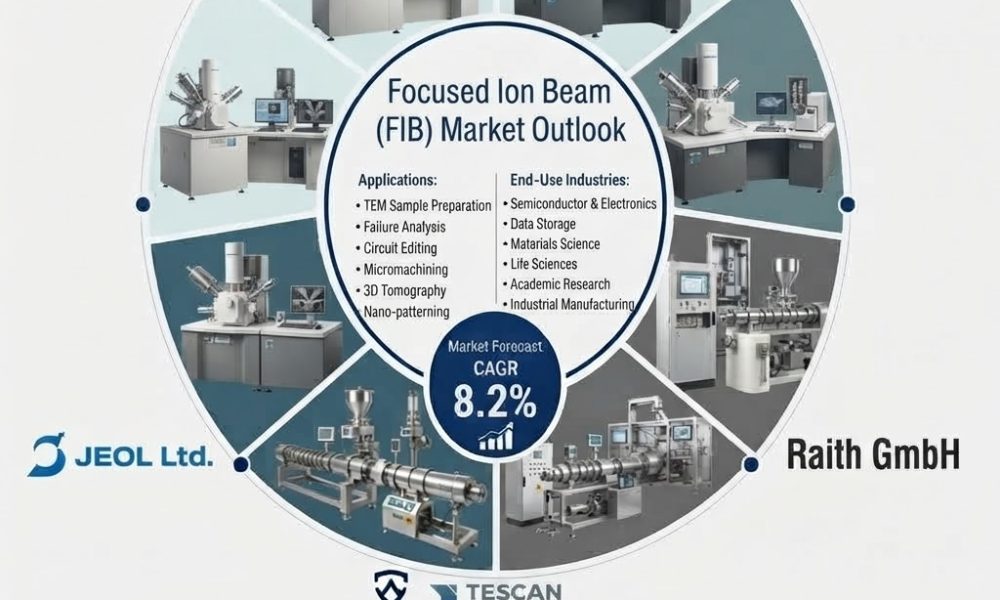
The global focused ion beam market is projected to increase from USD 1.5 billion in 2026 to USD 3.3 billion by 2036, expanding at a CAGR of 8.2% during the 2026–2036 forecast period. The market crossed USD 1.4 billion in 2025 as semiconductor laboratories continued investing in cross-sectioning and sample-preparation applications. Growth is supported by increasing demand for semiconductor failure analysis, where precise milling is required to expose buried defects before imaging and circuit-edit decisions.
Get detailed market forecasts, competitive benchmarking, and pricing trends: https://www.factmr.com/connectus/sample?flag=S&rep_id=15746
A report-cited industry development also supports semiconductor-related demand. On January 16, 2025, the U.S. Department of Commerce announced USD 1.4 billion in final awards to support the next generation of U.S. semiconductor advanced packaging, according to the report bibliography. Advanced packaging failure review is identified in the report as an opportunity for focused ion beam systems because packaging teams require cross-section evidence when assembly defects emerge after wafer processing.
Global Segment Leaders
- Product Type — Ga+ Focused Ion Beam Systems: 36.7% share in 2026. Established workflows and familiarity with performance and maintenance requirements support buyer confidence.
- Application — Semiconductor Failure Analysis: 31.2% share in 2026. Chipmakers use FIB systems to expose buried defects before detailed failure review.
- End User — Semiconductor Manufacturers: 31.4% share in 2026. Semiconductor manufacturers use nanoscale milling for defect inspection, yield improvement, and process troubleshooting.
- Distribution Channel — Direct Sales: 30.1% share in 2026. Technical demonstrations, application testing, installation planning, and post-sale service make direct supplier engagement important during procurement.
- Ion Source — Gallium Ion Source: 43.4% share in 2026. Many laboratories continue to use gallium ion sources because their milling performance and operating behavior are well understood.
Country-Level Performance
| Country | CAGR | Key Growth Driver |
| USA | 10.7% | Fab qualification work and service-led purchasing are increasing demand for failure-analysis platforms. |
| Japan | 9.9% | Reliability checks and compact laboratory workflows support demand for repeatable sample preparation. |
| Germany | 9.1% | Industrial research and semiconductor process validation support FIB adoption. |
| South Korea | 8.2% | Memory manufacturing and equipment service needs support defect-review applications. |
| Taiwan | 7.4% | Foundry activity and advanced device development create demand for faster failure review. |
| Canada | 6.6% | Research demand and the need for flexible sample-preparation tools support market development. |
| Singapore | 5.7% | Specialty fabs and compact technical support networks support selective FIB adoption. |
The country CAGRs and growth rationales above are reported directly by Fact.MR for the 2026–2036 period.
Regional Context
The USA and Japan form the faster-growing upper tier. In the USA, fab qualification work and service-led purchasing are strengthening demand for FIB systems used in failure analysis. Japan benefits from reliability-focused procurement and compact laboratory workflows that place emphasis on repeatable sample preparation.
Germany and South Korea remain close to the global market growth rate. Germany’s industrial research and semiconductor validation activities support adoption, while South Korea’s memory manufacturing base requires dependable FIB workflows for defect review and process learning.
Taiwan, Canada, and Singapore represent the slower-growth group within the seven profiled countries. Taiwan’s demand is linked to foundry activity and advanced device development, while Canada and Singapore have more selective demand tied to research institutes, specialty fabs, flexibility, and local technical support.
The full report provides country-level analysis across North America, Latin America, Europe, East Asia, South Asia and Oceania, and the Middle East and Africa, with 7 countries specifically profiled in the country comparison.
Competitive Landscape
The competitive landscape includes Thermo Fisher Scientific, Carl Zeiss AG, Hitachi High-Tech Corporation, JEOL Ltd., TESCAN GROUP, and Raith GmbH. Thermo Fisher Scientific is associated with dual-beam and sample-preparation platforms, while Carl Zeiss AG contributes FIB-SEM capabilities for materials and semiconductor research. Hitachi High-Tech Corporation and JEOL Ltd. add electron microscopy capabilities supporting imaging-led analysis, while TESCAN GROUP and Raith GmbH broaden the provider landscape through ion-beam and research-tool expertise.
The report bibliography cites two recent company developments: Thermo Fisher Scientific Inc. on October 6, 2025, regarding faster time to data in semiconductor fabs with multi-ion-species plasma FIB, and TESCAN Group on September 1, 2025, regarding its AMBER X 2 receiving the 2025 R&D 100 Award for plasma FIB-SEM innovation.
Top Trending Reports:
About Fact MR
(Fact MR) is a leading provider of market research and consulting services, offering syndicated and customized research across industries including semiconductor, electronics, and materials science.



