
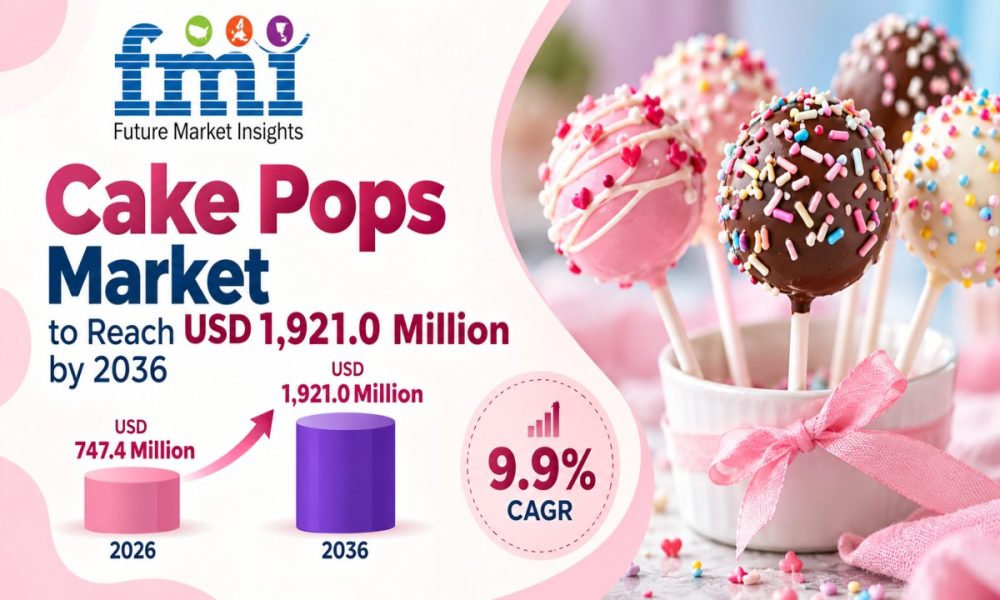
The global Cake Pops Market is projected to reach USD 1,921.0 million by 2036, up from USD 747.4 million in 2026, expanding at a 9.9% CAGR during the forecast period, according to the latest analysis by Future Market Insights (FMI).
The market is being supported by increasing demand for portioned desserts that combine familiar cake flavors with seasonal decoration and convenient single-piece consumption. Cake pops are gaining relevance across celebrations, everyday snacking, cafés, in-store bakeries and foodservice operations because they can be sold individually without cutting or plating.
Get Detailed Market Forecasts, Competitive Benchmarking, and Pricing Trends:
https://www.futuremarketinsights.com/reports/sample/rep-gb-34971
Classic-Original Products Continue to Lead Demand
Classic-original cake pops are estimated to account for 36.0% of product type demand in 2026, making them the leading product category.
Familiar cake flavors provide a stable base for seasonal decoration without requiring additional filling or layered assembly. Retailers and foodservice operators can therefore change visual themes while maintaining relatively consistent ingredient requirements.
Conventional Products Lead Claim-Nature Demand
Conventional products are projected to represent 51.0% of claim-nature demand in 2026.
Standard formulations provide manufacturers with greater flexibility when managing crumb moisture, texture and coating adhesion. These characteristics are particularly important because cake pops require stable centers and coatings to withstand handling and transportation.
Fresh Formats Hold a Significant Market Share
Fresh cake pops are expected to account for 31.0% of format demand in 2026.
Fresh products provide strong visual customization opportunities because bakery teams can adjust colors, garnishes and seasonal designs close to the point of sale. This makes them particularly relevant for celebrations, events and specialty bakery purchases.
Supermarkets and Hypermarkets Lead Sales Channels
Supermarkets and hypermarkets are forecast to account for 36.0% of sales channel demand in 2026.
Large grocery retailers can merchandise cake pops through in-store bakeries, seasonal displays and packaged bakery sections. The format can serve both planned celebration purchases and impulse snack occasions.
Portioned Snacking Expands Purchase Occasions
Cake pops benefit from their individual serving format, allowing consumers to purchase a small dessert without committing to a full cake.
Growing snack consumption creates additional opportunities for manufacturers to position cake pops as everyday treats rather than products reserved exclusively for birthdays or formal celebrations.
Seasonal flavors and limited-time designs can further increase trial by giving retailers a way to refresh assortments without permanently expanding their product range.
Decoration Labor and Coating Damage Create Challenges
The economics of cake pops depend heavily on saleable pieces per labor hour.
Manual finishing can increase production costs, while cracked coatings, displaced sticks or damaged decorations can create rework and product losses. These challenges become more significant as products move through longer distribution routes.
Delivery-Stable and Specialty Formats Create Opportunities
Gluten-free, clean-label and other claim-led products can broaden the consumer base when manufacturers can maintain the expected texture and appearance.
Frozen or chilled cake-pop bases can also allow decoration closer to the point of sale, potentially reducing damage during transportation. This creates opportunities for foodservice operators and specialty bakeries that require customization without maintaining extensive finished-product inventory.
Saudi Arabia Shows the Fastest Growth Among Highlighted Markets
Among the highlighted country markets, Saudi Arabia is projected to record an 11.6% CAGR through 2036, followed by the USA at 10.2%, the UK at 9.7%, France at 9.3% and Germany at 9.0%.
Saudi Arabia’s growth is associated with expanding hospitality and foodservice infrastructure. The USA benefits from broad grocery and in-store bakery coverage, while the UK, France and Germany provide established retail channels where pack economics, product consistency and shelf life influence adoption.
Competitive Landscape
The Cake Pops Market includes scaled dessert manufacturers, specialty bakery companies, coffeehouse operators and packaged sweet-baked product producers.
Key companies profiled by FMI include Rich Products Corporation, Dessert Holdings, Starbucks Corporation, Finsbury Food Group, Premier Foods plc, McKee Foods Corporation, Flowers Foods, Inc. and The J.M. Smucker Co.
Competitive positioning is influenced by cake portfolio breadth, seasonal customization, channel coverage, production scale, coating stability, packaging performance and geographic reach.
Key Industry Developments
The market continues to see new product launches, seasonal programs and expansion of portioned bakery formats.
In July 2026, Rich Products Corporation introduced Mini Cakes, expanding its individual-format dessert portfolio for foodservice and bakery applications.
In June 2026, Finsbury Food Group launched a Hello Kitty celebration cake at Tesco under a licensed character program, demonstrating continued interest in themed bakery products.
In May 2026, Premier Foods introduced new Mr Kipling products, including smaller-format sweet-baked offerings designed for changing consumer occasions.
Analyst Perspective
“Cake-pop economics should be judged by saleable pieces per labor hour and the share that survives transport without cosmetic damage. The strongest offers earn value from repeatable finishing and channel-ready packaging before premium decoration is applied.” — Nandini Roy Choudhury, Principal Consultant, Future Market Insights
Exclusive Discounts on Full Report
Cake Pops Market – https://www.futuremarketinsights.com/reports/cake-pops-market
Report Scope
The FMI study covers the Cake Pops Market by product type, claim-nature, format, packaging format, sales channel and region. Product categories include classic-original, layered & frosted, flavored & filled, mini & snacking formats, and premium/artisan products. Claim-nature categories include conventional, clean label, organic, gluten-free and high-protein/fortified products.
Formats include fresh, frozen, ambient packaged, chilled and par-baked/thaw-and-serve products. Packaging formats include multipack, single-serve, family/loaf pack and bulk foodservice. Sales channels include supermarkets & hypermarkets, artisan & specialty bakeries, convenience & forecourt, online & DTC and foodservice distributors.
The research covers North America, Latin America, Europe, East Asia, South Asia and Pacific, and the Middle East and Africa.
Key Executive Benefits
- Decision-Ready Insights
- Reduced Strategic Risk
- Market Entry Confidence
- Competitive Advantage
- Faster Growth Decisions
- Primary Market Validation
To explore how FMI Custom Research can support your strategic priorities, connect with our team at [email protected].
About Future Market Insights (FMI)
Future Market Insights, Inc. is an ESOMAR-certified, ISO 9001:2015 market research and consulting organization trusted by Fortune 500 companies. With a global presence across the U.S., UK, India and Dubai, FMI delivers data-driven insights across 30+ industries and 1,200 markets worldwide.



