
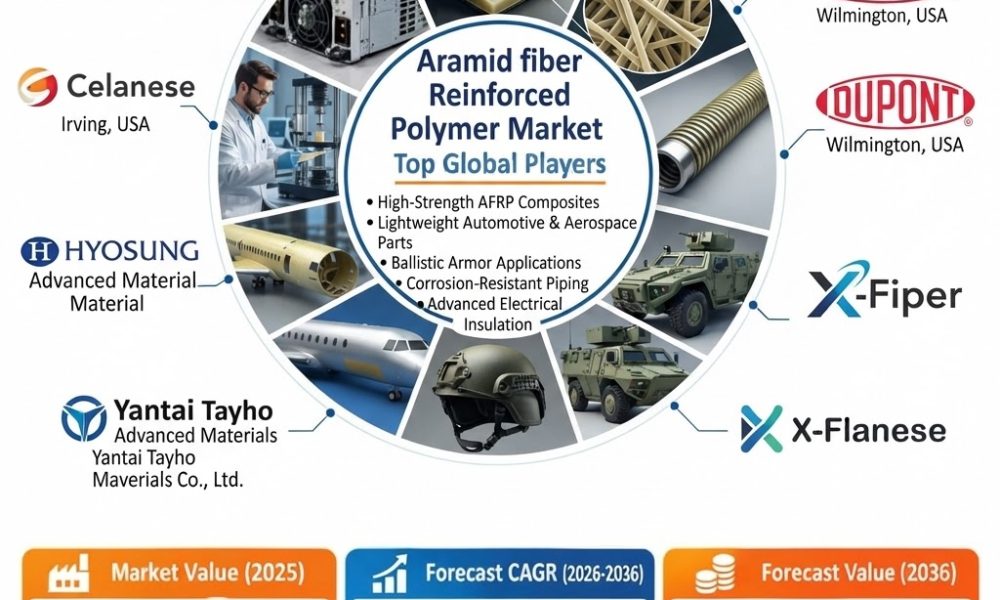
Aramid Fiber Reinforced Polymer Market reached approximately USD 4.8 billion in 2025 and is projected to increase from USD 5.2 billion in 2026 to USD 11.0 billion by 2036, expanding at a 7.8% CAGR during the 2026–2036 forecast period. An absolute opportunity of USD 5.8 billion is expected between 2026 and 2036. Aerospace qualification and lightweight structural design are supporting demand, with the Aerospace Technology Institute publishing a composites framework in July 2026 aimed at increasing the UK’s capability in aerospace composite technologies
Get detailed market forecasts, competitive benchmarking, and pricing trends: https://www.factmr.com/connectus/sample?flag=S&rep_id=5700
Global Segment Leaders
- Product: Aramid Fiber Reinforced Thermoset Polymers — 66.8% share in 2026; established use in structural composite applications supports dimensional stability and effective load transfer.
- Application: Aerospace & Defense Applications — 42.6% share in 2026; demand is supported by lightweight materials with high impact resistance and structural performance.
- End Use: Aerospace Industry — 61.4% share in 2026; stringent material qualification requirements and lightweight composite structures support demand.
- Technology: Resin Transfer Molding (RTM) — 53.9% share in 2026; controlled resin flow and repeatable production support shaped composite component manufacturing.
- Formulation: High Strength Structural Formulations — 74.3% share in 2026; load-bearing and impact-resistant requirements support adoption.
- Distribution Channel: Direct OEM Sales — 58.7% share in 2026; direct technical coordination supports material qualification and production-scale adoption.
Country-Level Performance
| Country | CAGR, 2026–2036 | Key Growth Driver |
| Germany | 8.97% | Germany’s Federal Ministry for Economic Affairs identifies fiber-reinforced composites among lightweight-material routes relevant to mobility and transport technologies. |
| Brazil | 8.19% | Embraer and Brazilian public-sector partners have supported development and validation of high-efficiency composite wing technologies. |
| USA | 7.41% | FAA guidance covers composite aircraft structures using aramid reinforcement, while U.S. Department of Energy programs address lightweight composite materials for transportation. |
| UK | 6.63% | The Aerospace Technology Institute published a composites framework in July 2026 aimed at increasing UK capability in aerospace composite technologies. |
| Japan | 5.85% | Japan’s Ministry of Economy, Trade and Industry has documented domestic expertise in molding and processing composite materials for aerospace programs. |
The country CAGRs and country-specific growth explanations are reported by Fact.MR for the 2026–2036 period.
Regional Context
Germany and Brazil represent the faster-growing country markets covered in the assessment, with CAGRs of 8.97% and 8.19%, respectively. Germany’s growth is associated with lightweight transport research and fiber-reinforced composites in mobility applications, while Brazil benefits from its aerospace manufacturing base and composite-structure development.
The USA, UK, and Japan represent comparatively slower-growing markets within the covered country set, although each has established application drivers. The USA benefits from aerospace qualification requirements and automotive lightweight-material research; the UK’s growth is linked to aerospace composite capability and manufacturing technologies; and Japan has established aerospace and automotive expertise in advanced composite processing.
The full report covers North America, Latin America, Europe, East Asia, South Asia and Oceania, and the Middle East and Africa, with five countries profiled individually: Germany, Brazil, USA, UK, and Japan.
Competitive Landscape
The competitive set includes Teijin Aramid, Jiangsu Hongbo Communication Technology Co., Ltd., DuPont, X-Fiper, Yantai Tayho Advanced Materials Co., Ltd., Hyosung Advanced Material, and Celanese. Teijin Aramid is positioned through its aramid portfolio and composite applications, while DuPont competes through Kevlar-based reinforcement materials. Yantai Tayho Advanced Materials and Hyosung Advanced Materials maintain para-aramid offerings. The report states that competition depends on fiber performance after conversion into the finished polymer system, including consistency during molding and technical support during customer qualification.
The fetched report page does not provide a separate “Key Developments” section with dated company developments, so no month/year company announcement has been added rather than introducing information not contained in the source.
Top Trending Reports:.
About Fact MR
(Fact MR) is a leading provider of market research and consulting services, offering syndicated and customized research across industries including aerospace, automotive, and chemicals & materials.



