
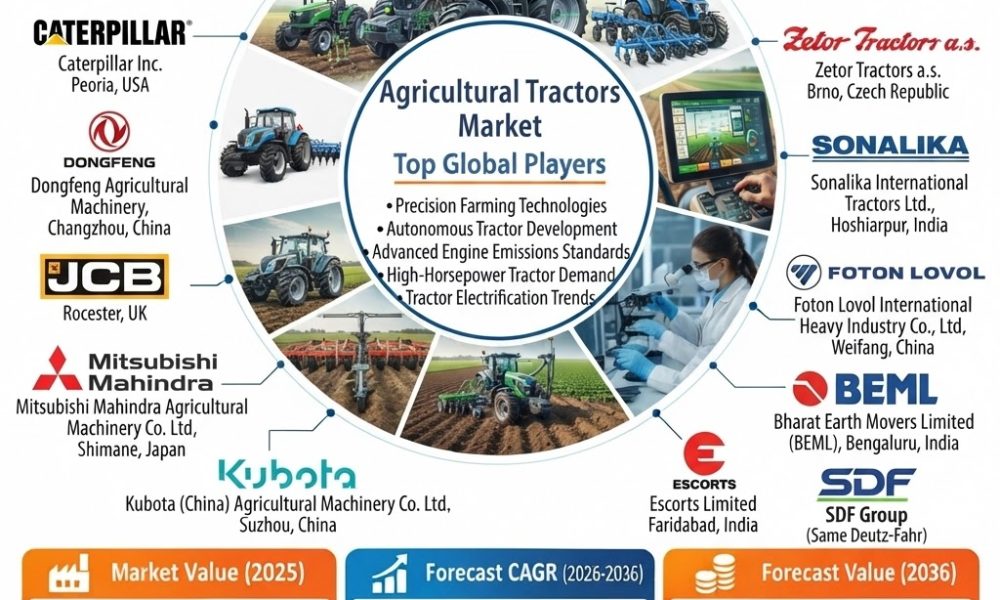
The global agricultural tractors market is projected to increase from USD 75.2 billion in 2026 to USD 134.7 billion by 2036, expanding at a 6.0% CAGR during the forecast period. The market reached USD 70.9 billion in 2025, with an absolute opportunity of USD 59.5 billion expected between 2026 and 2036.
Farm mechanization remains a key demand driver as tractors reduce manual labour requirements across land preparation, planting, transportation, and other time-sensitive operations. The Food and Agriculture Organization of the United Nations (FAO) identifies mechanization as a means of addressing labour shortages while improving the timeliness and productivity of agricultural work. Precision agriculture, equipment financing, and the need to complete field operations within limited planting and harvesting windows are also supporting tractor demand.
Get detailed market forecasts, competitive benchmarking, and pricing trends: https://www.factmr.com/connectus/sample?flag=S&rep_id=7101
Global Segment Leaders
- Utility Tractors — 36.9%: Utility tractors lead the Product segment in 2026 because they can support multiple farm activities, including tillage, planting, transport, and general material movement.
- 30 To 50 Horsepower — 32.4%: This horsepower range leads because it provides sufficient power for routine cultivation while balancing purchase cost and fuel consumption.
- Four Wheel Drive — 54.7%: Four Wheel Drive leads the Drive System segment because power transmission through both axles improves traction during tillage and operation with heavier implements.
- Diesel Powered Tractors — 71.8%: Diesel platforms remain the leading Fuel Type because they support extended field operations through established refuelling and service infrastructure.
- Tillage Operations — 29.6%: Tillage leads the Application segment because tractors provide the drawbar power required for recurring soil preparation and land-conditioning activities before planting.
- Commercial Farmers — 38.7%: Commercial farmers account for the largest End Use share because higher equipment utilization helps distribute tractor purchase and maintenance costs across larger operating volumes.
- Dealer Network — 62.5%: Dealer networks lead Distribution Channel because tractor buyers require equipment selection support, financing, maintenance, spare parts, and implement matching.
Country-Level Performance
| Country | CAGR | Key Growth Driver |
| Germany | 6.9% | Germany’s federal agriculture ministry notes that GPS guidance can optimize tractor routes and reduce fuel consumption, supporting demand for connected and precision-enabled machinery. |
| Brazil | 6.3% | BNDES Moderfrota provides financing for tractors and associated agricultural equipment, supporting fleet modernization. |
| USA | 5.7% | The 2022 Census of Agriculture recorded an average U.S. farm size of 463 acres, increasing the value of higher-utilization machinery. |
| UK | 5.1% | The 2026 Farming Equipment and Technology Fund includes a productivity category supporting investment in qualifying farm equipment. |
| Japan | 4.5% | MAFF reported that core agricultural workers declined from 2.4 million in 2000 to about 1.16 million in 2023, with 71% aged 65 or older, increasing the relevance of labour-saving machinery. |
Regional Context
Germany records the fastest growth among the profiled countries at 6.9% CAGR, supported by precision agriculture, GPS guidance, digitally connected machinery, and agricultural investment initiatives. Brazil follows at 6.3%, with agricultural production scale and machinery-financing programmes supporting tractor purchases.
The USA and UK represent comparatively moderate growth markets, with farm structure, labour economics, productivity programmes, and equipment investment shaping demand. Japan records the lowest CAGR among the five profiled countries at 4.5%, while its ageing and shrinking agricultural workforce continues to support interest in smart and labour-saving machinery.
The full report covers North America, Latin America, Western Europe, Eastern Europe, East Asia, South Asia and Pacific, and the Middle East & Africa, with country forecasts specifically provided for Germany, Brazil, the USA, the UK, and Japan.
Competitive Landscape
The competitive landscape includes TAFE Motors and Tractors Ltd. (Tractor and Farm Equipment Limited), Lamborghini Trattori (Argo Tractors), Caterpillar Inc., Zetor Tractors a.s., Dongfeng Agricultural Machinery, Sonalika International Tractors Ltd., JCB, Foton Lovol International Heavy Industry Co., Ltd., Mitsubishi Mahindra Agricultural Machinery Co. Ltd., Bharat Earth Movers Limited (BEML), Kubota (China) Agricultural Machinery Co. Ltd., Escorts Limited, International Tractors Limited, and SDF Group (Same Deutz-Fahr).
TAFE is positioned as the primary supplier in the market assessment, with a broad tractor portfolio covering multiple horsepower requirements. The report states that TAFE recorded approximately 214,951 tractor sales during FY26 and introduced hybrid tractor and vision-guidance technologies. Kubota’s technical programmes include automated tractors and implement-control systems, while SDF’s 2025 results identify specialized tractors as an important contributor to its tractor business. The report also notes that Escorts Limited now operates within Escorts Kubota Limited following Kubota’s acquisition of the Indian agricultural machinery business.
Top Trending Reports:
About Fact MR
(Fact MR) is a leading provider of market research and consulting services, offering syndicated and customized research across industries including Industrial Goods and agricultural machinery.



