
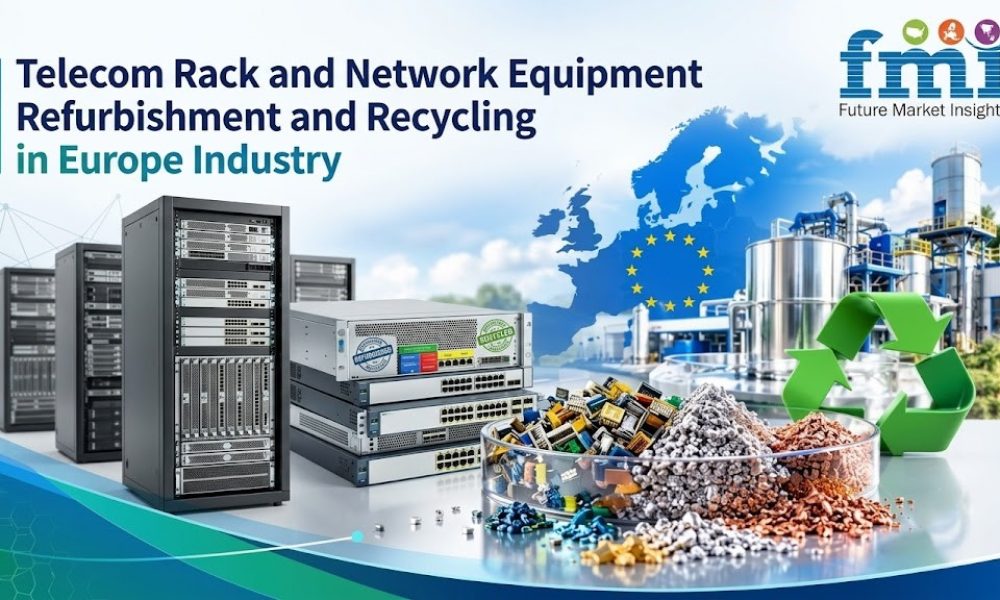
The telecom rack and network equipment refurbishment and recycling industry in Europe is entering a period of sustained expansion as network modernization programs increasingly incorporate secondary-asset recovery into equipment replacement cycles. According to Future Market Insights (FMI), the industry was valued at USD 2.2 billion in 2025 and is estimated to reach USD 2.4 billion in 2026. Revenue is projected to reach USD 5.1 billion by 2036, expanding at a 7.8% CAGR from 2026 to 2036.
The forecast represents an incremental opportunity of approximately USD 2.69 billion during the period. Growth is being supported by ongoing 5G standalone, FTTH, edge, and cloud infrastructure upgrades, which are increasing the volume of decommissioned and surplus telecom assets entering refurbishment, resale, repair, and recycling channels.
Get detailed market forecasts, competitive benchmarking, and pricing trends: https://www.futuremarketinsights.com/reports/sample/rep-gb-32751
Global Segment Leaders
Radio Access equipment is estimated to lead the equipment type segment, accounting for 34.0% share in 2026. Network modernization and site reconfiguration are releasing significant volumes of retired radio hardware into recovery channels. Concentrated equipment returns from antenna swaps and spectrum-related network changes are creating opportunities for processors with diagnostic, refurbishment, and material recovery capabilities.
By service type, refurbishment is projected to lead with a 38.0% share in 2026. Working routers, switches, transport equipment, and other network hardware can retain considerable commercial value when technical condition, testing capabilities, software access, and resale channels support secondary deployment.
Among end users, telecom operators are anticipated to account for 46.0% share in 2026. Their large installed equipment bases and formal replacement cycles make them the largest organized source of retired rack and network hardware.
By asset state, decommissioned equipment is expected to hold 41.0% share in 2026, reflecting the volume of intact equipment released through scheduled network replacement programs. By channel, direct programs are projected to account for 44.0% share, supported by vendor-managed return routes and contractual take-back arrangements.
Country-Level Performance
- United Kingdom: The UK is projected to register the highest growth among the covered countries, expanding at an 8.4% CAGR through 2036. Established secondary-market participation and active asset recovery practices are supporting equipment refurbishment and recycling activity.
- Sweden: The market is anticipated to grow at an 8.2% CAGR, supported by established equipment redeployment practices and acceptance of reused ICT hardware.
- Germany: Germany is projected to record an 8.1% CAGR as environmental compliance requirements and structured secondary hardware channels strengthen market activity.
- Netherlands: The country is estimated to expand at an 8.0% CAGR, with concentrated data center and network activity contributing to equipment turnover and recovery volumes.
- France: France is expected to register a 7.8% CAGR, with lifecycle extension practices receiving greater institutional support.
- Spain: The market is projected to grow at a 7.3% CAGR, reflecting continued development of refurbishment and recycling infrastructure.
- Italy: Italy is expected to record a 7.1% CAGR, with market activity developing from a comparatively less mature recovery base.
Regulatory and Operational Drivers
Europe’s repair policies and WEEE-related requirements are strengthening structured recovery, reuse, and recycling practices for telecom hardware. Operators are increasingly required to maintain greater visibility over retired equipment and establish documented downstream handling processes.
The economics of secondary equipment are also encouraging more systematic recovery. Delayed disposition can reduce resale value and increase warehousing costs, while organized return flows can provide refurbishers, resale platforms, and material recovery specialists with more predictable equipment volumes.
However, software licensing remains a constraint for refurbishment. Some network equipment depends on proprietary software, cloud-linked operating rights, or restricted licenses, which can prevent otherwise functional hardware from being redeployed. This creates a distinction between physical equipment condition and its actual secondary-market utility.
Opportunities Across the Value Chain
FMI identifies several opportunities for market participants. Diagnostic automation can help certified facilities test complex radio units at higher volumes and improve the allocation of functional hardware to refurbishment rather than scrap processing.
Closed-loop material integration represents another opportunity, particularly through the recovery of materials such as aluminum from telecom equipment and their reintegration into electronics manufacturing supply chains.
Localized processing nodes near major tower clusters can also reduce secure transportation requirements and accelerate collection, dismantling, testing, and material separation.
Competitive Landscape
The European market includes competition between independent ITAD facilities, refurbishment specialists, original equipment manufacturers, and recycling providers. Independent operators can focus on resale recovery and specialized legacy equipment, while OEM-linked channels can benefit from access to proprietary diagnostics, firmware, and established take-back structures.
FMI identifies TXO, Nokia, Ericsson, and PICS Telecom among the key companies active in the industry. Competitive positioning is influenced by technical validation capabilities, software access, certification, chain-of-custody visibility, reverse logistics, and downstream resale or recycling networks.
As network upgrade cycles continue, market participants are expected to place greater emphasis on integrating asset tracking with refurbishment and recycling workflows. This can help operators determine whether equipment should be refurbished, repaired, resold, harvested for components, or processed for material recovery.
Access the Complete Report in PDF Format: https://www.futuremarketinsights.com/reports/brochure/rep-gb-32751
Outlook
The telecom rack and network equipment refurbishment and recycling industry in Europe is transitioning from fragmented end-of-life handling toward more structured circular asset management. Network modernization, regulatory requirements, and the commercial value of reusable hardware are collectively expanding the role of secondary channels.
With the market projected to increase from USD 2.4 billion in 2026 to USD 5.1 billion by 2036, refurbishment, certified resale, repair, asset recovery, and recycling are expected to become increasingly integrated into telecom infrastructure lifecycle planning.
Business Impact
FMI helps organizations transform market complexity into strategic clarity, enabling leadership teams to identify growth opportunities faster, optimize resource allocation, strengthen competitive positioning, and make high-stakes business decisions with confidence.
To explore how FMI Custom Research can support your strategic priorities, please connect with our team at – [email protected]
About Future Market Insights (FMI)
Future Market Insights, Inc. (FMI) is an ESOMAR-certified, ISO 9001:2015 market research and consulting organization, trusted by Fortune 500 clients and global enterprises. With operations in the U.S., UK, India, and Dubai, FMI provides data-backed insights and strategic intelligence across 30+ industries and 1200 markets worldwide.



