
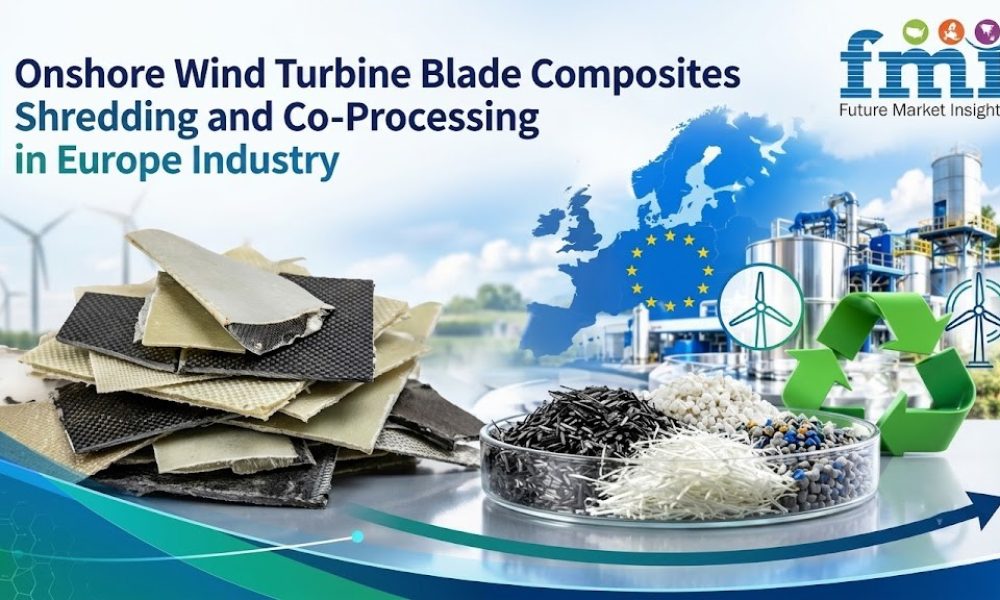
The European onshore wind turbine blade composites shredding and co-processing industry is projected to grow from USD 10.2 million in 2026 to USD 36.1 million by 2036, expanding at a 13.5% CAGR during the forecast period, according to Future Market Insights (FMI). The industry was valued at USD 9.0 million in 2025, with the forecast period representing an incremental opportunity of USD 25.9 million.
The market is being shaped by the rising volume of retired onshore wind turbine blades, increasing repowering activity, and narrowing disposal pathways for composite waste. Operators require practical treatment routes that can manage oversized blade sections while meeting the material specifications required by cement co-processing facilities.
Get detailed market forecasts, competitive benchmarking, and pricing trends: https://www.futuremarketinsights.com/reports/sample/rep-gb-32747
Shredding leads service stages
Shredding is projected to account for 52.0% share in 2026 within the service stage segment. Oversized blades are difficult and costly to transport intact, making size reduction an important starting point for collection, preparation, and downstream co-processing.
Mobile shredding and on-site primary reduction can reduce the transport burden associated with moving large blade sections from wind farms. Regional preparation hubs can then conduct secondary sizing and logistical consolidation before material is dispatched to cement plants.
Feedstock consistency remains important for wider adoption. Cement kiln operators require predictable particle size, calorific value, and mineral residue to maintain stable processing conditions and clinker quality. Greater consistency in shredded output could support the development of regional hub models connecting wind farm decommissioning projects with cement co-processing networks.
Epoxy and glass fiber dominate material composition
Epoxy resin systems are expected to hold a 63.0% share in 2026, reflecting the composition of a large portion of Europe’s installed onshore wind fleet. Cured thermoset composites provide calorific value during co-processing but require controlled combustion and feedstock management.
Glass fiber is projected to lead the fiber type segment with an 82.0% share in 2026. Glass-heavy blade waste can contribute mineral content during cement production, although its abrasive characteristics create additional equipment wear and handling requirements.
Processors therefore need material characterization and blending protocols to maintain a stable resin-to-glass balance. Proper preparation can help cement producers integrate composite waste while managing kiln chemistry and equipment performance.
Wind operators represent the largest customer group
Wind operators are expected to account for 58.0% share in 2026 by customer type. These companies remain directly responsible for blade removal, disposal execution, and site clearance when turbines reach retirement or repowering stages.
Demand is increasingly centered on reliable removal and traceable treatment rather than only the recovery value of individual blade materials. Operators may combine blade removal, transportation, and processing into integrated contracts to reduce execution risks and align disposal schedules with repowering projects.
Decommissioning is projected to dominate the blade lifecycle segment with a 68.0% share in 2026. As older onshore wind installations reach retirement, processing facilities must prepare for uneven inflows and potential capacity constraints around major wind farm decommissioning cycles.
Country-Level Performance
- Germany: The market is projected to expand at a 15.2% CAGR from 2026 to 2036, supported by a large base of aging onshore turbines and domestic cement capacity.
- Spain: Demand is forecast to rise at a 14.7% CAGR, with repowering activity supporting the need for structured blade removal and processing routes.
- Denmark: The industry is anticipated to grow at a 13.9% CAGR, supported by an established ecosystem for composite recovery and industrial reuse.
- France: Demand is projected to advance at a 13.1% CAGR, with domestic preprocessing capacity supporting future blade retirement requirements.
- Italy: The market is expected to register a 12.8% CAGR as regional repowering activity increases demand for disposal and co-processing routes.
- Sweden: Demand is forecast to grow at a 12.5% CAGR, supported by expanding handling requirements for retired utility-scale wind assets.
- Poland: The industry is projected to record a 12.2% CAGR, with improving local processing capacity supporting regional consolidation.
Access the Complete Report in PDF Format: https://www.futuremarketinsights.com/reports/brochure/rep-gb-32747
Market opportunities and competitive landscape
Opportunities are emerging around mobile preprocessing units, advanced feed calibration, and regional logistics networks. On-site shredding can reduce the burden of transporting intact blades, while automated feed preparation could help processors deliver more consistent material to cement facilities.
Competitive activity includes companies seeking to connect wind asset owners with dependable shredding, processing, and kiln offtake capacity. Wind operators are also placing greater emphasis on traceability and documented final treatment as part of decommissioning requirements.
Key companies profiled by FMI include Holcim (Geocycle), Veolia, Vestas Wind Systems, Stena Recycling, ACCIONA Energía, RenerCycle, and FCC Ámbito / EnergyLOOP.
The industry remains closely linked to the availability of cement facilities capable of accepting prepared blade composites. Wider commercial adoption will depend on consistent feedstock quality, suitable processing capacity, efficient logistics, and the ability to synchronize blade treatment with wind farm repowering and decommissioning schedules.
Business Impact
FMI helps organizations transform market complexity into strategic clarity, enabling leadership teams to identify growth opportunities faster, optimize resource allocation, strengthen competitive positioning, and make high-stakes business decisions with confidence.
To explore how FMI Custom Research can support your strategic priorities, please connect with our team at – [email protected]
About Future Market Insights (FMI)
Future Market Insights, Inc. (FMI) is an ESOMAR-certified, ISO 9001:2015 market research and consulting organization, trusted by Fortune 500 clients and global enterprises. With operations in the U.S., UK, India, and Dubai, FMI provides data-backed insights and strategic intelligence across 30+ industries and 1200 markets worldwide.



