
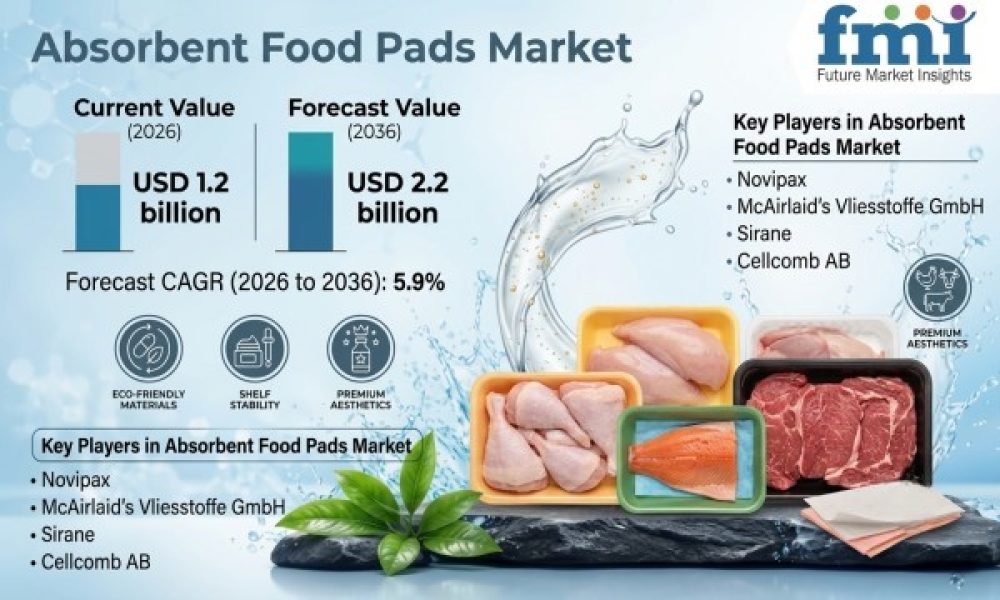
The global Absorbent Food Pads Market is projected to grow from USD 1.2 billion in 2026 to USD 2.2 billion by 2036, registering a 5.9% CAGR over the forecast period, according to the latest market analysis by Future Market Insights.
Absorbent food pads remain a recurring packaging component across chilled meat, poultry, seafood and produce applications. Each finished tray typically requires one moisture-control component, linking pad consumption directly with packaged-food production volumes.
The market is also being shaped by processor requirements around leakage control, food-contact documentation and compatibility with automated tray operations. Once a pad construction has passed commercial testing, processors tend to retain specifications where performance remains consistent across storage, denesting, placement and sealing.
Get detailed market forecasts, competitive benchmarking, and pricing trends:
https://www.futuremarketinsights.com/reports/sample/rep-gb-34567
Meat and Poultry Pads Maintain the Largest Product-Type Share
Meat & Poultry Pads are forecast to account for 38.0% of product type demand in 2026. Fresh protein releases measurable purge during refrigerated storage and distribution, creating a recurring requirement for controlled liquid absorption.
Processors evaluate pad capacity against portion weight, tray geometry and storage conditions. Customized dimensions can also help protect seal areas across different cuts and production lines.
Fresh red meat represents another important application, with a projected 32.0% share in 2026. Case-ready distribution extends the period during which pads must retain fluid while maintaining product presentation during retail handling.
Fluff Pulp + SAP Leads Core Material Demand
Fluff Pulp + SAP is estimated to hold 40.0% of core material demand in 2026. The construction combines liquid distribution through fluff pulp with retention from superabsorbent polymer, providing capacity without excessive thickness for conventional tray operations.
Converters can adjust pulp weight and polymer content according to food loads. However, alternative cellulose-led constructions must demonstrate comparable retention, sealed-edge integrity and production-line performance before processors replace established specifications.
Medium absorbency is expected to account for 38.0% of absorbency demand in 2026. The category fits common retail portions while avoiding the additional bulk associated with higher-capacity formats.
Qualification Requirements Shape Material Conversion
Food-contact review remains a key consideration when processors evaluate new core materials or padless tray systems. Approval can require migration records, composition documentation, placement testing and whole-pack validation.
This creates an opening for cellulose-only and SAP-free constructions, provided manufacturers can demonstrate fluid retention, sealed-edge performance and credible disposal routes for the relevant destination markets.
Country Growth Rates Show Different Market Conditions
Brazil is forecast to record the highest CAGR among the five profiled countries at 6.3% through 2036. The outlook reflects large protein output and recurring packaging requirements across export programs and longer distribution routes.
The UK follows at 5.8%, while Germany is forecast at 5.7% and the USA at 5.3%. Japan records a 4.5% CAGR, with detailed material review and qualification requirements influencing adoption timelines.
Country-level growth rates alone do not determine commercial opportunity. Processor concentration, current order scale, qualification costs, route-to-market structures and technical support requirements also influence supplier decisions.
Analyst Perspective
“Absorbent food pad contracts depend on tested retention at the actual purge load as a low-cost insert can disrupt a complete tray program. Manufacturers defend repeat business by aligning core composition and sealed-edge design with food-contact records plus uninterrupted replenishment for each approved format.”
— Nandini Roy Choudhury, Principal Consultant, Future Market Insights
Competitive Landscape
The competitive environment includes application-specific pad manufacturers, engineered absorbent-material suppliers and integrated packaging platforms.
Key companies profiled in the market include Novipax, McAirlaid’s Vliesstoffe GmbH, Sirane, Cellcomb AB, POMONA Company Ltd., Gelok International, Sealed Air and Celtex.
Recent developments highlighted in the report include McAirlaid’s Vliesstoffe GmbH receiving Grade A BRCGS Packaging Materials certification for its Berlingerode site in November 2025, Sealed Air installing its 4,000th CRYOVAC rotary vacuum chamber system at Cargill’s Dodge City facility in September 2025, and Cellcomb completing its acquisition of Finnish healthcare fibre-product maker Fatex in June 2025.
Report Scope
The Absorbent Food Pads Market is segmented by product type, core material, absorbency, application, end use, sales channel and region.
Product categories include Meat & Poultry Pads, Seafood Pads, Produce Pads, Universal – Tray Pads and Others. Core materials include Fluff Pulp + SAP, Airlaid Cellulose, Nonwoven Synthetic, Cellulose-Only and Others.
The study covers North America, Latin America, Europe, East Asia, South Asia and Pacific, and Middle East and Africa. The forecast period extends from 2026 to 2036 and incorporates primary and secondary research with market triangulation.
Explore In-Depth Analysis—Click Here to Access the Report!
https://www.futuremarketinsights.com/reports/absorbent-food-pads-market
FMI Custom Research: Strategic Intelligence for Confident Decision-Making
In today’s rapidly evolving business environment, leadership teams need more than market data—they need clear, actionable intelligence tailored to their strategic objectives. FMI’s Custom Research solutions are designed around the specific business questions organizations need answered, enabling executives to evaluate growth opportunities, validate investments, assess competitive dynamics, and reduce uncertainty before making critical decisions. By combining deep industry expertise, primary research, and proprietary market intelligence, FMI delivers insights that help organizations move from assumptions to evidence-based strategies with greater speed and confidence.
Business Impact
FMI helps organizations transform market complexity into strategic clarity, enabling leadership teams to identify growth opportunities faster, optimize resource allocation, strengthen competitive positioning, and make high-stakes business decisions with confidence.
To explore how FMI Custom Research can support your strategic priorities, please connect with our team at – [email protected]
About Future Market Insights (FMI)
Future Market Insights, Inc. (FMI) is an ESOMAR-certified, ISO 9001:2015 market research and consulting organization, trusted by Fortune 500 clients and global enterprises. With operations in the U.S., UK, India, and Dubai, FMI provides data-backed insights and strategic intelligence across 30+ industries and 1200 markets worldwide.



