
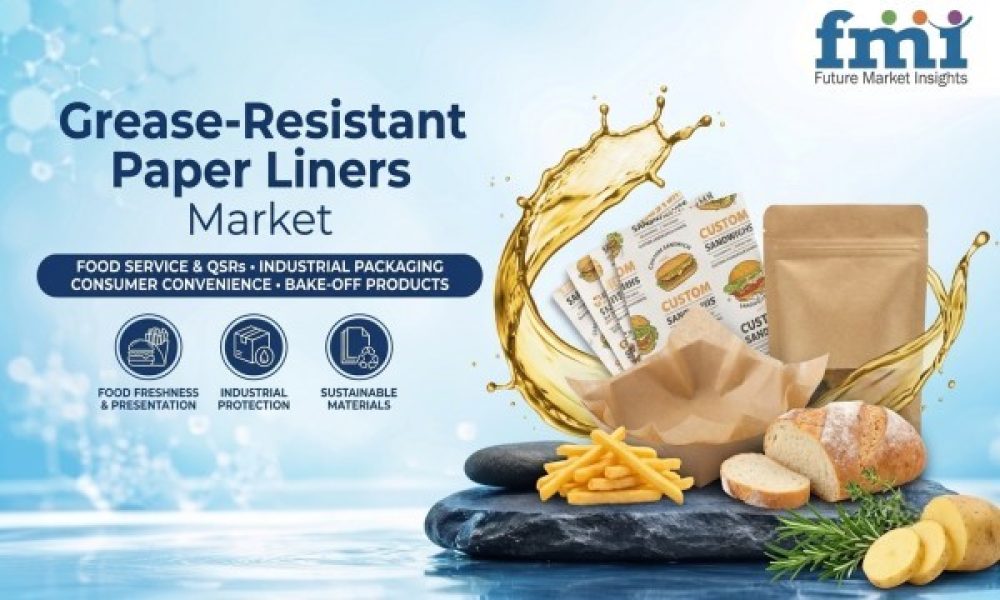
The global grease-resistant paper liners market is projected to increase from USD 727.5 million in 2026 to USD 1,327.6 million by 2036, registering a 6.2% CAGR during the forecast period, according to the latest market analysis by Future Market Insights (FMI).
The market is being shaped by a practical shift in how foodservice operators, converters, and paper mills qualify grease-resistant formats. As PFAS-treated papers give way to documented alternatives, suppliers must demonstrate oil holdout, wet strength, print performance, and line compatibility under actual food-service conditions.
Prepared-food transactions remain a direct source of recurring liner demand. Every wrap, tray sheet, basket liner, or interleaver used for a single service cycle can generate another paper requirement. USDA Economic Research Service data cited in the report showed United States food-away-from-home spending reached USD 1.41 trillion during 2025, highlighting the large consumption base supporting high-frequency foodservice applications.
Get detailed market forecasts, competitive benchmarking, and pricing trends:
https://www.futuremarketinsights.com/reports/sample/rep-gb-34569
PFAS Restrictions Reshape Barrier Paper Specifications
Regulatory changes are influencing material selection across food-contact paper programs. The report notes that the FDA determined in January 2025 that 35 PFAS food-contact notifications for paper greaseproofing were no longer effective.
In Europe, Regulation (EU) 2025/40 establishes enforceable PFAS concentration limits for food-contact packaging from August 2026. These developments are increasing the need for paper structures that can provide grease resistance while meeting food-contact and recyclability requirements.
For converters and paper mills, regulatory compliance is only one part of qualification. Actual food exposure can reveal weaknesses that standard laboratory tests may not capture. Heat, moisture, sauces, fold lines, and contact time can all affect oil holdout and sheet integrity during service.
“Paper mills earn repeat orders when one liner grade controls oil exposure and folding without slowing fast dispensing. Restaurant chains should compare migration files with line-trial data to confirm compliance under recurring operating conditions.”
— Nandini Roy Choudhury, Principal Consultant, Future Market Insights
Natural Greaseproof Liners Lead Product Types
Natural greaseproof liners are projected to account for 30.0% of product-type revenue in 2026. Their barrier performance is created through fiber refining and sheet-density control, reducing reliance on heavy surface coatings.
Virgin kraft pulp is estimated to hold 36.0% of the material category in 2026. Its long fibers, controlled cleanliness, and tear strength support direct food-contact applications where consistent sheet performance is required.
The 30-50 GSM range is expected to represent 46.0% of the basis-weight category in 2026. This range balances stiffness, grease holdout, fold performance, and fiber use across common foodservice formats.
Quick-service restaurants are projected to account for 30.0% of application revenue in 2026. Burgers, fries, tacos, baked foods, and other prepared meals create repeated demand for liners matched to different grease exposure and serving conditions.
Country Growth Reflects Different Qualification Requirements
Brazil is forecast to record the highest CAGR among the five profiled countries at 6.6% through 2036. The United Kingdom follows at 6.1%, while Germany is projected at 6.0%.
The United States is forecast to expand at 5.6%, while Japan records a 4.9% CAGR in the supplied country outlook.
The differences reflect more than foodservice activity. Distributor coverage, regulatory documentation, recycling requirements, inventory availability, dimensional tolerances, and customer qualification processes all affect how quickly demand converts into recurring liner orders.
Competitive Landscape
The competitive field includes natural greaseproof paper producers, engineered barrier-paper developers, and integrated specialty-paper groups.
Key companies profiled include Ahlstrom, Nordic Paper, delfort, Koehler Paper, Sappi, Mondi, UPM Specialty Papers, and Metsä Tissue.
The report identifies different competitive strengths across the supplier base. Natural greaseproof and parchment platforms compete on direct-food-contact experience and fiber control, while engineered barrier-paper developers address applications requiring additional moisture or oxygen protection. Integrated specialty-paper groups add application laboratories, conversion expertise, and geographic supply capabilities.
Recent developments also point to continued innovation in lower-coating and bio-based food-packaging structures. In March 2026, UPM Specialty Papers and Paramelt introduced a bio-based food-packaging concept for bakery, fast-food, and convenience applications. In August 2025, Mondi ramped up FunctionalBarrier Paper Ultimate production at its Solec plant in Poland following a EUR 16 million investment. In June 2025, Metsä Tissue licensed SAGA consumer sales and distribution in Finland and the Baltics to Fredman Group.
Market Scope
The Grease-Resistant Paper Liners Market covers product type, material, basis weight, application, end use, sales channel, and region.
Product types include natural greaseproof liners, coated grease-resistant liners, fluorochemical-free barrier liners, glassine liners, and others. Materials include virgin kraft pulp, recycled fiber, vegetable parchment, glassine, and other paper bases.
The report covers North America, Latin America, Western Europe, Eastern Europe, East Asia, South Asia and Pacific, and Middle East and Africa. The forecast period extends from 2026 to 2036.
Gain Comprehensive Knowledge—Read the Entire Report Now!
https://www.futuremarketinsights.com/reports/grease-resistant-paper-liners-market
FMI Custom Research: Strategic Intelligence for Confident Decision-Making
In today’s rapidly evolving business environment, leadership teams need more than market data—they need clear, actionable intelligence tailored to their strategic objectives. FMI’s Custom Research solutions are designed around the specific business questions organizations need answered, enabling executives to evaluate growth opportunities, validate investments, assess competitive dynamics, and reduce uncertainty before making critical decisions. By combining deep industry expertise, primary research, and proprietary market intelligence, FMI delivers insights that help organizations move from assumptions to evidence-based strategies with greater speed and confidence.
Business Impact
FMI helps organizations transform market complexity into strategic clarity, enabling leadership teams to identify growth opportunities faster, optimize resource allocation, strengthen competitive positioning, and make high-stakes business decisions with confidence.
To explore how FMI Custom Research can support your strategic priorities, please connect with our team at – [email protected]
About Future Market Insights (FMI)
Future Market Insights, Inc. (FMI) is an ESOMAR-certified, ISO 9001:2015 market research and consulting organization, trusted by Fortune 500 clients and global enterprises. With operations in the U.S., UK, India, and Dubai, FMI provides data-backed insights and strategic intelligence across 30+ industries and 1200 markets worldwide.



