
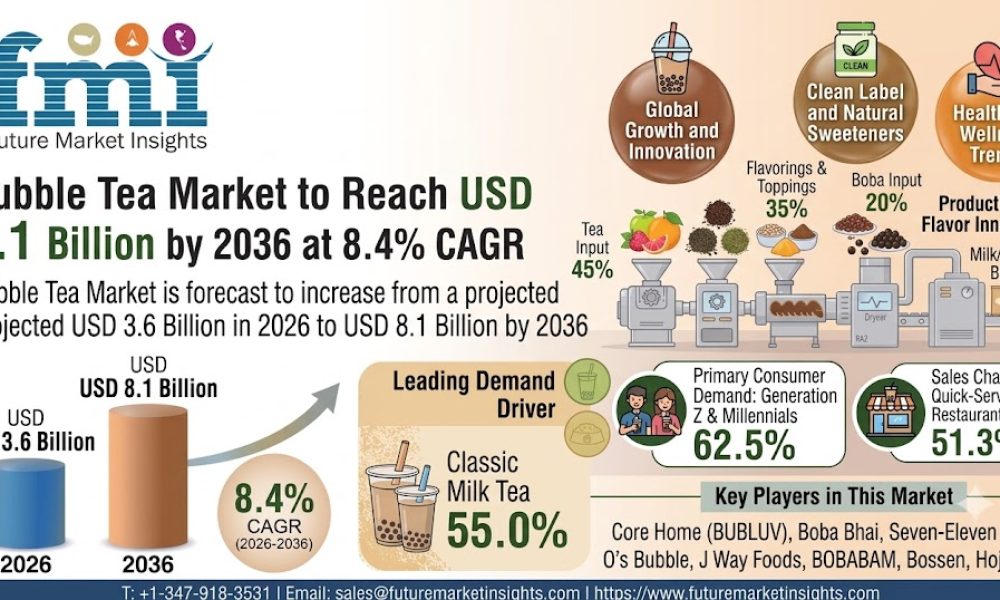
The global bubble tea market is forecast to increase from USD 3.6 billion in 2026 to USD 8.1 billion by 2036, expanding at an 8.4% CAGR during the 2026-2036 forecast period, according to Future Market Insights. The market stood at USD 3.3 billion in 2025. Growth is being supported by easier access to packaged boba, rising availability of shelf-stable Ready-to-Drink (RTD) products, and the expansion of bubble tea from specialist cafés into grocery, convenience, and online retail channels.
Get detailed market forecasts, competitive benchmarking, and pricing trends:
https://www.futuremarketinsights.com/reports/sample/rep-gb-12310
Regional Segment Leaders
As this is a global Bubble Tea Market report, the segment analysis reflects sugar content, product formats, consumer preferences, and country-level growth patterns across key beverage markets.
- Regular Bubble Tea – 68.4% of Sugar Content category revenue in 2026: Classic milk-tea and brown-sugar recipes continue to drive demand for full-sweetness products, maintaining regular bubble tea as the leading sugar-content category.
- Ready-to-Drink (RTD) – 87.2% of Format revenue in 2026: Sealed bubble tea beverages with pearls inside eliminate preparation requirements for consumers and support broader distribution through grocery, convenience, and online channels.
- USA – 10.4% CAGR through 2036: The USA records the fastest CAGR among the profiled countries, supported by growing retail availability, packaged boba adoption, and expanding consumer interest in convenient bubble tea formats.
Market Growth Context
The Bubble Tea Market is developing around the shift from café-based consumption toward convenient packaged formats. Rising access to packaged boba is helping bubble tea reach consumers beyond specialist shops, with shelf-stable RTD lines entering national grocery chains and other mainstream retail channels.
Consumer preferences are also broadening beyond traditional milk-tea offerings. Brands are introducing matcha, oolong, and fruit tea bases to provide greater flavor variety and appeal to consumers seeking different taste profiles.
The expansion of RTD bubble tea is particularly important to the market’s growth outlook. Sealed beverages containing pearls allow consumers to purchase and consume bubble tea without visiting a café, creating new opportunities across grocery, convenience, e-commerce, and other retail channels.
Sugar content is another important commercialization consideration. Local regulations and increasing consumer attention toward sugar intake are encouraging brands to provide different sweetness levels and develop low-sugar RTD options. Manufacturers that align sugar formulations with local market requirements can improve their ability to expand across international markets.
The market is also seeing increasing adoption of low-sugar RTD bubble tea across retail listings. This trend reflects a broader shift toward convenience combined with greater flexibility in sweetness and flavor selection.
Country-level growth varies across the markets covered by the report. The USA records a 10.4% CAGR through 2036, while Germany is expected to expand at a slower 6.4% CAGR, with sugar scrutiny influencing market development.
Commercial success through 2036 is expected to depend on convenient product formats, flavor innovation, flexible sweetness levels, retail accessibility, and the ability to preserve the customizable experience associated with traditional bubble tea.
Competitive Landscape
The competitive landscape features companies participating across packaged bubble tea, RTD beverages, specialty boba products, and retail distribution.
- Bubble Tea & Packaged Boba: Core Home (BUBLUV), Boba Bhai, Seven-Eleven Japan, O’s Bubble, J Way Foods, BOBABAM, Bossen, and Hojalicious are among the notable companies profiled by Future Market Insights.
Competitive differentiation depends on flavor variety, sweetness options, product convenience, packaging, retail availability, and the ability to translate the customizable café experience into packaged formats.
Companies are increasingly exploring matcha, oolong, fruit tea, and low-sugar formulations to broaden consumer appeal. At the same time, expansion through grocery, convenience, and online channels is creating additional opportunities for brands to reach consumers who may not regularly visit specialist bubble tea shops.
Get the Complete Story – Read More About the Bubble Tea Market:
https://www.futuremarketinsights.com/reports/bubble-tea-market
Analyst Perspective
“The future outlook of the bubble tea market will be shaped less by novelty and more by choice. Young adults treat bubble tea as a drink they build for themselves, picking the flavour, sweetness level and toppings, and brands that protect this sense of control can strengthen consumer loyalty.” – Nandini Roy Choudhury, Principal Consultant, Future Market Insights
About Future Market Insights (FMI)
Future Market Insights, Inc. (FMI) is an ESOMAR-certified, ISO 9001:2015 market research and consulting organization, trusted by Fortune 500 clients and global enterprises. With operations in the U.S., UK, India, and Dubai, FMI provides data-backed insights and strategic intelligence across 30+ industries and 1200 markets worldwide.
For Press & Corporate Inquiries
Rahul Singh
AVP – Marketing and Growth Strategy
Future Market Insights, Inc.
+91 8600020075
For Sales: [email protected]
For Media: [email protected]
For Web: https://www.futuremarketinsights.com/



