
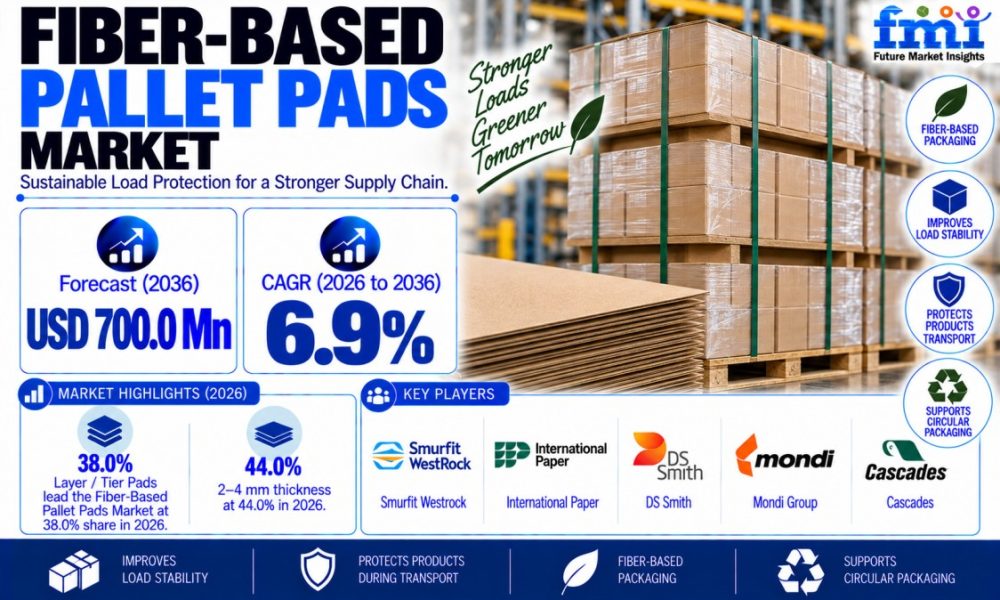
The global Fiber-based Pallet Pads Market is projected to grow from USD 359.2 million in 2026 to USD 700.0 million by 2036, registering a 6.9% CAGR during the forecast period, according to Future Market Insights.
Fiber-based pallet pads are used for layer separation, friction control, cushioning, load distribution, and contamination protection within palletized shipments. Their value extends beyond the sheet itself, as buyers evaluate their ability to reduce product movement, scuffing, breakage, rework, rejected deliveries, and dependence on additional stretch film.
>> Get Detailed Market Forecasts, Competitive Benchmarking, and Pricing Trends: https://www.futuremarketinsights.com/reports/sample/rep-gb-34210
Layer and Tier Pads Lead Product Demand
Layer / Tier Pads account for 38.0% of the product type segment in 2026, making them the leading product category.
These pads are placed repeatedly between layers of cartons, bottles, cans, pails, and other packaged products. As a result, consumption is closely connected to the number of layers shipped rather than simply the number of pallets handled.
Packaging engineers increasingly evaluate whether one pad specification can perform several functions, including pressure distribution, abrasion reduction, product separation, and support for automated depalletizing.
Corrugated Fiberboard Holds a 40.0% Material Share
Corrugated fiberboard represents 40.0% of material demand in 2026. Its liner-and-flute construction provides stiffness, low weight, moderate cushioning, and flexibility for converting.
The material also allows converters to adjust flute type, liner combinations, and recycled-fiber content according to individual load requirements. This flexibility is relevant for buyers balancing mechanical performance with sustainability targets.
The 2–4 mm thickness range represents 44.0% of the thickness segment, reflecting its suitability across general pallet configurations without adding excessive material or storage volume.
Load Stabilization Remains a Core Application
Palletized Load Stabilization accounts for 36.0% of application demand in 2026.
Fiber pads can increase interlayer friction and distribute contact pressure, helping reduce movement during transportation. However, buyers increasingly validate these benefits through route-specific testing, including tilt, vibration, and acceleration trials.
A pad that performs well in controlled testing may behave differently under actual warehouse humidity, storage duration, pallet geometry, or shipping conditions. This makes qualification an important part of the purchasing process.
Food and Beverage Represents 32.0% of End Use
The Food & Beverage sector accounts for 32.0% of end-use demand in 2026.
Food and beverage plants handle a broad range of containers, including cans, glass, PET, cartons, trays, and pails. Differences in surface characteristics create requirements around cleanliness, moisture response, traceability, and machine compatibility.
Automated palletizing also raises the importance of feeding consistency. Pads that curl, jam, or misfeed can interrupt high-speed production lines, making equipment-specific trials an important part of supplier qualification.
Direct and OEM Supply Leads Sales Channels
Direct / OEM supply holds a 40.0% share of sales channels in 2026.
Large-volume and multi-site buyers often approve pallet pads as part of a broader packaging system. Suppliers must therefore maintain consistent dimensions, friction characteristics, moisture response, and material specifications across different production locations.
Distributors remain relevant for standard sizes and smaller-volume requirements, where the annual volume may not justify direct tooling and qualification programs.
👉 Access the Complete Report in PDF Format: https://www.futuremarketinsights.com/reports/brochure/rep-gb-34210
Sustainability Creates Opportunity, but Performance Remains Critical
Recyclability requirements and efforts to reduce plastic transport components are supporting interest in fiber-based alternatives. At the same time, moisture, coating chemistry, load duration, and automated-line tolerances can extend qualification cycles.
EU Regulation 2025/40 is also increasing attention around packaging designed for recycling and the impact of coatings on recovery routes.
Future opportunities are emerging around anti-slip, moisture-resistant, and automation-ready fiber pads that combine material efficiency with measurable load performance.
Regional Growth Outlook
India is projected to record a 9.1% CAGR from 2026 to 2036, followed by China at 8.3% and Brazil at 7.3%. The United Kingdom is expected to grow at 6.4%, the USA at 6.2%, Germany at 6.0%, and Japan at 5.4%.
According to Nandini Roy Choudhury, Principal Consultant at Future Market Insights:
“Fiber-based pallet pads earn approval only when they improve load stability without creating new problems on the packing line.”
The competitive landscape includes Smurfit Westrock, International Paper, DS Smith, Mondi Group, Cascades, Georgia-Pacific, Klingele Papierwerke, Sonoco, Menasha Packaging, and Conitex Sonoco.
The full Fiber-based Pallet Pads Market report covers product type, material, thickness, application, end use, sales channel, and regional analysis for 2026–2036.
To explore how FMI Custom Research can support your strategic priorities, connect with our team at – [email protected]
About Future Market Insights (FMI)
Future Market Insights, Inc. is an ESOMAR-certified, ISO 9001:2015 market research and consulting organization trusted by Fortune 500 companies. With a global presence across the U.S., UK, India, and Dubai, FMI delivers data-driven insights across 30+ industries and 1200 markets worldwide.



