
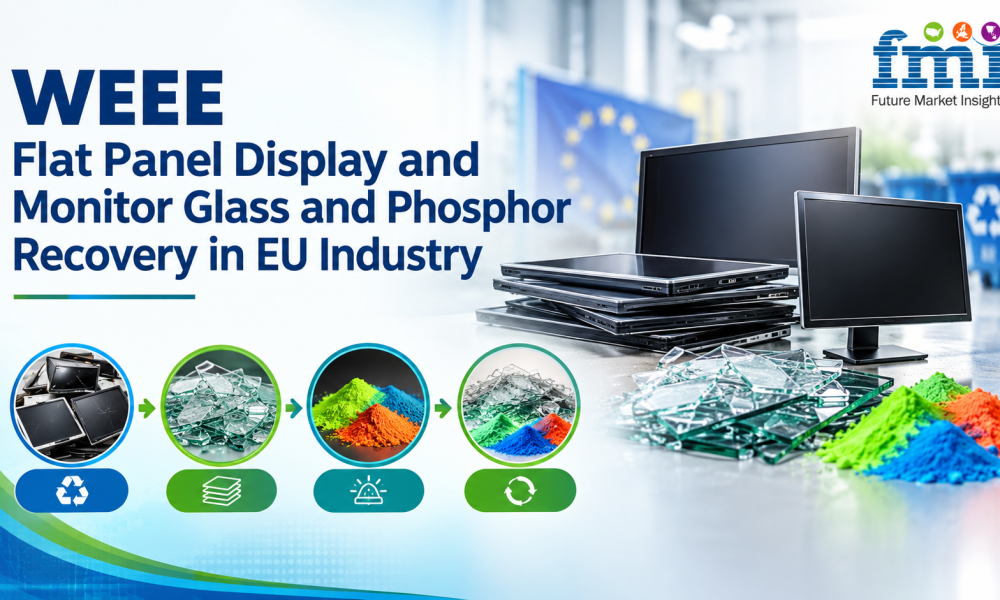
The WEEE flat panel display and monitor glass and phosphor recovery industry in the EU is valued at USD 43.6 million in 2026 and is projected to reach USD 76.6 million by 2036, expanding at a 5.8% CAGR from 2026 to 2036, according to Future Market Insights (FMI). The industry was valued at USD 41.2 million in 2025.
Growth is being shaped by tighter downstream quality requirements for recovered materials, particularly as recyclers and metallurgical processors impose stricter limits on phosphor residue in recovered glass streams. The market is increasingly focused on material purity, controlled dismantling, and specialized recovery infrastructure rather than collection volumes alone.
Get detailed market forecasts, competitive benchmarking, and pricing trends: https://www.futuremarketinsights.com/reports/sample/rep-gb-32753
Recovery Quality Becomes a Key Commercial Factor
Commercial performance across the EU is increasingly linked to the quality of recovered fractions. Poor phosphor removal can lower the value of glass cullet and restrict access to higher-value downstream applications. Residual yttrium, europium, and other contaminants can also affect buyer acceptance for cleaner recycled inputs.
Semi-automated and robotics-assisted dismantling is gaining importance as recyclers seek better fraction separation and higher processing efficiency. Semi-automated dismantling is estimated to account for 34.0% of the treatment process segment in 2026. Robotic unscrewing, guided cutting, and manual inspection can help operators improve throughput while maintaining better control over recoverable materials.
The shift toward process control is also encouraging investment in liberation, sorting, decontamination, and analytical verification capabilities. Facilities able to consistently deliver cleaner recovered materials can address downstream requirements for technical and specialty applications.
Monitors Lead the Display Source Segment
Monitors are expected to account for 38.0% of the display source segment in 2026, supported by relatively uniform product structures and steady corporate IT refresh cycles.
Compared with mixed television loads, monitor waste can offer more structured processing conditions for semi-automated dismantling lines. Uniform batches can simplify sorting and reduce manual adjustment, while controlled dismantling helps preserve recoverable glass and indium-bearing components.
Corporate IT teams also increasingly assess recycling partners based on secure data destruction and verifiable downstream recovery records. This supports formal monitor recovery channels and strengthens the role of established recycling operators with documented treatment capabilities.
Glass Cullet Remains the Leading Recovered Fraction
Glass cullet is projected to hold 56.0% of the recovered fraction segment in 2026, making it the primary recovered output from display waste processing.
Its commercial value depends increasingly on contamination control. Mishandled dismantling can spread hazardous residues into otherwise usable glass streams, potentially reducing batch quality and limiting downstream acceptance. Additional cleaning and verification processes can therefore become important before recovered cullet is supplied to industrial buyers.
In terms of output use, glass ceramics are estimated to account for 31.0% of the segment in 2026. Consistent material behavior under high-temperature processing conditions can support the use of recovered flat-panel glass in specialized ceramic applications.
Country-Level Performance
- Poland: The market is projected to expand at a 6.7% CAGR through 2036, supported by regional collection, cross-border processing, and expanding semi-automated dismantling capacity.
- Netherlands: Growth is estimated at 6.2% CAGR, supported by established secondary-material networks and downstream recovery infrastructure.
- Spain: The market is projected to register a 6.0% CAGR, with processing upgrades supporting cleaner and more specialized screen recovery.
- France: Growth is expected at 5.8% CAGR, supported by continued regulatory enforcement and cleaner recovery practices.
- Sweden: The market is forecast to expand at 5.5% CAGR, reflecting progress in controlled separation and material handling.
- Germany: Growth is projected at 5.2% CAGR, with emphasis on yield improvement and process efficiency.
- Italy: The market is anticipated to register a 5.0% CAGR, with improved recovery performance supporting industry development.
Opportunities for Recovery Operators
Opportunities are emerging around hydrometallurgical extraction integration, closed-loop supply agreements, and automated delamination scaling. Localized leaching capabilities can support the recovery of rare-earth elements from phosphor materials, while direct agreements between display manufacturers and integrated recycling hubs can strengthen domestic secondary-material supply chains.
Automated delamination can also reduce manual labor requirements while supporting higher-value recovery from rare-earth-containing monitor phosphors.
Access the Complete Report in PDF Format: https://www.futuremarketinsights.com/reports/brochure/rep-gb-32753
Competitive Landscape
The competitive environment is increasingly influenced by certified hazardous-fraction handling, downstream traceability, and the ability to deliver low-contamination recovered materials. Established processors can benefit from accumulated processing knowledge, assay records, model-specific dismantling experience, and stable automation settings.
Key companies active in the WEEE flat panel display and monitor glass and phosphor recovery industry in the EU include Renewi E-Waste (formerly Coolrec), Stena Recycling, Kuusakoski, Electrocycling, Veolia, and Sims Lifecycle Services.
As downstream buyers place greater emphasis on material purity and documented treatment pathways, processing capability and output consistency are becoming important factors in contract retention and market participation.
Business Impact
FMI helps organizations transform market complexity into strategic clarity, enabling leadership teams to identify growth opportunities faster, optimize resource allocation, strengthen competitive positioning, and make high-stakes business decisions with confidence.
To explore how FMI Custom Research can support your strategic priorities, please connect with our team at – [email protected]
About Future Market Insights (FMI)
Future Market Insights, Inc. (FMI) is an ESOMAR-certified, ISO 9001:2015 market research and consulting organization, trusted by Fortune 500 clients and global enterprises. With operations in the U.S., UK, India, and Dubai, FMI provides data-backed insights and strategic intelligence across 30+ industries and 1200 markets worldwide.



