
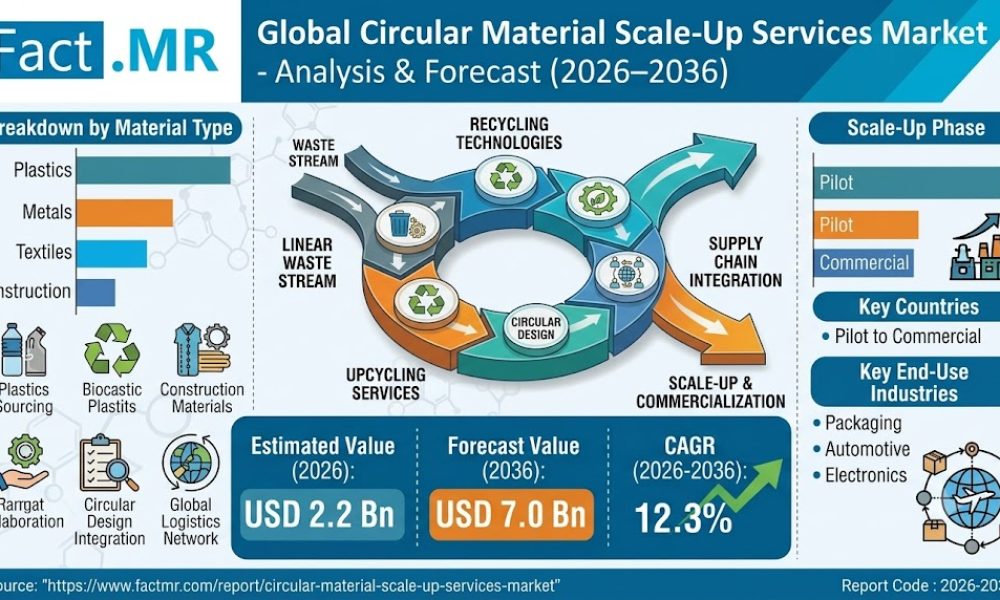
The global circular material scale-up services market is projected to grow from USD 2.2 billion in 2026 to USD 7.0 billion by 2036, expanding at a 12.3% CAGR during the forecast period. The market reached USD 2.0 billion in 2025, creating an absolute opportunity of USD 4.8 billion between 2026 and 2036. Demand is being driven by process teams that need to prove stable operating conditions before moving circular-material routes into larger equipment and commercial plants.
Circular material scale-up services help move processes from laboratory proof through pilot and demonstration stages toward plant use. They cover process trials, scale transfer, debottlenecking, plant transfer, and plant-readiness work. Recycled feedstocks can vary between batches, making pilot testing important for checking filtration, compounding, mixing, residence time, and other operating conditions before plant investment.
The U.S. Department of Energy announced on January 15, 2025, up to USD 100 million for pilot-scale carbon-conversion technologies. The funding targets high-technology-readiness carbon-conversion projects and adds to the broader need for pilot and scale-transfer capabilities.
Get Detailed Market Forecasts, Competitive Benchmarking, and Pricing Trends: https://www.factmr.com/connectus/sample?flag=S&rep_id=16559
Global Segment Leaders
- Lab-to-pilot — 39.0% share in 2026: This is the leading service stage because it is the first controlled point where process instability becomes visible outside laboratory equipment. Teams use pilot work to establish feed response, residence time, and stable run windows before committing to larger demonstration runs.
- Recycled polymers — 37.0% share in 2026: Recycled polymers lead the material segment because waste-derived feedstocks can vary between lots. Scale-up programs help determine whether filtration, mixing, and compounding remain stable as feed quality changes.
- Extrusion pilot — 33.0% share in 2026: Extrusion pilots hold the largest scale-asset share because continuous mixing and compounding are common requirements for polymer-based circular materials. Pilot equipment lets engineers evaluate shear, residence time, and throughput with lower material volumes than commercial lines.
- Process package — 31.0% share in 2026: Process packages lead the commercial-output segment because plant teams need defined operating ranges and equipment requirements that can be transferred from pilot results into production settings.
Country-Level Performance
- France — 13.3% CAGR: France records the highest projected CAGR among the five profiled countries. Its materials research base and chemicals and plastics industries support pilot programs that establish repeatable process windows before plant transfer. The French Ministry of Higher Education and Research reported in April 2026 that business R&D expenditure increased 1.0% in volume in 2024.
- United Kingdom — 13.0% CAGR: The UK is projected to expand at 13.0%, supported by business R&D and scale-up infrastructure. The Office for National Statistics reported on November 28, 2025, that UK businesses performed GBP 55.6 billion of R&D in 2024.
- Japan — 11.8% CAGR: Japan’s market is supported by research-intensive manufacturing and demand for repeatable process conditions before new materials enter established production lines. Japan’s Statistics Bureau reported in January 2026 that science and technology R&D expenditure totaled JPY 23.79 trillion in FY2024.
- United States — 11.5% CAGR: The U.S. market is supported by a large research pipeline moving toward pilot and demonstration work. The National Center for Science and Engineering Statistics estimated U.S. R&D performance at USD 993 billion in 2024, according to its February 27, 2026 release.
- Germany — 11.2% CAGR: Germany records the lowest CAGR among the five profiled markets. Its established process-design and extrusion base supports scale-up programs that test stable operating windows before transfer to plant equipment. Destatis reported on March 27, 2026, that German R&D spending reached EUR 137.1 billion in 2024.
Regional Context
Fact.MR covers North America, Latin America, Western Europe, Eastern Europe, East Asia, South Asia & Pacific, and the Middle East & Africa, with detailed country analysis for the United States, United Kingdom, Germany, Japan, and France. The five-country CAGR range spans 2.1 percentage points, from France at 13.3% to Germany at 11.2%.
Western European markets show strong demand for scale-up services as circular-material policy and business R&D create requirements for pilot validation and plant transfer. The UK combines substantial business R&D with dedicated scale-up infrastructure. Japan and the USA have large research bases that can generate pilot and demonstration requirements, while Germany combines R&D spending with established extrusion and separation capabilities.
Competitive Landscape
Key companies profiled in the circular material scale-up services market include Sulzer, Coperion, Clextral, and Gneuss. Their relevance spans process development, extrusion pilots, mixing, recycling trials, separation, and scale-transfer support.
Coperion has a direct role in recycling scale-up through its Recycling Innovation Center, where customers can test recycled materials and complete recycling-process configurations under production-oriented conditions. In July 2025, Coperion reported that two recently commissioned chemical plastics recycling lines could each process up to 6,000 kg/h. Its testing infrastructure is designed to help translate trial results into equipment and plant-system decisions.
Sulzer, Clextral, and Gneuss broaden the provider group across process-development and scale-up requirements. The market includes extrusion pilots, reactor pilots, coating lines, separation and purification systems, and compounding lines, giving providers several routes to support circular polymers, chemicals, fibers, and recovered-material programs.
Analyst Opinion
Shambhu Nath Jha, Principal Consultant at Fact.MR, stated:
“The difficult step in circular materials is often the move from a successful formula to a stable process. Scale-up programs are expected to gain value where they match plant settings and generate proof that plant teams can use. Providers that combine flexible pilot assets with feed checks and practical transfer records are better aligned with that decision point.”
Market Considerations
For circular-material developers, recyclers, process engineers, and plant operators, several factors are shaping scale-up requirements:
- Feedstock consistency: Trial batches may differ in composition, making representative feed availability important before a process is transferred.
- Process transfer: Pilot results need to translate into defined plant operating ranges, equipment requirements, and quality limits.
- Extrusion performance: Shear, residence time, screw configuration, filtration, and throughput need to be tested before commercial-scale operation.
- Downstream qualification: Test batches can provide material for downstream conversion and quality checks before final process settings are fixed.
- Debottlenecking: Existing plants may require process changes when circular feedstocks are introduced into established lines.
- Yield and cost models: Economic models help teams assess whether a process remains workable as throughput moves toward commercial scale.
- Representative material: Limited access to feedstock that accurately represents future commercial input can delay scale-up decisions.
Fact.MR identifies integrated trial-to-transfer service packages, chemical and polymer recycling scale-up, battery-material pilot processing, and separation and purification test services as opportunity areas. Feedstock inconsistency, limited representative material, capital review before demonstration scale, and weak transferability between different equipment remain constraints.
Research Methodology
Fact.MR’s analysis draws on 120+ sources, 35+ company portfolios, 25+ countries, and more than 20 industry interviews. Primary research includes manufacturers, service providers, technology developers, distributors, end users, and subject-matter experts. Desk research covers government statistics, regulatory publications, company filings, trade data, technical studies, industry associations, standards, public policy, and other authoritative sources.
Market estimates combine historical performance, demand indicators, pricing and volume trends, segment shares, company participation, country-level growth, adoption patterns, investment activity, and market barriers. The report uses a hybrid top-down and bottom-up approach based on pilot-service activity, equipment-center capabilities, circular-material process requirements, country evidence, and provider portfolio review.
Explore More Related Studies Published by Fact.MR Research:
Custom Software Development Market
Digital Media Market
About Fact.MR
Fact.MR is a leading provider of market research and consulting services, offering syndicated and customized research across industries including Consumer Goods, Healthcare, and Chemicals & Materials.



