
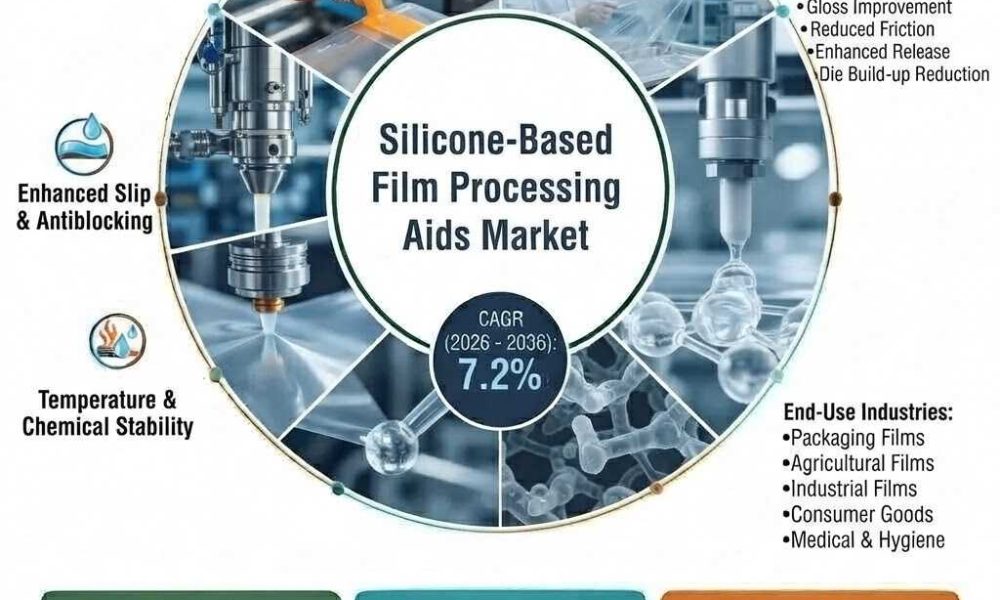
Silicone-Based Film Processing Aids Market – The Silicone-Based Film Processing Aids Market is projected to increase from USD 1.3 billion in 2026 to USD 2.6 billion by 2036, registering a 7.2% CAGR during the forecast period. The market was valued at USD 1.2 billion in 2025. Demand is being supported by processors reviewing non-fluoropolymer alternatives as PFAS-related packaging requirements receive greater attention. The European Commission states that Regulation (EU) 2025/40 applies from August 12, 2026, including PFAS limits for food-contact packaging.
Get detailed market forecasts, competitive benchmarking, and pricing trends https://www.factmr.com/connectus/sample?flag=S&rep_id=16576
Global Segment Leaders
- Processing Aid Chemistry — Silicone masterbatch: 34.0% share in 2026. Pelletized silicone masterbatch is easy to feed and can be metered into existing extrusion lines without a separate liquid system.
- Processing Function — Melt-fracture reduction: 31.0% share in 2026. Processing aids can help the melt exit more evenly at useful line speeds while limiting die-lip deposits that contribute to defects and cleaning stops.
- Polymer Substrate — Polyethylene: 36.0% share in 2026. Polyethylene is widely used in blown and flexible film, where surface defects and die deposits can reduce usable output.
- Application — Blown film: 29.0% share in 2026. Melt fracture, haze, gauge variation, and die deposits can affect long production runs, making processing stability important for blown-film converters.
Country-Level Performance
| Country | CAGR | Key Growth Driver |
| France | 7.4% | INSEE reported a business-climate index of 101 for rubber and plastic products in May 2026, above the long-term average of 100. |
| United States | 7.4% | The U.S. Bureau of Economic Analysis reported USD 19.0 billion in new foreign direct investment expenditures for U.S. plastics and rubber products manufacturing in 2025. |
| China | 7.2% | China’s National Bureau of Statistics reported that value added in rubber and plastic products manufacturing increased 6.1% year over year from January through August 2026. |
| Germany | 7.2% | The German Environment Agency reported around 5.5 million tonnes of dual-system packaging waste were recycled in 2024. |
| Japan | 6.1% | The report describes Japan’s mature polymer-conversion base and cites the Ministry of Economy, Trade and Industry’s February 27, 2026 industrial production report; no Japan-specific quantitative figure is stated in the country analysis. |
The country figures and supporting evidence are taken from the report’s country analysis and bibliography.
Regional Context
France and the United States are the fastest-growing profiled markets at 7.4% CAGR through 2036. France’s growth is associated with active plastics output and changes in packaging materials, while the United States benefits from an established plastics and rubber manufacturing base and active film-line investment.
China and Germany are projected to grow at 7.2% CAGR. China’s large polymer-processing base and rising rubber and plastic product output support demand, while Germany’s packaging recycling framework connects film design with extrusion efficiency and recycling requirements.
Japan records the lowest displayed CAGR at 6.1%. The report associates its more moderate growth with a mature plastics and polymer-conversion industry and a stable film-conversion base.
The full report covers North America, Latin America, Western Europe, Eastern Europe, East Asia, South Asia & Pacific, and Middle East & Africa, with five profiled countries: the United States, China, Germany, Japan, and France.
Competitive Landscape
Key companies identified in the report include Dow, Wacker Chemie, Momentive, Evonik, DuPont, and SILIKE. These suppliers offer silicone or siloxane-based technologies addressing extrusion efficiency, melt behavior, die buildup, surface properties, and film performance. Competitive differentiation can involve resin compatibility, dosage, processing stability, and technical application support.
The report’s bibliography cites a September 23, 2025 announcement from Dow concerning an alternative to fluoropolymer-based polymer processing aids for film packaging. It also cites an August 11, 2026 Directorate-General for Environment update on new EU packaging rules and restrictions on PFAS in food-contact packaging.
- Demand Drivers in the Market
- Processors are studying non-fluoropolymer options as PFAS rules receive more attention. Packaging and food-contact requirements are adding to this review.
- Silicone masterbatch offers a pellet form that is easy to feed. Converters can meter it into existing extrusion lines without a separate liquid system.
- Polyethylene remains a key substrate for blown and flexible film. These lines combine high output with strict needs for optics and sealing. Stable processing helps maintain surface quality during long runs.
To view related Reports
Glass-Rforced Substrate Market
About Fact MR
(Fact MR) is a leading provider of market research and consulting services, offering syndicated and customized research across industries including Chemical & Materials, Packaging, and Manufacturing.



