
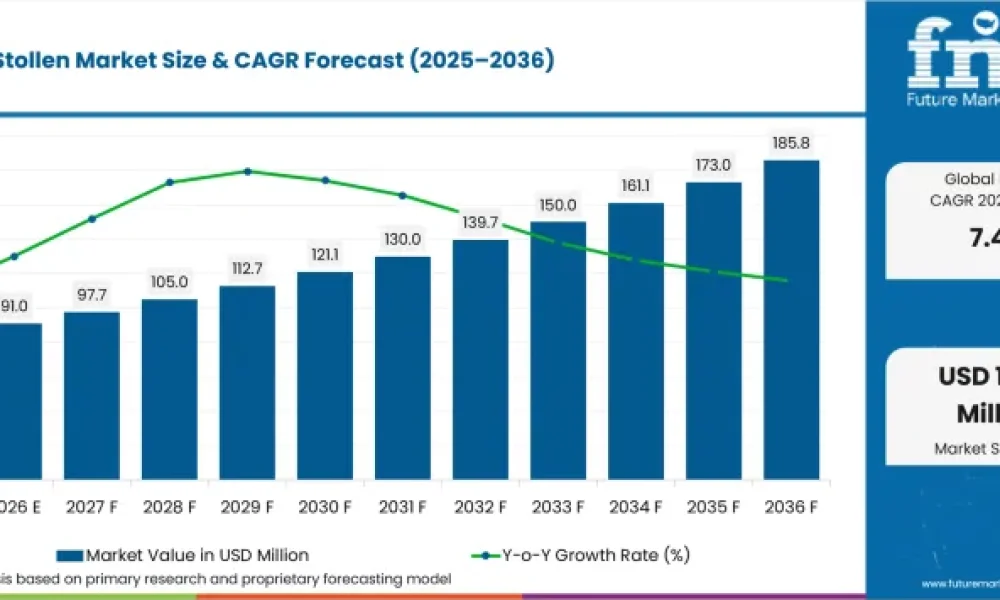
The Germany stollen market is forecast to increase from USD 91.0 million in 2026 to USD 185.8 million by 2036, expanding at a 7.4% CAGR during the 2026–2036 forecast period, according to Future Market Insights. Demand is supported by Christmas traditions, protected Dresden provenance, familiar recipes, and repeat seasonal purchasing. Retailers and specialist bakeries concentrate procurement ahead of the Christmas selling period, while ingredient commitments, inventory planning, and short sell-through windows remain important considerations for producers and distributors.
Get detailed market forecasts, competitive benchmarking, and pricing trends:
https://www.futuremarketinsights.com/reports/sample/rep-gb-35193
Global Segment Leaders
As this report focuses on the German stollen industry, segment insights highlight key product types, claim-nature preferences, and formats shaping seasonal demand.
- Classic – Original — 36.0% of Product Type demand in 2026: Maintains a leading position as the familiar category reference point, supported by traditional recipes and established consumer expectations around seasonal stollen.
- Conventional — 56.0% of Claim – Nature demand in 2026: Accounts for the largest share as mainstream consumers continue to favor familiar taste profiles and established Christmas recipes.
- Frozen — 29.0% of Format demand in 2026: Supports inventory flexibility by allowing products to be prepared ahead of the narrow Christmas retail window, although ingredient commitments and seasonal sell-through remain important operating considerations.
Market Performance in Germany
The report examines demand across Germany, where stollen purchasing is strongly connected to Christmas traditions, protected regional provenance, retail distribution, and specialist bakery channels.
- Market Size in 2026: USD 91.0 million
- Forecast Market Size in 2036: USD 185.8 million
- CAGR: 7.4% (2026–2036)
- Market Value Increase: USD 94.8 million between 2026 and 2036
Retailers concentrate orders before Christmas because protected origin and familiar recipes provide the category with a recurring seasonal purchasing trigger. In October 2025, the Schutzverband Dresdner Stollen reported that approximately 100 protected-area producers participated in its 17-day annual inspection cycle. The qualification process provides an authenticity assessment before the main seasonal selling period.
Channel economics also influence how forecast demand translates into actual orders. National grocery retailers provide seasonal products with broad consumer access, while Dresden-based specialists can pursue higher unit realization by emphasizing provenance and traditional positioning.
Regional Context
Germany’s stollen market is increasingly influenced by Christmas purchasing patterns, regional provenance, ingredient availability, production planning, and the ability to manage inventory during a narrow seasonal selling period.
Protected Dresden origin provides a distinctive provenance element for premium products, while conventional stollen remains important across mainstream retail. Producers must balance advance commitments for butter, dried fruit, and other key ingredients with the uncertainty of final Christmas sell-through.
Frozen formats can provide additional inventory-planning flexibility by enabling production ahead of the peak period. However, the category remains exposed to seasonal margin pressure when committed ingredients and finished inventory must be cleared after Christmas.
The market therefore depends not only on seasonal demand growth but also on effective production scheduling, packaging, replenishment, and inventory management throughout the Advent selling period.
Competitive Landscape
The report’s Key Players section identifies Kuchenmeister, Lambertz, Dr. Quendt, Emil Reimann, Dresdner Backhaus, Bäckerei Wippler, Ottendorfer Mühlenbäcker, and Bäckerei Siemank.
Competition centers on traditional recipes, Dresden provenance, seasonal availability, product consistency, packaging, and retail distribution:
- Large-Scale Bakery & Confectionery Producers: Kuchenmeister and Lambertz participate through established bakery production capabilities, broad distribution, and seasonal product portfolios.
- Dresden-Based & Traditional Producers: Dr. Quendt, Emil Reimann, Dresdner Backhaus, and Bäckerei Wippler compete through traditional stollen production, regional identity, and Dresden provenance.
- Regional Bakery Specialists: Ottendorfer Mühlenbäcker and Bäckerei Siemank participate through regional bakery operations, seasonal products, and established consumer relationships.
Competition also reflects the importance of maintaining product authenticity and packaging presentation throughout the Christmas selling period. Producers that manage ingredient commitments, inventory, replenishment, and provenance communication effectively can address the category’s concentrated seasonal demand.
Analyst Perspective
“Germany stollen should be judged on post-Christmas margin because gross seasonal sell-in can hide markdown losses after the peak. Protected Dresden origin earns more when packaging and replenishment preserve the provenance premium through the final Advent weeks.” — Nandini Roy Choudhury, Principal Consultant, Future Market Insights
About Future Market Insights (FMI)
Future Market Insights, Inc. (FMI) is an ESOMAR-certified, ISO 9001:2015 market research and consulting organization, trusted by Fortune 500 clients and global enterprises. With operations in the U.S., UK, India, and Dubai, FMI provides data-backed insights and strategic intelligence across 30+ industries and 1200 markets worldwide.
For Press & Corporate Inquiries
Rahul Singh
AVP – Marketing and Growth Strategy
Future Market Insights, Inc.
+91 8600020075
For Sales: [email protected]
For Media: [email protected]
For Web: https://www.futuremarketinsights.com/



