
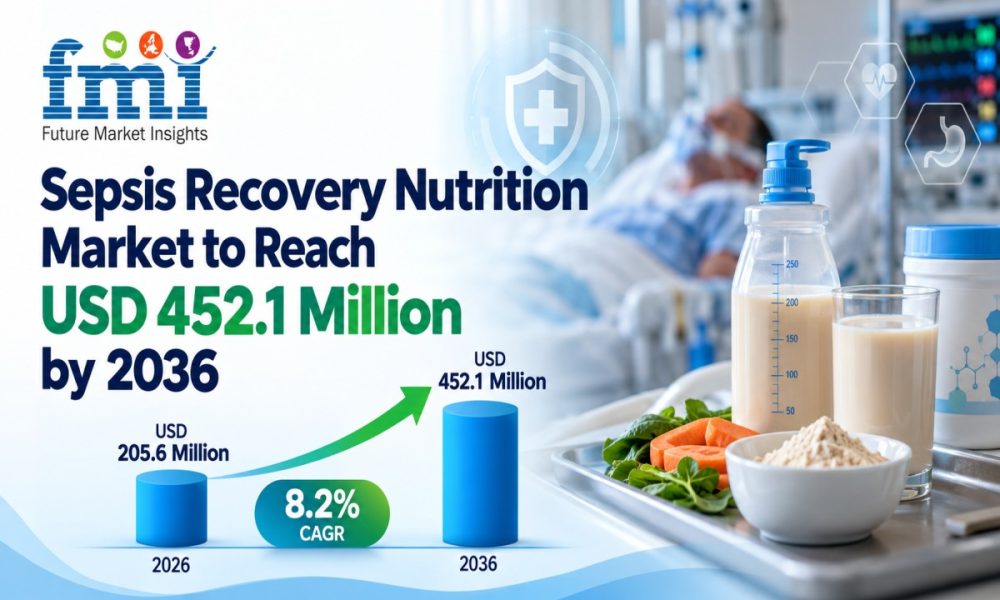
Global sepsis recovery nutrition market projected to grow from USD 205.6 million in 2026 to USD 452.1 million by 2036 at an 8.2% CAGR, according to Future Market Insights
The global Sepsis Recovery Nutrition Market is projected to reach USD 452.1 million by 2036, up from approximately USD 205.6 million in 2026, expanding at an 8.2% CAGR during the forecast period, according to the latest analysis by Future Market Insights (FMI).
The market is being supported by earlier nutrition intervention during critical illness, growing recognition of nutrition’s role in recovery, increasing use of enteral feeding protocols and continued demand for nutritional support as patients transition from intensive care to general wards and home-based recovery.
Sepsis recovery nutrition includes clinically directed nutritional products used to support patients during and after severe sepsis. The market includes high-protein enteral feeds, immune-modulating formulas, antioxidant and micronutrient blends, enteral tube feeds, ready-to-drink oral nutritional supplements and modular nutrition products.
Get Detailed Market Forecasts, Competitive Benchmarking, and Pricing Trends:
https://www.futuremarketinsights.com/reports/sample/rep-gb-34895
High-Protein Enteral Feeds Anchor Formulation Demand
High-protein enteral feeds are projected to account for 42.1% of formulation demand in 2026, making them the leading formulation category.
Protein delivery becomes an important consideration during recovery from severe illness as clinicians seek to address nutritional requirements while accounting for feeding tolerance, fluid restrictions and changing patient conditions.
Acute ICU Phase Represents the Largest Recovery Stage
The acute ICU phase is projected to account for 51.1% of phase demand in 2026.
The ICU represents the point at which many initial nutrition decisions are established for patients with severe sepsis or septic shock. Critical-care teams assess feeding route, rate, tolerance and nutrient delivery as patients stabilize.
Enteral Tube Feeds Lead Product Forms
Enteral tube feeds are expected to account for 39.1% of product form demand in 2026.
Tube feeding provides controlled nutrient delivery for patients who cannot meet nutritional requirements orally during stabilization.
Ready-to-hang enteral formats also fit established hospital workflows and can provide continuity before patients transition toward oral nutritional supplements as swallowing ability, appetite and overall condition improve.
Early Nutrition Protocols Support Market Expansion
The increasing incorporation of nutrition into early sepsis management is supporting market demand.
The 2026 Surviving Sepsis Campaign guideline recommends enteral nutrition within 72 hours for adults with sepsis or septic shock when appropriate.
Earlier nutrition decisions create a defined point for hospitals to introduce clinically appropriate formulas and continue nutritional management as patients progress through recovery.
Hemodynamic Instability and Feeding Tolerance Remain Constraints
Despite growing adoption, patient-specific clinical conditions can limit the speed and extent of nutrition escalation.
Hemodynamic instability, gastrointestinal dysfunction and feeding intolerance can require adjustments to feeding rate, route or formula selection.
Consequently, a single protein target or formula strategy may not apply uniformly throughout a patient’s recovery.
Post-Discharge Recovery Creates Additional Opportunities
Sepsis recovery frequently extends beyond the ICU and hospital stay, creating opportunities for nutrition products designed for ward and home-based use.
Patients transitioning from tube feeding to oral intake may require ready-to-drink oral nutritional supplements, powder modules or other medical nutrition formats.
The ability to maintain continuity between hospital and home nutrition plans can support longer-term product use when clinically indicated.
South Korea Shows the Fastest Growth Among Highlighted Countries
FMI’s country-level analysis identifies South Korea as the fastest-growing market among the highlighted countries, with a projected 8.6% CAGR through 2036.
The United States follows at 7.7%, the United Kingdom at 7.4%, Germany at 7.1%, and Japan at 6.5%.
The difference in country growth rates reflects variations in healthcare systems, clinical nutrition adoption, hospital structures, sepsis burden, reimbursement environments and post-discharge care pathways.
Country-Level Market Analysis
South Korea
South Korea’s sepsis recovery nutrition market is projected to expand at an 8.6% CAGR through 2036.
Concentrated tertiary-care networks and structured clinical pathways provide opportunities for nutrition products that fit hospital protocols and support transitions between ICU and ward care.
Nutrition suppliers also need formats capable of adapting to route changes and different stages of recovery.
United States
The United States is projected to record a 7.7% CAGR during the forecast period.
The country’s large hospital system and substantial sepsis burden create significant demand for clinical nutrition products.
However, hospital formularies, coverage arrangements and post-discharge supply systems can vary between healthcare networks. Suppliers therefore need both institutional access and products that can support continued nutrition after hospital transfer when clinically appropriate.
United Kingdom
The UK sepsis recovery nutrition market is projected to grow at a 7.4% CAGR.
Integrated care pathways require hospitals to develop practical nutrition plans that can continue into community-based recovery.
Nutrition suppliers can benefit from products that support the transition from acute hospital care toward oral and home-based nutritional support while fitting budget and clinical requirements.
Competitive Landscape
The Sepsis Recovery Nutrition Market includes multinational medical nutrition companies, hospital-focused healthcare suppliers and specialized nutrition manufacturers.
Key companies profiled by FMI include Fresenius Kabi, Abbott, Nestlé Health Science, Danone Nutricia, Baxter, B. Braun, Megalabs USA LLC and Medtrition.
Competitive positioning is influenced by enteral and oral nutrition portfolio breadth, hospital relationships, clinical education, product availability, route flexibility and the ability to support nutrition across different stages of recovery.
Key Industry Developments
The sepsis recovery nutrition market continues to evolve through new product launches, clinical nutrition programs and research collaborations.
In March 2025, Medtrition launched the ProSource Cup portfolio, providing a protein-focused format for oral and tube-fed patients.
In October 2025, Danone Nutricia launched Fortimel PlantBased Protein, a high-protein, high-energy plant-based oral nutritional supplement designed for patients with disease-related malnutrition.
In January 2025, Fresenius Kabi renewed its collaboration with the European Society of Intensive Care Medicine, including nutrition research, critical-care education and fellowship programs.
Analyst Perspective
“Hospital accounts should evaluate sepsis recovery nutrition by route flexibility and protocol fit before comparing unit price. Commercial value rises when one portfolio supports ICU feeding and later oral recovery without breaking the clinician’s nutrition plan.” — Nandini Roy Choudhury, Principal Consultant, Future Market Insights
Exclusive Discounts on Full Report
Sepsis Recovery Nutrition Market – https://www.futuremarketinsights.com/reports/sepsis-recovery-nutrition-market
Report Scope
The FMI study covers the Sepsis Recovery Nutrition Market by formulation, phase, product form, end user, sales channel and region. Formulations include high-protein enteral feeds, immune-modulating formulas, antioxidant and micronutrient blends, and others. Phases include acute ICU phase, ward step-down and post-discharge recovery. Product forms include enteral tube feeds, ready-to-drink oral nutritional supplements, powder modules and others. End users include ICUs, hospitals/general wards, homecare and others. Sales channels include hospital pharmacy, retail pharmacy, online, institutional tender and others.
The research covers North America, Latin America, Europe, East Asia, South Asia and Pacific, and the Middle East and Africa.
The forecast period extends from 2026 to 2036.
FMI’s methodology combines primary and secondary research with market triangulation. The analysis considers clinical nutrition protocols, hospital purchasing, product developments, healthcare infrastructure, regulatory developments and country-level market conditions.
Key Executive Benefits
Decision-Ready Insights
Reduced Strategic Risk
Market Entry Confidence
Competitive Advantage
Faster Growth Decisions
Primary Market Validation
To explore how FMI Custom Research can support your strategic priorities, connect with our team at [email protected].
About Future Market Insights (FMI)
Future Market Insights, Inc. is an ESOMAR-certified, ISO 9001:2015 market research and consulting organization trusted by Fortune 500 companies. With a global presence across the U.S., UK, India and Dubai, FMI delivers data-driven insights across 30+ industries and 1,200 markets worldwide.



