
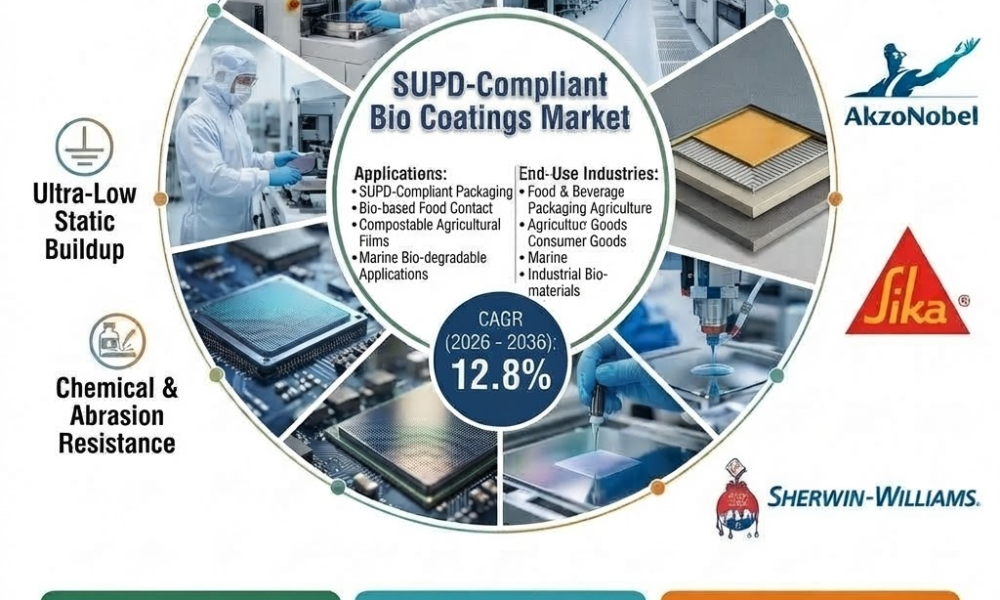
The global SUPD-Compliant Bio Coatings Market is projected to grow from USD 2.9 billion in 2026 to USD 9.5 billion by 2036, registering a 12.8% CAGR during the forecast period. The market reached USD 2.5 billion in 2025, with an absolute opportunity of USD 6.7 billion expected between 2026 and 2036.
Growth is being supported by demand for functional coatings that help paper and fiber packaging deliver grease, moisture, sealing, and other performance requirements while supporting efforts to reduce conventional plastic use.Foodservice packaging is a key demand area. Cups, takeaway packs, wraps, and other short-use formats need coatings that can withstand heat, moisture, and oils without compromising package functionality. Paper and board converters are also looking for coating systems that work with familiar production equipment and support the intended recovery or disposal route.
Get detailed market forecasts, competitive benchmarking, and pricing trends: https://www.factmr.com/connectus/sample?flag=S&rep_id=16542
The report identifies aqueous biopolymer dispersion as the leading coating chemistry, with an expected 34.0% share in 2026. Water-based application allows thin functional layers on paper, paperboard, and molded fiber while limiting major process changes.
By performance, heat seal is expected to account for 37.0% share in 2026. Reliable sealing remains important for cups, wraps, pouches, cartons, and flexible fiber packs. Grease and moisture barriers also remain central to maintaining package performance during food contact.
Paper is projected to lead the substrate segment with 33.0% share in 2026, reflecting its broad use across foodservice and flexible packaging formats. Meanwhile, foodservice is estimated to represent 36.0% share in 2026, supported by the need for coatings that perform under exposure to liquids, oils, and heat.
Country-level growth also varies across major markets. China is projected to record a 14.1% CAGR through 2036, followed by the United States at 13.6%, Germany at 13.4%, France at 12.9%, and Japan at 11.7%.
The report links regional demand to foodservice activity, packaged-food channels, fiber recovery systems, packaging redesign, converting capacity, and local packaging requirements.
Industry participants also face practical challenges. Cost premiums compared with established coatings, barrier trade-offs under heat and moisture, conflicts between recycling and compostability routes, and qualification time across different substrates and production lines can affect adoption.
For packaging producers, the report highlights the importance of testing coating weight, drying settings, seal strength, crease integrity, and line-speed performance before large-scale deployment. Food brands also need to align coating selection with the intended disposal or recovery route.
Shambhu Nath Jha, Principal Consultant at Fact.MR, states:
“The commercial test is no longer bio-based content alone. A coating has to survive converting and food contact while also fitting the package end-of-life route. Firms that combine barrier performance with heat sealing and clear rule fit files are expected to gain the most useful testing positions.”
The competitive landscape includes Siegwerk, XAMPLA, Michelman, Zerocircle, and BIBAC. The report examines providers across aqueous biopolymer dispersions, PHA or polyester bio-coatings, starch and polysaccharide systems, natural wax or lipid coatings, and bio-attributed acrylic hybrids.
Competition is assessed around coating performance, substrate compatibility, sealing reliability, food-contact suitability, converting-line fit, and alignment with the intended end-of-life route.
The SUPD-Compliant Bio Coatings Market study covers coating chemistry, performance, substrate, application, and region. It includes aqueous biopolymer dispersion, PHA/polyester bio-coating, starch/polysaccharide, natural wax/lipid, and bio-attributed acrylic hybrid chemistries. Performance categories include heat seal, grease barrier, moisture barrier, crease resistance, and oxygen/aroma barrier.
The study covers paper, paperboard, molded fiber, cellulose film, and specialty fiber substrates. Applications include foodservice, flexible food packs, cartons, takeaway packaging, and consumer goods.
Geographic coverage spans North America, Latin America, Western Europe, Eastern Europe, East Asia, South Asia & Pacific, and Middle East & Africa, with detailed country analysis for the United States, China, Germany, Japan, and France.
The analysis draws on 120+ sources, 35+ company portfolios, 25+ countries, and more than 20 industry interviews, combining primary research with government statistics, regulatory publications, company information, trade data, technical studies, industry associations, standards, and public policy.
Top Other Reports:
Precious Metal Market Forecast 2026-2036:
High-Heat Epoxy Films Market Forecast 2026-2036: Global Market to Reach USD 3.4 Bn by 2035 at ~ 9.0 % CAGR
About (FACT MR)
Future Market Insights (FACT MR) provides market research and industry analysis covering market size, segmentation, competitive landscapes, country-level trends, and growth outlooks across global industries.



