
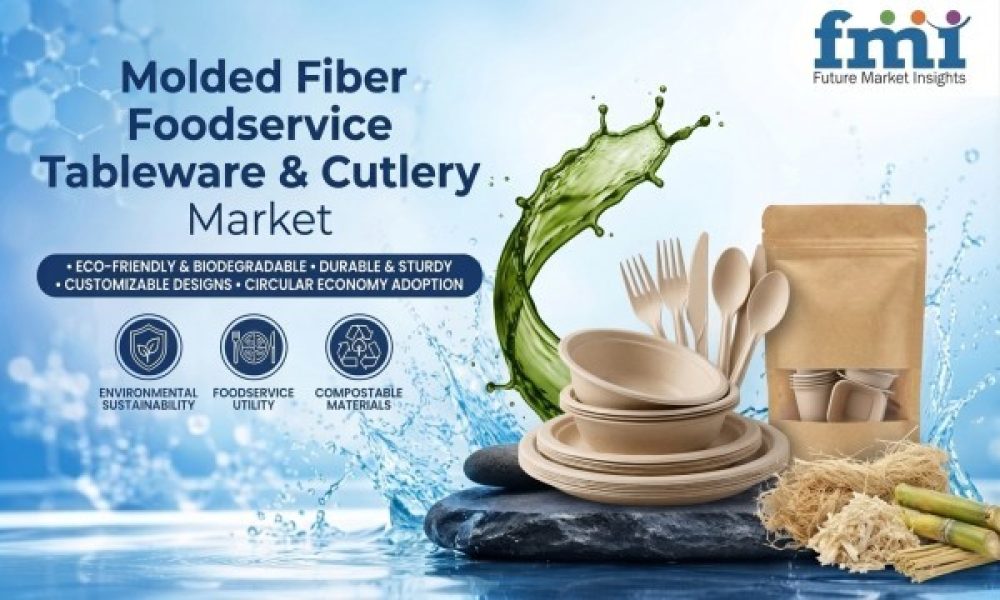
Foodservice packaging buyers are moving beyond simple plastic substitution as molded fiber products face closer scrutiny around heat, oil exposure, barrier performance, food-contact compliance, and local disposal routes. According to Future Market Insights, the Molded Fiber Foodservice Tableware & Cutlery Market is projected to rise from USD 24.2 billion in 2026 to USD 63.9 billion by 2036, advancing at a 10.2% CAGR.
The market is benefiting from wider fiber-tableware adoption across standardized foodservice formats, particularly where restaurant chains can apply common specifications across recurring orders. The expansion of the molded fibre packaging market is also supporting forming capacity that can serve related trays, bowls, cups, plates, and cutlery.
QSR Standardization Is Shaping Commercial Demand
Quick-service restaurants are projected to account for 45.1% of end use in 2026. Centralized specifications allow restaurant groups to qualify tableware designs once and extend them across comparable menus, outlets, and holding periods.
Paper cutlery is estimated to represent 40.8% of product demand in 2026. Its compact storage profile and broad meal coverage support recurring foodservice orders, although commercial qualification still depends on stiffness during actual service conditions.
Foodservice operators are increasingly using menu trials to test filling temperatures, transport movement, leakage, bending strength, and surface softening. This creates a more practical approval process because performance is assessed against the menu rather than the material label alone.
Get detailed market forecasts, competitive benchmarking, and pricing trends:
https://www.futuremarketinsights.com/reports/sample/rep-gb-34259
Regulations Raise the Bar for Fiber Packaging Claims
The regulatory environment is also influencing product development. The European Commission confirmed in February 2025 that the Packaging and Packaging Waste Regulation had entered into force, strengthening recyclability and consumer-information requirements across packaging formats sold in European Union markets.
At the same time, local collection systems can differ substantially. Eurostat reported in October 2025 that paper and cardboard represented 40.4% of European Union packaging waste in 2023, but that figure does not establish recovery suitability for coated foodservice products.
In the United States, food-contact oversight operates alongside state-level rules covering barrier chemistry and disposal claims. The U.S. Food and Drug Administration stated in January 2025 that authorization for 35 PFAS-related food-contact notifications was no longer effective, increasing the need to qualify alternative grease and barrier treatments against intended service conditions.
China also introduced GB/T 27591-2025 for paper tableware in May 2025, with implementation during December 2025. The standard provides a shared reference for discussing strength and food-contact performance across production sites.
Molded Fiber Leads the Material Mix
Molded fiber is projected to account for 41.6% of material demand in 2026. Its ability to support reinforcing ribs and deeper shapes across bowls and trays allows manufacturers to spread tooling and process-control investments across related products.
Commercial fiber-forming technology is widening the usable production base. PulPac reported in October 2025 that HZ Green Pulp had begun full-scale commercial production of dry molded fiber coffee lids in Malaysia. The European Investment Bank also announced financing in July 2025 to support PulPac research and commercialization through 2029.
Further commercial activity is emerging in foodservice applications. In June 2026, PulPac reported a joint venture between HZ Green Pulp and Hotpack Global linking dry molded fiber production with a broader foodservice packaging network.
Duni Group also introduced new products during 2026, including Tray Contrast and Ronda Contrast with a functional barrier for cold foods, while Duni launched Sealable Ronda for hot and cold dishes within its Duniform system in April.
Country Growth Varies With Compliance and Infrastructure
Country-level forecasts show different market conditions across major markets. India is projected to expand at 8.4% CAGR, followed by China at 8.0%, the UK at 7.6%, the USA at 7.2%, and Germany at 6.8% through the forecast period.
India is using agricultural residues and engineering partnerships to develop molded tableware. In October 2025, the Press Information Bureau reported that IIT Roorkee and Parason Machinery had developed wheat-straw tableware.
In the USA, Dart reported in May 2025 that TÜV Austria had certified all Dart-designed molded fiber products, including dinnerware, trays, bowls, portion containers, and hot cup lids. Such developments support structured product qualification, while local composting access remains uneven.
Analyst Perspective
“Commercial growth depends on whether paper cutlery resists bending and molded fiber containers retain barriers across hot and oily menu conditions. QSR adoption can scale through centralized specifications, but local recovery routes determine whether compostability claims remain credible across every outlet. Manufacturers that connect forming control with menu testing and regional disposal guidance are better positioned for repeat foodservice orders.”
Nandini Roy Choudhury, Principal Analyst, Future Market Insights
Competitive Landscape
The market includes established foodservice packaging groups, molded fiber specialists, technology developers, and regional manufacturers. Notable companies profiled include Sabert Corporation, Huhtamäki Oyj, Novolex Holdings, LLC, Duni AB, Dart Container Corporation, PulPac AB, Pakka Limited, and Footprint.
Recent developments include Novolex’s Eco-Products collaboration with DNO Produce on a molded fiber cup for school nutrition programs in April 2025. Huhtamäki launched home and industrially compostable ice cream cups in July 2025, while Footprint expanded into PE-free hot and cold cups in July 2026 following its acquisition of a platform from Transcend Packaging.
Market Snapshot
- 2026 market value: USD 24.2 billion
- 2036 market value: USD 63.9 billion
- Forecast CAGR: 10.2%
- Leading product: Paper cutlery at 40.8% share
- Leading end use: QSR at 45.1% share
- Leading material: Molded fiber at 41.6% share
- Highest profiled country CAGR: India at 8.4%
Report Scope
The report covers the market by product, material, end use, and region, with quantitative analysis in revenue and CAGR terms. Product segments include paper cutlery, plates, trays, and cups. Material segments include molded fiber, bagasse, and paper, while end-use analysis covers QSR, catering, and retail.
Regional coverage spans North America, Latin America, Western Europe, Eastern Europe, East Asia, South Asia and Pacific, and Middle East and Africa, with detailed country analysis including the USA, China, Germany, UK, and India.
The study uses a hybrid bottom-up and top-down approach supported by primary interviews, official desk research, market sizing, forecasting, and multi-source data validation.
Find Out More—Read the Complete Report for Full Insights!
https://www.futuremarketinsights.com/reports/molded-fiber-foodservice-tableware-and-cutlery-market
FMI Custom Research: Strategic Intelligence for Confident Decision-Making
In today’s rapidly evolving business environment, leadership teams need more than market data—they need clear, actionable intelligence tailored to their strategic objectives. FMI’s Custom Research solutions are designed around the specific business questions organizations need answered, enabling executives to evaluate growth opportunities, validate investments, assess competitive dynamics, and reduce uncertainty before making critical decisions. By combining deep industry expertise, primary research, and proprietary market intelligence, FMI delivers insights that help organizations move from assumptions to evidence-based strategies with greater speed and confidence.
Business Impact
FMI helps organizations transform market complexity into strategic clarity, enabling leadership teams to identify growth opportunities faster, optimize resource allocation, strengthen competitive positioning, and make high-stakes business decisions with confidence.
To explore how FMI Custom Research can support your strategic priorities, please connect with our team at – [email protected]
About Future Market Insights (FMI)
Future Market Insights, Inc. (FMI) is an ESOMAR-certified, ISO 9001:2015 market research and consulting organization, trusted by Fortune 500 clients and global enterprises. With operations in the U.S., UK, India, and Dubai, FMI provides data-backed insights and strategic intelligence across 30+ industries and 1200 markets worldwide.



