
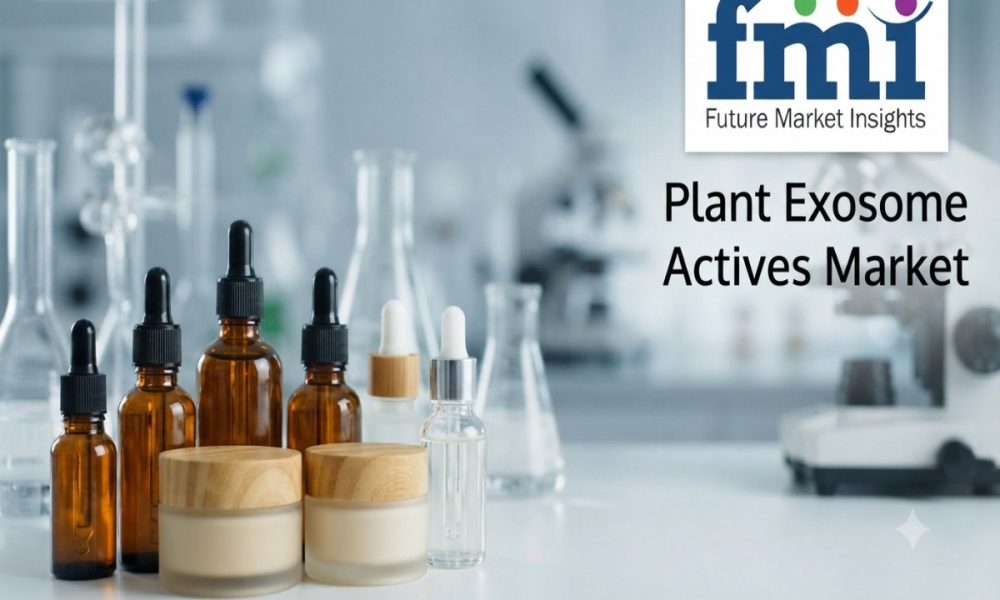
The global plant exosome actives market is projected to grow from USD 165.1 million in 2026 to USD 279.4 million by 2036, expanding at a 5.4% CAGR during the forecast period, according to Future Market Insights (FMI). Growth is being supported by premium skincare programs that increasingly require reproducible ingredient performance, stable vesicle identity, and evidence that can support cosmetic claims.
Beauty and cosmetic laboratories are moving plant exosome actives from early-stage ingredient screening toward formal qualification. The shift is increasing the importance of batch consistency, stability, formulation compatibility, and documented efficacy. Ingredient suppliers that can provide formulation-ready systems and clear technical documentation are positioned to address a key barrier to broader adoption: the validation work required before brands commit to recurring purchases.
Premium Skincare Drives Demand for Plant Exosome Actives
Premium facial skincare remains a central demand area because brands can use a single active across multiple positioning areas, including anti-aging, hydration, brightening, soothing, and barrier care.
In March 2026, Symrise launched Cellexora MD as a plant-derived true-exosome ingredient with documented stability, reproducibility, and clinical assessment. Such developments give formulation teams more defined reference points when comparing plant-derived vesicles with established cosmetic bioactives.
The application landscape reflects this demand. Facial skincare is expected to account for 38.0% of the market in 2026, supported by premium active budgets and multi-benefit formulations. Face serums and creams also provide established testing and development workflows, reducing some of the setup required for novel biological ingredients.
Get detailed market forecasts, competitive benchmarking, and pricing trends: https://www.futuremarketinsights.com/reports/sample/rep-gb-35099
Standard Grade and Anti-Aging Lead Key Segments
By product type, standard grade is projected to hold a 39.0% share in 2026. Its relatively accessible qualification requirements make it suitable for routine stability, dosage, compatibility, and batch-comparison testing.
By function, anti-aging is expected to account for 24.0% share in 2026. Wrinkle appearance, elasticity, and skin-resilience endpoints give cosmetic laboratories measurable parameters for evaluating plant-vesicle technologies alongside peptides and botanical actives.
By grade, standard cosmetic grade is projected to represent 49.0% of the market in 2026. It provides a commercial pathway for brands seeking differentiated biological ingredients without the additional manufacturing controls associated with pharmaceutical or clinical-grade materials.
Recent product activity also illustrates the broader movement toward evidence-backed cosmetic biotechnology. In April 2026, DSM-Firmenich introduced EXOVIVE LIFT following a placebo-controlled study focused on elasticity and wrinkle performance. Clariant also introduced AlgaSurge in April 2026, combining biotechnology-derived positioning with hydration and cellular-renewal evidence.
Qualification Costs Create a Key Market Challenge
Plant exosome actives face a distinct qualification challenge because source material, isolation conditions, storage, and processing can influence vesicle characteristics. Uneven characterization can increase testing requirements and extend development timelines.
Cosmetic launches in regulated markets also require safety documentation and defensible claims. The European Commission’s Safety Gate 2025 report identified cosmetics as 36% of validated dangerous-product alerts, making ingredient identity, documentation, and product substantiation important considerations for manufacturers.
This environment creates opportunities for suppliers that can shift part of the technical burden away from brand laboratories. Defined vesicle specifications, stability information, recommended use levels, application testing, and claim-support documentation can help shorten the path from laboratory evaluation to commercial formulation.
“Plant exosome actives justify premium pricing if vesicle identity survives batch release and finished-formula stability testing. Commercial advantage comes from reducing brand-side validation with characterization data, use-level guidance, and claim evidence that carries from prototype into launch.”
— Nikhil Kaitwade, Principal Consultant, Future Market Insights
Regional Markets Show Different Commercialization Patterns
Country-level growth varies across the assessed markets. Saudi Arabia is projected to expand at 6.7% CAGR, followed by the UAE at 6.4%, South Korea at 6.0%, and the USA at 5.7%. France is forecast at 5.4%, Germany at 5.1%, Japan at 4.8%, and the UK at 4.4%.
Saudi Arabia’s premium beauty investment and expanding cosmetics infrastructure support demand for novel actives, while UAE distributors can benefit from regional prestige-beauty channels. South Korean ODM and brand ecosystems create opportunities for formulation-ready biological ingredients, particularly in facial care.
In the USA, a broad base of beauty brands, laboratories, and contract manufacturers provides opportunities for pilot programs and novel-active evaluations. Mature European and Japanese markets place greater emphasis on documentation, stability, traceability, and defensible cosmetic claims.
Access the Complete Report in PDF Format: https://www.futuremarketinsights.com/reports/brochure/rep-gb-35099
Competitive Landscape
The market includes direct plant-exosome platforms alongside broader cosmetic biotechnology and biofunctional-active providers. Key companies profiled by FMI include DSM-Firmenich, Symrise, Vytrus Biotech, Ashland, Clariant, Croda, Givaudan, and BASF.
Competitive activity is centered on plant-derived bioactive development, clinical and claims evidence, formulation support, delivery technologies, and geographic reach. Recent developments include Croda’s commissioning of its Guangzhou hub in June 2026, Ashland’s appointment of IMCD US as an exclusive US distributor for personal and home care ingredients in March 2026, and Givaudan’s opening of its White Biotechnology Innovation Centre in Toulouse in October 2025.
Plant Exosome Actives Market Report Scope
The FMI report analyzes the market by product type, function, application, grade, sales channel, and region. The study covers North America, Latin America, Western Europe, Eastern Europe, East Asia, South Asia and Pacific, and the Middle East and Africa.
The market definition includes commercially sold plant-derived extracellular vesicles, exosome-like nanovesicles, and standardized plant-vesicle systems positioned as functional cosmetic actives or active-delivery ingredients. Finished-product revenue, human- or animal-derived exosome products, and substitute actives not sold as plant exosome actives are excluded.
The forecast covers 2026 to 2036 and uses primary and secondary research, market triangulation, market sizing, forecasting, and data validation.
Business Impact
FMI helps organizations transform market complexity into strategic clarity, enabling leadership teams to identify growth opportunities faster, optimize resource allocation, strengthen competitive positioning, and make high-stakes business decisions with confidence.
To explore how FMI Custom Research can support your strategic priorities, please connect with our team at – [email protected]
About Future Market Insights (FMI)
Future Market Insights, Inc. (FMI) is an ESOMAR-certified, ISO 9001:2015 market research and consulting organization, trusted by Fortune 500 clients and global enterprises. With operations in the U.S., UK, India, and Dubai, FMI provides data-backed insights and strategic intelligence across 30+ industries and 1200 markets worldwide.



