
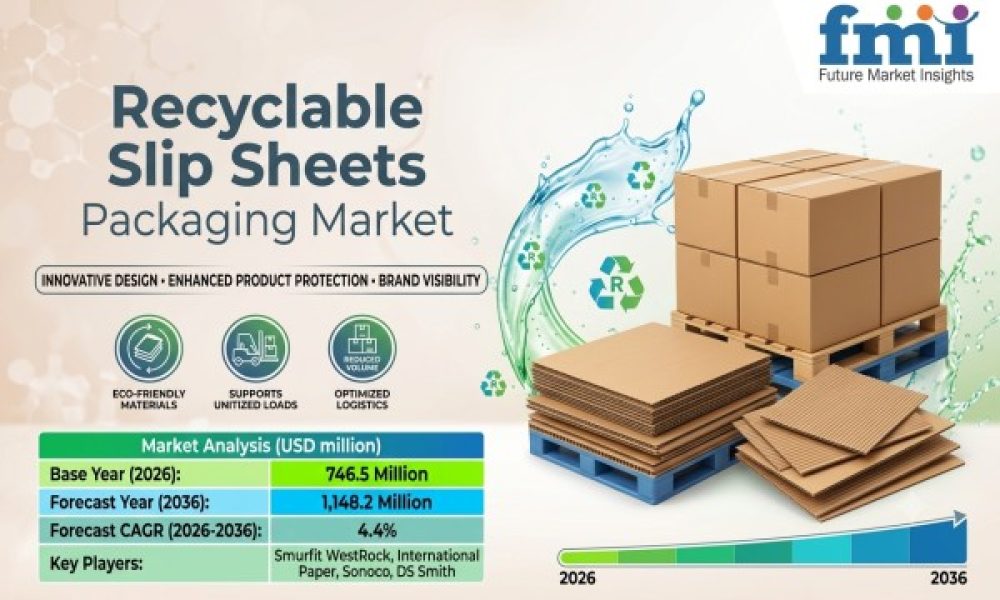
The global Recyclable Slip Sheets Market is projected to grow from USD 746.5 million in 2026 to USD 1,148.2 million by 2036, adding USD 401.7 million at a 4.4% CAGR, according to Future Market Insights. The market is being shaped by logistics teams looking beyond conventional pallets and assessing whether thinner load carriers can deliver handling reliability while reducing transport and storage requirements.
Slip sheets can replace a thick transport base with a thin sheet designed for push-pull handling. The commercial case, however, depends on more than the sheet itself. Attachment availability, operator training, load qualification, surface friction, and compatibility with equipment at both ends of a shipment can determine whether a pallet-replacement program works in routine operations.
Get detailed market forecasts, competitive benchmarking, and pricing trends:
https://www.futuremarketinsights.com/reports/sample/rep-gb-34237
Fiber-Based Formats Remain Central to One-Way Freight
Recyclable Kraft Paperboard accounts for 46.0% of the material segment in 2026. Its position reflects a combination of strength, thin profile, converting flexibility, and an established fiber-recovery route.
Converters can modify caliper, laminate plies, and introduce anti-slip or moisture-resistant surfaces while retaining the underlying fiber platform. This makes paperboard particularly relevant for open-loop freight where the transport sheet moves with the load rather than returning as a reusable asset.
The report also finds that Single-Lip configurations hold 32.0% of the lip-configuration segment. For consistent shipment flows, a reinforced tab can support push/pull handling without requiring the material and orientation rules associated with more complex configurations.
Open-Loop Shipments Shape Reusability Demand
Single-Use Recyclable slip sheets represent 58.0% of the reusability segment in 2026. The structure of many freight flows explains this position. Shippers may control packaging at origin but lack practical ways to recover a low-value transport base from the consignee.
At the same time, closed-loop applications create an opportunity for recyclable HDPE and PP sheets. Tracking, return, repair, and verified recycling pathways can make durability commercially relevant where the same transport lanes operate repeatedly.
The 1,000-2,000 kg load-capacity segment holds 44.0%. These loads can benefit from a lightweight platform while still requiring dependable handling during warehouse and transport operations.
Food and beverage applications account for 34.0% of the end-use segment. Repetitive movement of ingredients, cartons, cans, bottles, and finished cases creates opportunities to measure freight and storage savings, although cleanliness, moisture, compression, and product-damage controls remain essential.
Direct and OEM Sales Lead Qualification-Heavy Purchases
The Direct / OEM channel represents 39.0% of the sales-channel segment in 2026. Slip-sheet purchases often require more technical qualification than a standard catalog purchase.
Packaging engineers and material-handling teams may need to align sheet material, caliper, lip configuration, surface friction, load capacity, palletizer settings, and push/pull attachments. This helps explain why suppliers with customization and technical support capabilities can play a direct role in implementation.
India and China Show Faster Country Growth
Country growth rates reveal different commercial paths. India is forecast to expand at a 6.6% CAGR from 2026 to 2036, followed by China at 5.9%. Brazil records a 4.7% CAGR, while the USA and UK each stand at 4.0%.
In India and China, expanding logistics digitization and packaging-circularity programs can support new capacity and first-time equipment qualification. Germany and the UK place greater emphasis on recyclability documentation and producer-responsibility economics, increasing attention to traceable fiber grades and coating choices.
Analyst Perspective
“The recyclable slip sheets market is moving from a simple pallet-replacement proposition toward lane-specific logistics engineering. Freight and storage savings create interest, but adoption depends on whether push-pull equipment and load stability can be managed at both ends of the shipment.”
— Nandini Roy Choudhury, Principal Consultant, Future Market Insights
The competitive environment includes Smurfit WestRock, International Paper, Sonoco, DS Smith, Mondi Group, Nefab Group, Greif, RTS Packaging, Conitex Sonoco, and Uline. Companies compete through fiber grades, reusable-sheet capabilities, customization, technical support, converting depth, and access to customers.
Smurfit WestRock accounts for 9.8% of the market in the supplied analysis. Nefab combines fiber-based and reusable packaging capabilities with customization and technical support, while other companies bring different combinations of paperboard, corrugated, packaging, and distribution capabilities.
Dive Deeper into the Data—View the Full Report Here!
https://www.futuremarketinsights.com/reports/recyclable-slip-sheets-market
What the Report Covers
The Recyclable Slip Sheets Market study covers material, lip configuration, reusability, load capacity, end use, sales channel, and region. The market includes recyclable Kraft paperboard, recyclable HDPE, recyclable PP, and corrugated fiberboard slip sheets within the defined segment universe.
The research covers North America, Latin America, Western Europe, Eastern Europe, East Asia, South Asia and Pacific, and the Middle East and Africa. It includes the USA, China, Germany, Japan, India, UK, Brazil, and more than 25 additional countries.
FMI applies a hybrid bottom-up and top-down approach using supplier revenues, material and converting economics, unit-load adoption, channel activity, trade and regulatory evidence, and end-use demand. Primary research includes discussions with manufacturers, converters, distributors, material-handling specialists, logistics engineers, procurement teams, and end users.
FMI Custom Research: Strategic Intelligence for Confident Decision-Making
In today’s rapidly evolving business environment, leadership teams need more than market data—they need clear, actionable intelligence tailored to their strategic objectives. FMI’s Custom Research solutions are designed around the specific business questions organizations need answered, enabling executives to evaluate growth opportunities, validate investments, assess competitive dynamics, and reduce uncertainty before making critical decisions. By combining deep industry expertise, primary research, and proprietary market intelligence, FMI delivers insights that help organizations move from assumptions to evidence-based strategies with greater speed and confidence.
Business Impact
FMI helps organizations transform market complexity into strategic clarity, enabling leadership teams to identify growth opportunities faster, optimize resource allocation, strengthen competitive positioning, and make high-stakes business decisions with confidence.
To explore how FMI Custom Research can support your strategic priorities, please connect with our team at – [email protected]
About Future Market Insights (FMI)
Future Market Insights, Inc. (FMI) is an ESOMAR-certified, ISO 9001:2015 market research and consulting organization, trusted by Fortune 500 clients and global enterprises. With operations in the U.S., UK, India, and Dubai, FMI provides data-backed insights and strategic intelligence across 30+ industries and 1200 markets worldwide.



