
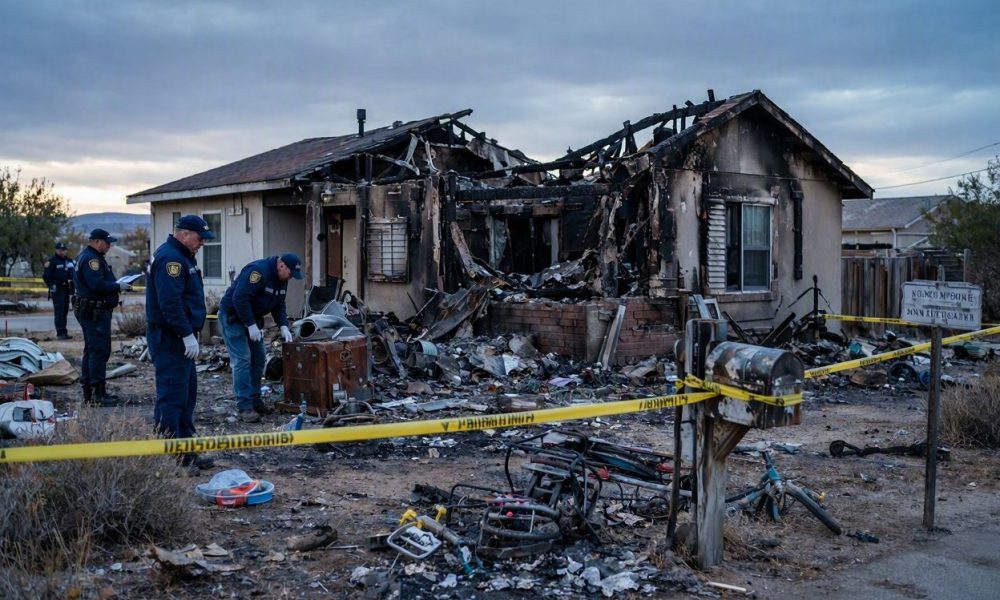
Accused of killing his wife and two children before an explosion destroyed their Scottsdale home in April 2001, Robert William Fisher remains wanted more than 25 years later, despite his removal from the FBI’s Ten Most Wanted Fugitives list.
WASHINGTON, DC, September 15, 2026 — The destruction of a Scottsdale home on April 10, 2001, exposed the deaths of Mary Fisher and her two children, beginning a homicide investigation and a prolonged search for the husband and father authorities accuse of killing them.
Robert William Fisher was absent when investigators examined the devastated residence, and his disappearance became the central unresolved element of a case that later led to murder and arson charges and years of national fugitive publicity.
Ten days after the explosion, the family’s Toyota 4Runner was discovered on a forest road near Young, Arizona, with the family dog alive nearby, providing an important lead that did not produce Fisher’s capture or establish his ultimate fate.
As of September 15, 2026, the FBI continues to publish a wanted notice for Fisher, identifying allegations of three counts of first-degree murder, arson of an occupied structure, and unlawful flight to avoid prosecution.
The continuing notice matters because Fisher was removed from the agency’s Ten Most Wanted Fugitives list in November 2021, a publicity decision that did not mean he had been arrested, cleared, or located.
Three Victims Were Found Inside the Home
The victims were Mary Fisher, her daughter Brittney, and her son Bobby, whose bodies were discovered after an explosion and fire destroyed the family’s home in a south Scottsdale neighborhood on the morning of April 10.
Mary was 38, Brittney was 12, and Bobby was 10, placing a mother and two school-age children at the center of a case that would increasingly be discussed through the disappearance of the person accused of killing them.
Investigators concluded that the deaths involved violence preceding the destruction of the house, making the incident a homicide and arson investigation rather than an accidental residential fire in which the occupants had simply been unable to escape.
That distinction explains why the investigation focused on criminal responsibility for both the deaths and the destruction, while the absence of Robert Fisher raised a separate question about where he had gone and whether authorities could locate him.
The dramatic appearance of the damaged home became an enduring Image of the case. Still, the three victims remain its essential human facts, independent of the speculation that developed around the missing husband and father.
The Explosion Brought the Crime Into Public View
The blast occurred at approximately 8:42 a.m., according to the local Silent Witness case summary, bringing emergency responders to a scene where the immediate fire response was followed by the discovery of the victims and a criminal investigation.
Authorities allege that the destruction was deliberate, and the FBI’s current account states that Fisher is wanted for allegedly killing his family and then causing the house in which they lived to explode in April 2001.
The allegation concerning the fire is therefore part of the case against Fisher. Still, it remains an allegation that has not been tested through a completed criminal trial resulting in a conviction.
A careful account can explain the relationship between the killings and the subsequent destruction without treating every reconstruction of the night’s events as conclusively established, especially where precise timing depends on investigative interpretation rather than a judicial finding.
The central publicly documented sequence is that three family members were found dead, the home had been destroyed, and Fisher was missing, circumstances that led authorities toward a criminal case and an increasingly extensive search.
An ATM Image Became an Early Reference Point
Surveillance footage recorded Fisher withdrawing money on the night of April 9, 2001, providing investigators with an Image from the hours before the explosion and a reference point for reconstructing his movements around the time of the crime.
His wife’s sport utility vehicle was associated with that appearance, according to reporting on the investigation, connecting the surveillance evidence with a vehicle that would later become a major focus of the search after its discovery outside Scottsdale.
The footage establishes an appearance at a particular time and place. Still, it does not by itself settle every question about when the killings occurred, whether Fisher returned home afterward, or precisely when he left the area.
Those limits matter because a short surveillance sequence can become the foundation for a much broader narrative, even when some of the movements placed around it remain inferred rather than directly documented in the publicly available evidence.
For the investigation, the Image provided something concrete to examine. At the same time, the missing interval between known events remained part of the work needed to reconstruct the crime and determine where Fisher might have gone next.
The Vehicle Was Found in Tonto National Forest
On April 20, 2001, the family’s Toyota 4Runner was found parked on a forest road east of Young, Arizona, bringing the search into the Tonto National Forest and giving investigators a location connected to the missing vehicle.
The family dog was discovered alive near the vehicle, adding an unusual and widely remembered detail to the case without answering the central questions of when Fisher had been there or where he went afterward.
The discovery gave investigators a place to search and examine, but locating a vehicle associated with a wanted person is different from locating that person or establishing the direction and means of any subsequent travel.
The forest setting encouraged attention to Fisher’s outdoor experience. Yet, thevehicle’ss presence alone could not determine whether he remained nearby, departed the area, or died somewhere authorities had not found during the ensuing investigation.
The Forest Discovery Did Not Establish His Fate
An abandoned vehicle can support several investigative possibilities, but choosing among those possibilities requires additional evidence, and the Fisher case has not produced a publicly confirmed outcome establishing either his death or a later residence.
Thedog’ss survival likewise does not provide a reliable answer about the missing person’s intentions or movements, even though its discovery gave the episode an emotional detail that remained prominent in later accounts of the search.
The appropriate conclusion is that the vehicle and dog were found near Young, while Fisher was not, leaving the search with significant physical evidence and an unresolved question rather than a confirmed ending in the wilderness.
Fisher Became a Nationally Publicized Fugitive
The FBI added Fisher to its Ten Most Wanted Fugitives list on June 29, 2002, making him the 475th person included in the program and expanding public attention beyond the Arizona communities already familiar with the killings.
That designation came more than a year after the destruction of the family home, placing it later in the investigation rather than at the beginning of the police response or the first effort to locate him.
The national listing gave Fisher’s photographs and identifying information a wider audience, seeking recognition from people who might encounter him or possess information relevant to his disappearance after the Scottsdale deaths and the vehicle’s discovery.
It did not establish where he was living or guarantee that a reported sighting would prove accurate, because the publicity still had to generate information that investigators could corroborate and connect to the person named in the warrants.
Over time, the search became one of Arizona’s most recognizable unresolved fugitive cases, while the underlying task remained locating Fisher so authorities could address the outstanding allegations through the appropriate legal process.
The Top Ten Removal Came in November 2021
Fisher was removed from the FBI’s Ten Most Wanted Fugitives list on November 3, 2021, after spending more than 19 years in the program, but the agency continued to seek him through its broader wanted-person listings.
The removal concerned his place in a particular publicity program, and it should not be interpreted as a dismissal of the criminal allegations or a determination that investigators no longer had grounds to pursue him.
The FBI’s current murder-fugitive page confirms the continuing request for information, making it inaccurate to describe the 2021 change as the closure of the Scottsdale case or an announcement that Fisher’s disappearance had been resolved.
Older articles and some public references may still call him a Top Ten fugitive. Still, an updated account should identify him as a former member of that list who remains wanted in connection with the family killings.
The distinction is more than a matter of terminology, because confusing removal with resolution can lead readers to believe that an arrest, exoneration, or confirmed death occurred when no such development accompanied the change.
The Search Continued Through the 2nd Anniversary
An Arizona Family report marking the 2nd Anniversary in April 2026 described Fisher as still missing and the search as continuing, underscoring how long the case had remained unresolved after the original Scottsdale investigation began.
The Anniversary brought renewed attention to the victims and the disappearance. Still, it did not supply a confirmed new location or change Fisher’s status from wanted suspect to a defendant whose case had reached trial.
That distinction matters when assessing renewed coverage, because a new documentary or anniversary report can generate tips without announcing a breakthrough by the law enforcement agencies handling the case.
The ongoing public appeal supports the conclusion that authorities still seek Fisher, but it does not establish whether investigators have substantiated any recent theory about his location or survival.
His Background Offers Leads, Not Answers
The FBI’s profile describes Fisher as an outdoorsman with hunting and fishing experience. It lists past work in medical and firefighting roles, details meant to aid recognition rather than explain how he lived after disappearing.
Those characteristics have influenced public discussion of whether he could have remained in remote terrain. Still, an ability associated with someone’s earlier life cannot establish what that person actually did over the following quarter-century.
The profile also identifies physical characteristics and age-enhanced photographs, reflecting the practical challenge of searching for someone whose familiar images were taken many years before the current stage of the investigation.
Such images can help prompt a useful report. However, they remain estimates of appearance rather than recent photographs, and anyone believed to resemble Fisher would still have to be identified through corroborating evidence.
The Case Does Not Establish Whether Fisher Is Alive
The length of the disappearance has produced competing explanations. Still, the public record reviewed here does not establish that Fisher survived under another identity or that he died in the forest after abandoning the vehicle.
Both claims would require evidence beyond the facts that he disappeared and has not been publicly located, because the absence of a confirmed sighting cannot independently establish either continued survival or a particular cause and place of death.
The FBI’s active notice reflects an ongoing law enforcement position. At the same time, uncertainty about his fate remains a separate factual limitation that should be stated clearly rather than filled with a confident but unsupported narrative.
For that reason, describing Fisher as still wanted is supported by the current official record, whereas describing his present lifestyle, residence, or health would imply knowledge that investigators have not publicly established in the sources examined.
Mary, Brittney and Bobby Remain Central
The unanswered question of what happened to Fisher can dominate coverage. Still, the investigation began with the deaths of Mary, Brittney and Bobby, whose lives should remain distinct from the public fascination surrounding the missing suspect.
The passage of 25 years represents more than the duration of a search, because it also marks the years in which relatives and others connected to the victims have lived without a courtroom resolution of the allegations.
No description of the abandoned vehicle, outdoor terrain, or fugitive publicity should obscure that underlying loss, which explains why the case continues to matter even when new coverage cannot offer a confirmed investigative breakthrough.
At the same time, Fisher remains accused rather than convicted, and preserving that legal distinction does not diminish thevictims’’ importance or the seriousness of the offenses that authorities allege he committed against them.
Public Information Still Requires Verification
The FBI considers Fisher armed and extremely dangerous and directs information to law enforcement, making the public’s role one of reporting relevant observations rather than approaching or confronting someone believed to resemble the wanted person.
A possible sighting would still require investigators to confirm identity and evaluate supporting information, particularly when many of the publicly familiar photographs are decades old and physical appearance may have changed substantially.
The same verification requirement applies to claims circulated online, where repetition can make a theory appear like fact even when no agency has confirmed the underlying identification or the supposed development.
Lawful Relocation Is a Separate Subject
For readers researching legitimate citizenship planning, Amicus International Consulting’s second-passport information concerns a different administrative topic, and the evidence reviewed for this article does not establish that Fisher obtained another citizenship or used such a process after disappearing.
The company’s tax identification information likewise addresses documentation outside the facts of this investigation, whose unresolved questions concern the killings, Fisher’s alleged responsibility, and his whereabouts after the family vehicle was found in Arizona.
The Scottsdale Case Remains Unfinished
The known history begins with three deaths and a destroyed home, continues through the discovery of a vehicle in the forest and years of national publicity, and remains open with Fisher still identified as wanted by the FBI.
More than 25 years later, neither his removal from the Top Ten list nor the persistence of competing theories has supplied a confirmed ending, leaving Mary, Brittne, and Bobby’s deaths at the center of an unresolved criminal case.




